Skip to content

On Scene Lists: What Your Story Needs

We’ve been talking about long synopses and scene lists this week. Yesterday I went into some detail on what scene lists are for.

Today I want to tell you how to write one. It shouldn’t be hard, but it’s definitely going to take some time and thought. So let’s get started!

Meat on the Bones

By this point in your prewriting process, you have everything you need to make a story. You’ve got a beginning and an end. You’ve got characters, you’ve got conflict, you’ve got an overview of the plot. Making the novel requires you to flesh out that skeleton, though.

If you want, you can jump straight into writing and achieve that. I find I always benefit from one last bit of structure, though. With a beginning, an end, and a few big plot points, you’ve got a general direction, but a scene list gives you every turn along the way.

That’s really what I was talking about yesterday. Your story arc (your short plot synopsis) determines what needs to happen, big picture, as you move from beginning to end. Building a scene list helps you extrapolate from that to figure out what needs to happen in any given chapter, any given scene.

What Needs to Get Done

It’s like the list I shared about my weekend. I knew all the big things that had to happen — Consortium party Sunday, Cowboys game on Monday, homework due on Tuesday — and then I broke it down into smaller parts to figure out how I would get from one to the next, and in each of the smaller parts I had something that needed to happen. If I missed that, the next step in the path wouldn’t really work out right.

A lot of the time when you come up with a story idea, it’s just a beginning or an end. You have an idea for a really cool scene, and you want to make that happen. You do some thinking (or work through some prewriting exercises), and you figure out how to turn one idea into a whole story.

That’s enough to get most people to commit to NaNoWriMo. It’s big, it’s exciting, and it feels almost doable. If you have that much, you’ll probably make it at least a week into November. That’s my experience.

What usually stops people after that first week is sandbars, roadblocks — writer’s block. You know the story you want to tell, you know where it’s supposed to go, but right now (in the middle of chapter three or 200 words into a Tuesday that needs to see 1,667 words written), you just have no idea how to get there.

The answer, as I promised yesterday, is a scene list. The answer is scenes. Scenes are the stepping stones that get from one big cool event to the next one. And, like I said yesterday, a scene list tells you at ever step of the way what happens next.

Your NaNoWriMo Scene List

The lovely Kelley, writing at a coffee shopSo let’s get started. If your experience is anything like mine, your scene list should probably be 5-10 pages (give or take 2), but it depends on the complexity and the length of your story.

Create a list of every major scene in your novel, explaining for each scene (in 2-5 sentences) what characters are involved, what they do, and what impact it has on the story.

I recommend starting with your Table of Contents and expanding from there. In fact, if you wrote out the old-timey chapter titles as I described in that article, you’re probably half done. Expand those sentences into paragraphs. Explain anything that isn’t clear.

Give away the ending, too. This is for you, and if you don’t know your ending, you can’t really write the beginning and middle. If you haven’t thought it through yet, now’s the time.

When you’re done, you should have a complete story down on paper. Then all that’s left is writing. And that’s exactly what November is for.


On Scene Lists: Building a Novel

This week, your big NaNoWriMo prewriting assignment is to develop a long synopsis, or scene list.  I’ve talked before about writing a plot synopsis (and all its various forms), and tucked in there is a brief description of a scene list:

A scene list is primarily useful as a prewriting or editing tool. It forces you to map out the actual structure of your story, down to the very building blocks, and then gives you an easy place to spot errors or weak points, to tinker and rearrange.

To make a scene list, you start at the very beginning of your story, and write one to two paragraphs describing what happens in every scene. When you’re finished, you’ll have your entire plot down on paper — every twist and every turn — without all that messy set design, characterization, and description.

That’s certainly how we’re using it this week. Today I want to go into a little more detail than those two short paragraphs give.

The Building Blocks

When you do the assignment tomorrow, you’re going to build your story. You’ve already scoped it out, with the Conflict Resolution Cycle Worksheet. You’ve laid a path of stepping stones with your mock Table of Contents.

And you’ve grasped at the heart of it with your short synopsis. That’s something you’re going to need when you try to sell your story (as I mentioned in that older article). It’s a great starting place, when you think about your story, but to really figure out what your novel needs, you’ve got make a scene list.

We’ve talked about scenes, and I suggested every chapter should contain one or two scenes. In my work, I almost always do two scenes per chapter – one establishing a conflict, and the other overcoming it. I like my scenes to blend dialogue with action and, wherever possible, to alternate between the dialogue-heavy ones and the action-heavy ones. Just to keep things moving.

Ultimately, though, your story will tell you what content a given scene will have. You might set out to write a lengthy philosophical discourse on the social implications of unrestrained speech on conservative talk radio, and find your characters’ discussion interrupted when a cop jumps out of his patrol car to ask them why they’re out walking so late at night. That happened to me. I never did get around to the conclusion of that conversation.

Your story will evolve, your story will exert independence and try to self-differentiate and do all the other things teenagers do to frustrate their parents. That’s a good thing (in teenagers and in novels), but your job as the writer is to make sure your story gets from its beginning to its end, no matter what crazy style choices it expresses along the way.

Your Plan of Action

And, just like the parent of a teenager, if you walk into that process blindly — unprepared, without a plan — you’re going to have some real trouble. I don’t recommend it. This week’s assignment is all about having a plan.

You’re going to build a map out of some of the concepts you first encountered in the Table of Contents, and then more explicitly in the Worksheet. You’re going to decide what happens in every scene of your novel.

If you did the short synopsis, you’ve already done all the work of boiling it down to one page, so you might expect some difficulty breaking that back out into a longer list. That’s not really the best way to do this anyway, though.

What you want to find for your scene list isn’t an overview of the story, but a detailed look at each of the discrete events that takes place in the story. Think of this not as expanding your short synopsis, but as expanding your Table of Contents.

What Happens Next

This assignment will probably be a lot of work. It’ll probably take 5-10 pages, and that’s if you keep things brief and leave out all the flowery language that makes writing fun. But let me tell you why it’s worth it: once you’re done with this, you’ll walk into November knowing what happens next.

On November 1, that’s the first scene. That’s easy. You’ve probably been building the first scene (and the first page, and the first line) since you first decided you were going to write a novel.

But when you get to the end of that first scene, you’ll have to decide what comes next. Sometimes it flows organically, but a lot of the time you have to make your story get on to the next major plot point.

That’s not so hard on November 2, but come the middle of the month, you’ll find yourself sitting at your computer, a paragraph away from finishing scene 16 and agonizing over exactly how to do that, because your next paragraph needs to transition somehow to where the protagonist will end up next. And the cursor will just blink at you, impatiently demanding over and over again, “What’s next?”

I’ve been there all too often, and that’s the question that has, more than anything, driven me to close my book and give up on my word count for the day. If you don’t have a plan, every paragraph can trap you in that indecision. If you have a vague idea where you want to end up, that can be even more frustrating because you feel the burden of making up something that will actually get you closer to your goal (without actually knowing whether it will).

When you have your long synopsis, though, there is no question. You know what’s next. It’s the next scene in your list. It’s the next paragraph on your page.

Oh, there’s still work to do. You still have to actually write it. But that’s what November is about. Writing your story. My goal for these prewriting exercises is to make sure you can dedicate the whole month of November to writing it.

So figure it out now, make it up, play with the building blocks of your story and move them around until they make something beautiful. Put it down on paper, and you’ll know exactly where to go when you’re wrapping up the scene at the diner, the scene at the chemicals plant, the scene at the Vatican. You go to the next paragraph in your synopsis, and get to work.

What I Learned About Writing This Week…from Disappointing Reads

Ready To Quit

Greetings, my precious inklings. Today, we’re going to talk about pickiness.

Once upon a time, I was much more meticulous than I am now in many areas of my life. True, I still alphabetize my books by author; and recently, for the first time ever, I shelved all of those alphabetized books by genre. And yes, I do stack the glass bowls in a certain order every time I put them away. But it’s only because that’s the most efficient way to get them into the cabinet! I swear!

Anyway. I have, indeed, retained some of the picky preferences of my youth. But I’ve also relaxed quite a few of my personal rules over the years, especially in regard to books I read.

By The Book

Once upon a time, if you borrowed a book from me (read: if I most generously lent you a portion of my treasure), that borrowing came with the strictest of rules: Don’t dog-ear the pages. Don’t even think about turning down the corners. And whatever you do, you’d better bring that book back to me with an unbroken, unmarked spine — because after I read a book, it still looks like it’s fresh out of the bookstore, and you had better return it to me in precisely that condition!

As you might already have guessed, gentle readers, not many people even wanted to borrow any of my books. Much less gained my approval for a loan.

Oy vey.

In the meantime, I have grown older, mayhap a bit wiser, and most certainly less anal. Borrow my books. Break all of those rules — please. Because none of those rules exist anymore. I’ve finally figured out that if you return my book in broken-spined, dog-eared condition, it probably means you’ve enjoyed it. Heaven forbid. 😉

But onward and tally-ho. Another book-related rule I’ve always followed is that even if I’m not enjoying a book, I must finish reading it. After all, I’m not a quitter, right?

Um. Wrong.

The One Where I Give Up

I’m a quitter. I’ll admit it. I’ve decided that I don’t have time to finish books I’m not enjoying. I read for fun, not for intellectual exercise. If I finish a book I don’t like, then yeah, maybe I’m learning what not to do as a writer. But I’m having a hideous, miserable time doing it. Why torture myself, when I can learn just as much from my writer’s bible (read: Stephen King’s On Writing: A Memoir of the Craft) or from UnstressedSyllables itself — and enjoy every moment of that refreshing, well-writ prose?

Over the last month, I have picked up and almost immediately set down again two novels in particular. I won’t name them, because that would just be sad. But I’ll tell you a little bit about them.

The first was a sci-fi fantasy epic (although according to Josh, I need to revise my personal understanding of “epic”; revision is dutifully in-progress; and Josh, you’re makin’ me want to write one; thanks 😉 ) — where was I? Oh yes, sci-fi fantasy “epic” with oodles of potential, what with an entire planet’s memory getting erased and so forth. As Mr. Spock would say, with lifted eyebrow, “Fascinating.”

But I don’t care what the jungle looks like or what Minor Character X did with his financial holdings twenty years before the story starts. And even if I did care, I certainly wouldn’t want to read about it for fifteen pages. Halfway through this book, I was so bored and so desperate to find the tiny bits of Story contained within it, I flipped to the last chapter, read that the hero kills his enemy and gets the girl, and then closed the book one last time with a sigh of relief.

Uffda. Somebody preserve me from fellow fantasy/sci-fi writers who indulge themselves so generously in world-building, reading them is like watching the most boring documentary you can remember from high school.

The other book I picked up and then dropped was an urban fantasy involving flying horses. Sadly, I never got to the flying horses part because the characterizations in Chapter One made me want to cry. And not because they were so tragically good that I was overcome by the empathies they elicited within my heart. Can we say “wooden dialogue” and “paper doll cutouts”? Yes, dear inklings, I do believe we can. I didn’t even get to the end of Chapter Two.

I’ve Just Had An Apostrophe ( — I think You Mean An Epiphany)

And that’s when it hit me: If I’m not enjoying a book, I don’t have to finish it. Nobody’s pointing a gun at my head or threatening me with dismemberment if I refuse to continue adventuring into the realms of a poorly-written novel. The Evil Imps Of Noveling Retribution are not going to swoop in and tattoo “I’M A LOSER” on my forehead.

No. The only consequence of permanently closing a bad book is that I gain more time to delve into books containing quality writing.

I’ll make no complaints about that.

And The Moral of The Story…

Perusing the Unstressed Syllables archives, you’ll find plenty of helpful hints on how to grab a reader’s attention and keep it. Get in late, get out early. Craft a baiting first line and a killer first paragraph. Know your characters so well, your readers fall in love on page one. And so forth. You don’t need me to reiterate, dear inklings. This site is ripe for your picking.

So when you come across a book that doesn’t hook you from the get-go, remember all the stuff you’ve gleaned from this site and from other writing resources. Pay attention, put your own stories to the test, and be honest with yourself about what’s interesting and what’s not. Commit to your art and write a story that makes your readers want to devour the next chapter and the next and the next — instead of skipping to the last page to find out how you cleaned up the mess.

Make them want. And that’s WILAWriTWe!

(For more on the subject of “liking” or “disliking” a particular book, check out Aaron’s series on reading like a writer, especially this article.)

Photo credit Julie V. Photography.

On Scene Lists: Complications

As my sister so kindly pointed out, I’ve fallen a bit behind on the blog posts lately. And that’s after cutting my weekly commitment by half. I still mostly blame schoolwork, but that’s really just my temporary excuse. Give me a week, and I’ll be able to blame NaNoWriMo for a full month.

After that…well, I’ll have to make something up. I’m going to spend all of November making somethings up (50-190 thousand somethings, to be precise), so how hard could that be?

Honestly, this summer was crazy and fall is looking worse. I have no idea how I’m going to handle November with everything on my plate. And if those words sound familiar, then you were probably reading my blog around this time last year.

That’s…well, that’s a different blog. This time last year, I didn’t have Unstressed Syllables to worry about. I also didn’t have a rigorous publication schedule looming, marketing demands for my newly published book, a burgeoning arthouse to build, coursework for a master’s degree, or a growing clamor from my fans for more books in their hands.

That last one I’m not complaining about.

Actually, I’m not complaining about any of it. That list makes me incredibly proud of everything I’ve done over the last year, and excited about everything I plan to do in the next. It certainly keeps me busy, though.

Last Friday, I realized with a start that it was nearly November, and that I had two big homework assignments coming due, and that I hadn’t yet written any blog posts for this week. Luckily, I was looking forward to a weekend which meant some free time (right?), so I sat down to figure out my schedule.

  • Saturday morning, I needed to do some shopping for Sunday’s plans (see below). I was also supposed to take AB along with me. No problem.
  • Saturday afternoon, I needed to help Trish pack the car for her afternoon plans (she had a scrapbooking party to attend from 3 PM to midnight). I also needed to watch the kids for several hours before the babysitter was available.
  • Saturday evening, while the kids were at the babysitter’s, I needed to watch the OU game, find myself some dinner, and get a lot of reading done for my homework assignment.
  • Saturday night, nine-ish, I needed to pick the kids up from the babysitter’s, get them ready for bed and put to sleep, and then finish the OU game and get more reading done.
  • Sunday morning, I needed to wake up in time to make it to church. (Just made it.)
  • Sunday afternoon, I got to spend time with Carlos and Julie, in town visiting, and needed (during that visit) to get us all caught up to speed on each other’s ongoing projects.
  • Sunday evening, I needed to host a huge party for all of our current Consortium members. There were a lot of people working together (whether they knew it or not), and mostly through me as an intermediary, and this was our first chance to get everyone in the same room and put faces with names. (It was a huge success.)
  • Sunday night…well, the party lasted late. And then I went to bed.
  • Monday morning, I needed to go to work and get a lot of stuff ready for a little leave of absence. (Didn’t end up happening.)
  • Monday afternoon, I needed to meet with Shawn and some of his in-laws for a drive down to Dallas.
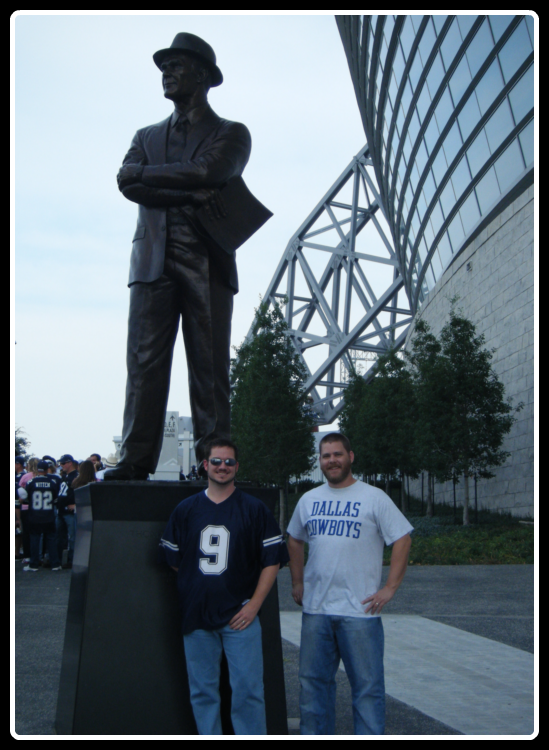
  • Monday evening, I needed to wait in line at the unbelievably awesome new Dallas Cowboys stadium, because we somehow got there an hour too early. I got a picture of me standing under the Landry statue, though, so that’s something.
  • Monday night, I needed to watch the Cowboys snatch victory from defeat, trounce a division opponent, and launch their meteoric rise toward their most phenomenal football season in my lifetime. (Didn’t end up happening.)
  • Monday late, late, late night, I needed to get some more reading done for my homework project on the drive home.
  • Tuesday morning, I needed to wake up early (in spite of the late, late, late night), and go to work.
  • Tuesday afternoon, I needed to put together a short report on the book I’d just barely finished reading for class, meet Toby for our regular weekly lunch/program development meeting, and then attend class at OU, before driving back to work for another two hours.
  • Tuesday evening, I needed to watch the kids while Trish went to book club.
  • Tuesday night, I needed to sleep like you would not believe.

And, surprisingly enough, I got most of that done. Forgot to work in the blog post, and I hated seeing Romo broken on the field, but it’s still a pretty impressive scene list.

Oh yeah. Scene lists. Let’s get to that.

On Narrative Scenes: Writing a Scene

This week we’re talking about narrative scenes — the storytelling elements that clarify your characters and progress your plot.

How Scenes Work

As I said yesterday, every scene in your story must move your story forward. That can consistent of character-building, occasionally, and really only in the first act, but in most genres you want to move the plot forward in virtually every scene.

The easiest way to guarantee that happens is to really understand your story’s Conflict Resolution Cycle — specifically the Obstacles along your character’s path — and make sure that every scene either introduces a new Obstacle or involves your protagonist overcoming a previous Obstacle (or both).

Working with Obstacles

Now, to live up to that, you may have to break your Obstacles down into smaller pieces than you’d originally thought. Instead of

The protagonist learns the identity of his nemesis

it becomes

  1. The protagonist realizes he has a nemesis working against him.
  2. The protagonist discovers a clue as to his nemesis’s identity.
  3. The protagonist finds an expert in ancient hieroglyphics allowing him to interpret the clue.
  4. The protagonist solves the ancient riddle, recognizing it as a present-day English pun.
  5. The protagonist wins a fist-fight against a well-meaning but blindingly closed-minded cop.
  6. The protagonist accesses the police database and learns the identity of his nemesis.

There’s a story. Not a terribly clever one, but it would do for Dan Brown.

Anyway, I present this long list because you can clearly see how each of those items could make a scene or two. In the first scene, perhaps the protagonist is idly poling his gondola along the river-streets of Venice when someone throws a hatchet at him. He gives chase, but is unable to catch or even clearly see his attacker.

We’ve set up an Obstacle, now. In scene two, at some particular intersection, our protagonist discovers some discarded bit of paper that the attacker clearly dropped while fleeing. That overcomes the “no idea who the attacker is” Obstacle, but introduces a “how can he figure out what the clue means” Obstacle.

Before we started on characters or Conflict Resolution Cycles or any of this, I had you start out with a mock Table of Contents. This would be a great time to review the work you did on that project, and see how the chapter titles you guessed at fit with what you now know about your story now.

You can make changes, if any jump right out at you, but the important thing is to see the difference between your Conflict Resolution Cycle — your story idea — and the individual scenes that you will use to tell that story.

Write a Scene (Creative Writing Exercise)

The lovely Kelley, writing at a coffee shopLet’s go ahead and get some practice on that storytelling. If you’re a strict interpretationist, you know better than to write any words on your actual NaNo novel, but you can still write a scene related to the novel. Maybe one that came before or after, maybe one featuring tertiary characters who would never actually get their own dedicated screen time in the real narrative.

Whatever your justification, I want you to write something that’s kind of like getting started on your book. And I want you to do it now. You won’t have a lot of leisure time come November, so let’s get in that habit.

Write 1,000-5,000 words presenting a complete scene associated with your story idea.

The word count requirement provides you a big window – approximately 3 pages to 15 pages. 15 pages makes a respectable Short Story, according to most definitions. It makes a good chapter, too. You don’t particularly need to aim for that, though. Your assignment is to write one complete scene. That means, within whatever story it’s a part of, it should move the story forward.

You may choose to write a scene right out of your story. It could be the first scene, the last scene, the climax, or just some scene that is already strong in your mind, and you want to get it down on paper. This can be a great chance to see what happens to your story idea when you commit it to story form.

You don’t have to start on your story yet, though. If you’d feel more comfortable saving that for later, you may choose to write a scene otherwise associated with your story. It could be the exciting (but irrelevant) story of how two key characters first met, or something fascinating that happens to one of the minor characters, that won’t make it into your finished story. You could even write an alternate ending, or describe how the story might have gone if your protagonist were a low-down dirty cheat.

In the end, this assignment serves several purposes. It’s practice, for your daily writing. It’s the first time you’ll get your feet wet with actual prose composition (everything else has been pre-writing so far). With any luck, it will give you an opportunity to apply the ideas discussed in this chapter, and focus on how the part of the story you’re telling actually moves the overall story forward.

Be sure to clearly establish the setting, provide enough characterization to carry the scene, and incorporate some element of the Conflict Resolution Cycle, showing the protagonist either encountering or overcoming an Obstacle (or both).

On Narrative Scenes: Choosing Your Scenes

This month we’re reviewing all the parts and processes that go into developing a story. Our goal is to put together a complete prewriting package to do some of the heavy lifting for you when it comes time to write a novel in November.

So far, if you’ve been following along, you have Characters, you have the elements of a Plot, presumably you know your Setting, but we still have to discuss how you actually write the story. What do you do to convert that story idea we have so well documented into an actual story?

Thinking in Scenes

The answer is writing scenes. Scenes are the building blocks of any story. Whether it’s a poem, a bit of interpretive dance, a Great American Novel, or a major motion picture, a story is told in scenes. A story told without clearly defined scenes is, essentially, a synopsis. This is how we separate storytelling from summary.

No matter what time frame you’ve chosen for your story, it probably contains the potential for an infinite number of scenes. You could use flashbacks and flashfowards to give the story context, you could have a play-within-a-play, or dreams or hallucinations – you could write a thousand scenes into a narrative that only actually takes place within a single room, over a span of a couple minutes. It would probably be dreadful, but it could be done.

The point is, the story idea that you have already developed contains within it a boundless sea of scenes. A few of them are gripping, immersive. Some of them leap out at you, defining moments in the path from the Big Event to the stunning Climax. Most of them are irrelevant.

Choosing the Scenes

Your job, as the storyteller, is to choose which scenes you are going to include in your story. That’s it. Once you have a character list and a premise, most of the scenes can be extrapolated from there, but it’s up to you to choose which scenes to present to your audience.

For an excellent example of that, just consider the Harry Potter books. He’s in school the entire time, right? For the first five books, at least, he’s spending most of his time in classes, presumably, but how many scenes can you remember where he was in a classroom? They are far fewer than the scenes in the dining hall or the common room, scenes on the Quidditch field or (most common) skulking down shadowy corridors.

Of course, there are scenes that take place in the classroom – often highly dramatic scenes that jump immediately to mind – and that’s precisely the point. She could have included thousands of classroom scenes, but instead she chose just the ones that served the story best, and implied all the hours spent bent over a textbook or scribbling down notes.

When it comes time for you to convert your story idea into a story, there is just one rule you must remember: every single scene must move your story forward.

Believe me, you will write scenes that you absolutely fall in love with but that don’t measure up to that one rule. And, painful as it will be, you’ll have to cut them out of the story. That is the price writers pay. Apart from the rejection letters, it’s really the only one — having to remove something so beautifully crafted from your masterpiece. It’s necessary, though.

Writing the Scene

Before you can start cutting anything, though, you’ve got to get it written. We’ll start on that with this week’s big writing assignment.

Come back tomorrow, and we’ll move you a big step closer to your NaNoWriMo novel with a little bit of practice writing.

What I Learned about Writing this Week…from Making New Writing Friends

Once upon a time, there was a highly intelligent, gifted young writer who lived in a far away land and didn’t have any writing friends.

She had friends who thought it was cool that she wrote. She had friends who enjoyed reading some of what she wrote. She had friends who told her she was pretty good. But she didn’t have any other writers to share her work with.

None of her friends knew about having a mind full of characters who talked to her all the time. None of her friends really understood what she meant when she mentioned her troubles with POV. Her frantic scribbles on restaurant napkins earned her the name “eccentric.”

Still, though she sometimes felt sad and sometimes abandoned her writing for months on end, she never gave up hope that sometime in the future, somewhere in the big Out There, she would meet other writers who would get it.

Then, one day, she moved from the far away land to another land. And there, after only a little bit of keeping her ear to the ground, she met a tribe of writers: outwardly rational creatures who knew how to nod in the right places and which salad fork to use…but who harbored within a flashing, untameable streak that called them to brave the wilds and fight their way to the edge of the pool and drink deep, drink from the Source, and then pour out that creative energy into making stories the world had not yet read.

In other words, they were creatures like herself.

She fell in love with them, and they fell in love with her, and they talked about plot development together and about what happens when characters don’t do what one wants them to. With her new tribe, the young writer embarked upon a quest to solve the world’s problems through many hours of philosophical discussion and to find exactly the right way to make a glass of American iced tea. They huddled in circles over coffee and late-night breakfasts and scrawled their desperate words with the frenetic energy of addicts inhaling lines of coke.

The young writer had found her Narnians, and they were more cramazing than she had ever hoped.

Her craft had never been more glorious. And within her tribe, she was home.

(If you don’t have a writing group, you need to find one. You’ll be happier. I promise. So go find them — your tribe needs you. And that’s WILAWriTWe.)

Photo credit Julie V. Photography.

On Narrative Scenes: My Best Break-Up

I’m not at all sure it’s a good idea to tell this story. No one’s ever called me “discerning,” though. So I’m going to tell it anyway.

I’ve spent most of my life trying (successfully, for the most part) to win the love of the woman who most loves Gods Tomorrow. That’s a writer’s fairytale, right there.

Still, I haven’t always been with Trish. I dated a couple other girls, while I was still a stupid high school kid, and as is probably to be expected, both relationships ended in dramatic conflagration. In other words, they ended in good stories. And the better story (which is to say, the one that makes me look far worse), is Lindsay’s.

We dated for seven months — most of my junior year in high school — and the story of how we got together could be a really sweet one, if it weren’t so overshadowed by the ending. The ending, though….

There came a point when, for whatever stupid high school reason, I became convinced the relationship needed to be over. It wasn’t really any shortcoming of hers, or really anything specific. I was just a deeply romantic sort of person back then, and I didn’t feel like the relationship lived up to my expectations anymore. There was insufficient magic.

And once I’d come to that conclusion, it was over. The tragedy, though, was that I came to that conclusion on February 10th. Romantic that I was, the imminence of Valentine’s Day did not escape me, and that presented a huge problem.

See…I was concerned that, if I broke up with her before Valentine’s Day, we’d live the rest of our lives wondering if a successful holiday date might have been just the magic needed to save the relationship. And, of course, I had some concern she might feel…I dunno, ripped off, that she didn’t get to have a Valentine’s Day. I mean, how sad is that, to be newly-dumped on the most romantic of all holidays?

On the other hand, if we did stay together through Valentine’s Day, and then I broke up with her afterward…well, that would just undermine the whole value of the magical memory. Right? She’d know those happy hours for the sham they were, and probably hate me more for it.

I’ve since been told, often and fervently, that I was a moron for thinking this was a difficult decision. To me, though, it was a puzzle I couldn’t solve.

So…well, Valentine’s Day rolled around, and I still hadn’t decided, so I stuck with the plans we’d already made. I went to pick her up, dressed up all fancy, and found her completely stunning. We went out to an extravagant dinner, made pleasant conversation over our Big Macs, and then I drove her out to a romantic overlook out by the lake.

I spread a blanket, and we stretched out side-by-side to stare up at the brilliant sky all full of stars, and for a long time we just lay there enjoying the beauty of it. Then she poked me gently in the ribs and said, “You’re awful quiet.”

I probably grunted in response, unsure what to say, and she said, “Whatcha thinkin’ about?”

I looked over at her, held her eyes for a moment, but I couldn’t keep it up. I looked back up at the stars and said, “Well…there’s something I need to discuss with you, but I don’t know if we should discuss it now, or later. It’s…well, it’s not very happy.”

She surprised me with a big smile, and rested her head on my shoulder. “Later,” she said. “If it’s not happy, save it for later, because this is just too perfect.” She sighed deeply, and then said with a chuckle, “I mean, unless you’re going to break up with me or something.”

I bit my lip, and then said quietly, “So…we should discuss it now.”

On the Conflict Resolution Cycle: The CRC Worksheet

Okay, for a week now I’ve been talking about the Conflict Resolution Cycle worksheet. It’s a questionnaire/assignment I cooked up a couple years back to force a writer through the questions necessary to convert a story idea into an actual narrative.

Most of the questions explain themselves, so instead of opening with a big long introduction, I’m just going to dive right in.

The Conflict Resolution Cycle Worksheet (Creative Writing Exercise)

The lovely Kelley, writing at a coffee shopThis worksheet takes a little serious consideration, but the writing part shouldn’t take much time. I’d recommend reading it over start to finish, then giving yourself a day to think about it, and then going through it once more filling in the answers in order.

If you don’t have an answer for a section, make it up. Just like your Mock ToC, none of this is set in stone. Having something is better than nothing — it gives you a starting point to work from, anyway.

Now…let’s get started.

1. Protagonist

Describe your protagonist. If you have already created Character Descriptions for your story (that was one of last week’s assignments that didn’t get its own article), then you can simply state which of the characters is your protagonist. Otherwise, on a separate page describe a Protagonist character in the level of detail required for one of your Main Characters from that assignment.

In addition, give a brief description of the protagonist’s day-to-day life before the story starts. It doesn’t need to be perfect, it just needs to be the life that the character has come to expect. A born loser sort of character could have his life disrupted by a sudden, profound winning streak just as easily as a spoiled rich kid could be impacted by an unexpected series of unfortunate events.

Here, just describe what the character has come to expect out of life, before the Big Event.

2. The Big Event

Choose a Big Event for your story. Pretend it’s going to happen on page one. What happens that throws your character out of his normal life, and into a story?

3. The Conflict

You need to describe this separately so you can differentiate the two in your head. The Big Event could be over by the end of the first page, but the story goes on. What effect does the Big Event have in the character’s life, and why does that effect drive the character to action?

4. The Obstacles

List five obstacles the protagonist will have to overcome, following the Big Event, to achieve Resolution. Limit your description of each obstacle to 1-2 sentences. Start with the first obstacle you expect your character to face, and end with the last one. (The rest can come in any order.) Your final story may have three obstacles in it. It may have three hundred. For this exercise, just pick five possible obstacles the character could encounter.

1.

2.

3.

4.

5.

Of the five, choose which one do you think will be the biggest. Is it the first? Is it the last? Why?

5. The Climax

The protagonist’s resolution of the final obstacle is called the Climax. Briefly describe the manner in which the protagonist might overcome that obstacle, and briefly (1-2 sentences) analyze how dramatic you think that scene will come across to readers.

6. The Resolution

You don’t need to describe the Resolution itself. When the protagonist overcomes his final obstacle, the Conflict you described earlier will be removed from his life or negated as a driving force. Instead, consider (in 3-5 sentences) the emotional impact you think the Resolution should have on readers. Happiness? Depression? Satisfaction? Curiosity? Bewilderment?

Start by considering the emotional impact the Climax will have on the protagonist, and consider the reader’s relationship to the protagonist. Describe the effect you intend.

7. The Story

When you have completed this worksheet (and only then) reread your answers to this assignment, and consider how your story falls within the definition of a story given above, paying special attention to the purpose of Conflict Resolution Cycle as I described it yesterday, and the maxim, “get in late, get out early.” How do you think your story matches up against these instructions? Don’t be too negative in your evaluation, but if you find places in your story that don’t match the instructions given, make notes of those for future review.

If you’re trying to get everything done in time for NaNoWriMo, you need to get this one out of the way. Try to have it done by tomorrow night, and then glance back at my old descriptions of the types of plot synopsis, and put together a short plot synopsis before the end of next week.

On the Conflict Resolution Cycle: Designing a Narrative

Earlier this week I told a story. It was one I had to tell, under the circumstances. On the day I launched Gods Tomorrow to the public, you’d better bet I was going to talk about my novel.

It works well as an illustration for the writing principles I want to talk about this week, though. Any good story does — or, I should say, any story that’s well-told — so I chose the one that killed the most birds with the fewest stones.

The most important parts of the narrative were:

  • The establishing intro, in which I conveyed who I was and what I would be talking about, which is to say the proof copies of my novel
  • The big event (receiving the first proof copy of my novel) which shook up my life and introduced conflict (it was beautiful but flawed)
  • The obstacles to my happiness (those would be the actual flaws in the book), and the things I did to overcome those obstacles
  • The climax (it was an admittedly weak one, but that’s because Amazon has such a convenient system in place for self-publishing)
  • And the resolution, in which I now have a perfectly beautiful book for sale on Amazon.

What I like, for the careful reader, is that in the conclusion it ties this one small scene, this one circuit through the CRC, into the larger conflict story I’ve been spinning here on my blog, of the difficulties I’ve faced with traditional publishers over the last decade. That’s a nice touch.

Designer Storytelling

I throw around a lot of synonyms sometimes, counting on you to catch the subtle differences in usage. Just as an example, I sometimes talk about writing, sometimes about creative writing, sometimes about storytelling, and sometimes about narrative.

This week’s series is all about narrative, and when I use that word, I really mean something along the lines of “designer storytelling.” Or maybe “deliberate storytelling.” “Narrative” is the stuff you’re doing while telling a story.

And the Conflict Resolution Cycle is the basic structure of narrative. It’s the foundation on which you’ll build your narrative elements (your scenes and settings and character interactions), and then you’ll wrap that narrative with the sopping papier mache strips that make up a “story,” and pop the narrative balloon inside so it looks to a casual reader like this elegant tale sprang fully formed from your creative genius.

We know the secret, though. The secret is: storytelling is a craft.

Narrative Tension

One of the most important elements of that craft is narrative tension. That’s the questions in your readers’ minds that make them turn the page. A good story has to have some sort of narrative tension going for every single page, but maintaining that is a real challenge.

The Conflict Resolution Cycle is part of the answer to that challenge. Instead of trying to force a single question to carry the full weight of the story, and hold up for page after page after page, we structure a story in scenes, that successively answer little questions and replace them with new ones, always overlapping, and always–very gradually–pushing toward an answer to the great Story Question that drives the narrative arc.

A good book runs like clockwork.

When you think about the Conflict Resolution Cycle, when you look over the worksheet tomorrow, imagine a cogwheel spinning in circles, driving a gear with question after question after question. Each one grabs your readers for a moment (or a page), spins them a little further along, and then lets them go to be replaced by the next.

Narrative Pacing

The speed of your little cogwheel represents another major element in designer storytelling: narrative pacing. That refers to the speed at which you move the story along, the rate at which Things Happen, from page to page.

There’s not a single perfect target. It varies from genre to genre and, honestly, from reader to reader. By and large, though, the trend of the last several decades has been toward faster and faster pacing.

That’s a big part of the drive behind the explosion in Young Adult literature (particularly among non-young-adult readers). It’s also started a trend toward first-person present-tense narrative, in an artificial bid to make the narrative seem faster and more immediate. I’m not a fan.

The alternative, though, is to actually manage your story’s pacing, and that’s a lot harder than throwing gimmicks at it. But with a little effort and a little insight, it’s certainly doable.

The trick is to understand where your pacing comes from. And, in context, I’m certain you already know the answer.

The Conflict Resolution Cycle.

Your story’s pace is determined by the rate at which you introduce new obstacles and resolve old ones — and then by the amount of time you spend between scenes letting your character consider just how they feel about that new obstacle they just encountered, or how they plan to resolve it in the following chapter.

That last bit is described as “scene and sequel,” and it’s a concept I’m just now studying for the first time. I promise a more detailed post on it in the future, but for now it’s enough to know that it’s there…and that every time you drop into one of those introspective “sequels,” you’ve just backed off the throttle on your narrative.

Sometimes that’s a good thing. The trick is to know just how fast you’re going, at every milestone along the way, and manage your scenes to maintain the speed you want, right through to the resolution.

Come back tomorrow, and I’ll give you the worksheet I designed to help with that.