Skip to content

What I Learned about Writing this Week…from Seeing a Friend Get Published

Okay, first off, please to be ignoring the poor grammar in the above title and in this sentence. I just couldn’t help myself.

Secondly, I’ve just returned home from a celebration honoring a guy you might have heard about before. His name is Aaron Pogue, and he is a published author.

Gods Tomorrow is a sci-fi thriller that will grab you with its first sentence and not let you go until its last one. Maybe not even then. If you haven’t already ordered your paperback copy or downloaded your digital copy, you should do that right now.

Go ahead. I’ll wait.

Excellent. You won’t regret it.

Now on to this week’s lesson. Tonight, I watched my fellow writer read to his public from an honest-to-goodness, yo-mamma-said-it-would happen, spiffy spankin’ new published copy of his book.

It looks and reads professional. It is professional. It’s the world of Aaron’s imagination, contained within turnable, bound pages. You can see it in a bookshelf. You can pick it up. You can flip pages and find lines of Katie’s dialogue and get so excited that you squeal. šŸ˜‰

In my case, you can open the book to the title page and, right above Aaron’s signature, read the words “To Courtney, who’s next.”

Dear friends and neighbors, I like that. I like that a lot. I like that enough that I would frame and hang it, if it didn’t mean ripping a page out of Aaron’s newly published novel, which feels as though it would border on blasphemous.

I like it…but it also freaks me out a little. Because I know it’s gonna require lots of work on my part. Not to mention time, focus, determination, possibly shed tears, and likely spilled blood. I think of what more I need to do to get there, and part of me cringes.

But the greater part of me, the part that runs wild through light and shadow, the part that goes down to the pool and drinks deep of The Story that has sustained our craft for millennia…that part looks at what Aaron has accomplished, sees what indeed might be, and answers with an unequivocal yes.

Sometimes, I feel blocked. Sometimes, I feel discouraged and think there is absolutely no point in continuing to try. But you know what? That blocked, empty, frustrating thing is a lie. This can happen. I can do this — and you, dear inklings, can do it, too. Because we all go down to that pool, and in some measure, we all know what it is to drink from it.

Aaron’s not the first to show us what what can happen when you go to that pool so often, your feet wear a path into the grass. Aaron also won’t be the last. I want to be next. And I’m willing to bet that you do, too.

We can do this. And that’s WILAWriTWe.

(Oh! In case you don’t recognize it, the pool metaphor comes from Stephen King’s On Writing. The pool has guided my creative thinking for years and reminds me to focus and believe, especially during those times when the words will not come.)

Photo credit Julie V. Photography.

On the Conflict Resolution Cycle: Gods Tomorrow

A week and a half ago — Friday, October 1 — I was at work when I got a call from Trish. She could barely talk, she was so excited. She finally found the words, though.

“Aaron…a package just arrived. I think it’s your book.”

I wanted to shout, “Well what are you waiting for?!” But since I was at work, I restrained myself and said quietly, “Well, open it.”

“Are you sure?”

“Yes. I have to know!”

And then I had to wait. She couldn’t find a knife or scissors to cut the tape. She fumbled with her keys in her excitement, and then mumbled a little apology. Then, at last, she tore the package open, and I heard her breath escape her.

“Well?” I said, afraid.

“Oh, Aaron,” she said. “Just…wow. It’s so beautiful.”

I didn’t cry. I did wonder how on earth I was going to get anything done at work all day. Trish was thinking the same thing.

“Hmm…” she said. “You’ll have to meet me for lunch so you can get it.” We made plans to meet at 11:00 — it was just barely 10:00 when she called — and I spent the next forty minutes bouncing on the edge of my seat and staring at the clock.

Then I drove across town to meet her, and found her already waiting, sitting in her car in the parking lot, reading my book.

My book.

And she was right. It was beautiful. She relinquished it to me and I flipped through it, checked the title page, skimmed my back cover copy. And this time, I almost did cry. It was beautiful.

We went in, ordered our food, and once we were settled I started looking closer. I frowned, and Trish spotted it. “What?”

“Well…” I said. “The font’s a little too small for the page size.” Trish didn’t see it, but that’s the sort of thing I do for a living. I also realized I’d forgotten to justify the text column, and the margins were too wide. Trish pointed out a typo on the Acknowledgments page, and later that day Julie pointed out a flaw in the version of the cover art I’d submitted to the printer.

They were all tiny things — the sort of things I’d have to point out for you to notice — but among them, they shattered the illusion. They marred the perfect beauty of the thing, and before I knew it, I wasn’t even smiling. It’s remarkable how far I fell for want of a single point in font size.

I didn’t have time to mope, though. I went right back to work on it, fixing typos. I rebuilt my document, fighting font size, and space between lines, and margins, and everything I could to make it look right without changing the page count (which would have required a major rework on the cover art, as the spine got wider).

I also got a fix from Julie for the cover art, and switched the justification and even found room to add an About the Author page. Then I checked back in with Amazon and gave them the new files. I ordered another proof. And then I waited.

One week ago today, last Tuesday, I got home from work and found a package on the counter. I couldn’t find a knife or scissors, even standing in the middle of the kitchen, and when Trish gave me her keys I was so excited I fumbled them a bit before I tore the package open.

Then I slid the book out, and my heart stopped.

It was perfect.

I flipped through it again, expecting to find more little flaws that had slipped through the cracks. I held it up side-by-side with the first proof to compare the cover art changes. I turned to the back and stared at my face staring back at me….

And I fell in love.

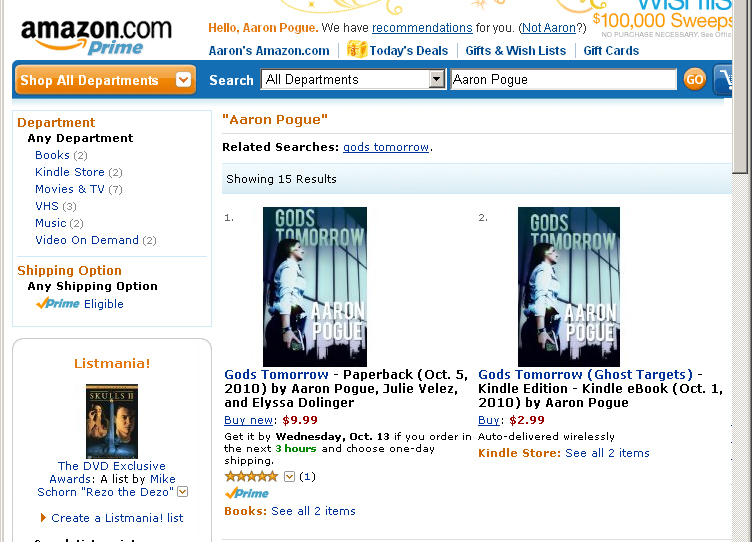
I went to my project page on Amazon, the next step in the publication process, and approved the proof copy. Then I got an automatically-generated email from them a little while later with a link to my product page, asking me to review the details and provide feedback. I clicked on it without really thinking…and found myself at Amazon.com.

Really, truly, at Amazon.com. Like this:

And that’s when I cried.

I’ve spent the last week making sure my book is available everywhere I can get it. There’s a paperback at Amazon, and an e-Book for the Kindle. There are copies available for the Barnes & Noble Nook, and for the iPad through Smashwords.

And yesterday it finally struck me: in the last two weeks, I’ve become a published author. And not just that! After wrestling with the same heart-breaking conflict for the last fifteen years, I turned myself into the solution to the biggest obstacle in my life. I’ve become a publisher, too.

Gods Tomorrow, on sale everywhere Tuesday, October 12th.

That’s the resolution to the first book in my series. It’s…beautiful.

On Narrative Structure: The Mock Table of Contents

Okay, October is already washing out from under us like sand in the surf, right? Next thing we know, we’re going to be caught in an undercurrent and sweeping toward Christmas without a lifeguard in sight.

(I may have gotten lost in my metaphor there.)

That’s okay. I don’t know how closely you looked at the prewriting schedule I posted last week, but even though I talk about doing prewriting “in October,” it’s really only a handful of assignments, most of which don’t take more than a day or two.

Today we’re going to start with the quickest and the easiest: the mock Table of Contents. All you need to write that one is a vague idea what happens in your story.

Coming Up with a Story

If you don’t have any idea at all what happens in your story, don’t panic. You can skip this assignment and come back to it later (it’s one of those “one or two days” assignments), or you can look at this as an opportunity to figure it out.

If you decide to skip it, go ahead and write up some character descriptions, and then put in some real effort next week when I give you the Conflict Resolution Cycle worksheet. That exercise is all about developing a plot, and once you’re through with it, the Table of Contents will be easy. Just come back to it, then.

Most people won’t have that problem, though. Most people who decide to write a novel start with a story idea — maybe one that’s been kicking around in the back of their minds for years, maybe one that struck them like a lightning bolt and demands being told. It could be character-driven, or gimmick-driven, or genre-driven, it doesn’t matter. Most people who sit down to write a novel have a story in mind.

Thinking in Chapters

The problem is, most people don’t really know what a story is. That’s what I was trying to get at in yesterday’s article, introducing the concept of Narrative Structure and the idea of managing the reader’s experience as you provide not just a retelling of interesting characters and events, but a gradually unfolding understanding.

This assignment is designed to help you put that last part into practice. You’re going to convert your story from an idea into a sequence of scenes.

That will help you think through what it really takes to build a story, but it also has another benefit: once you’re done, you’ll actually know what your chapters are. That means when you sit down to start writing next month, you’re not starting from a blank page. You’re starting with a known path, known milestones, and a good idea what has to happen before you finish writing whichever scene you’re working on.

Actually Making a Mock Table of Contents (Creative Writing Exercise)

The lovely Kelley, writing at a coffee shopSo…how do you get started? Pretend your book is already finished. What would the Table of Contents look like? Write one up. Don’t bother about including imaginary page numbers, just fill in the chapter titles.

Remember what I said yesterday about the sequence of story events. Think of each chapter as a story event, that has to belong within the story you’re telling, and needs to move it forward. Now’s your chance to pick the series of events that will reveal the story from beginning to end.

I recommend aiming (very loosely) for about 15 chapters. That makes them a little over 10 pages, on average, for a medium-sized book. Once you’re finished, your Table of Contents can act as a sort of outline.

If you haven’t been working on the story idea long enough to have chapters already basically figured out, you can use the old-timey convention of making chapter titles as sentences, such as, “Chapter 2: In which the princess encounters a common soldier, and seeks refuge in his hotel room; also, the soldier and his friend plot to turn a profit.” Something of that sort.

If you don’t have a plot in mind at all, don’t stress about it. Just make up fifteen events in order and see what happens. If you don’t like it, toss them out and make up fifteen new ones. This isn’t a binding commitment.

Also, remember that it’s a fictional story, and you’re in control. You don’t need to know what happens, you get to make it up. Start at chapter one, make up a situation that seems like it would be interesting, then try to guess what would happen next. Do that fifteen times, and you’re done.

On Narrative Structure: Outlines

On Tuesday I told the story of the time I learned why I was such an awful baseball player: I only learned after it was over that I was severely nearsighted. I suspect my lone experience with team sports would have gone a lot differently if I’d played the season in glasses.

I’ll never know, though. I suffered too much humiliation, and my teammates suffered too many losses at my hands, so none of us were really anxious to get me back on the field the following year. So, as it happened, I never even tried again.

The story, there, is in the sequence. If a couple key things had happened in a different order, my story might be a vastly different one. Novelists these days (and readers, too) tend to be pretty dismissive of plot, but the whole fabric of your story — no matter the genre — depends on the things that happen, and what order those things happen in.

So, at the very least, you should give it some thought. My first NaNoWriMo prewriting assignment is designed to make you do just that, so let’s consider what kind of preparation needs to go into a mock Table of Contents.

Get in Late, Get Out Early

One of the most important aspects of nailing down your sequence of events is first choosing the outside boundaries. Just like putting together a jigsaw puzzle, it’s a lot easier to define the outside edges first, and then fill in the middle.

So start by figuring out your beginning and end. You don’t have to know the actual scenes, what happens, but you should know vaguely which portion of your protagonist’s life story you’re going to tell.

To do that, you have to have a story — and not just a story, but a protagonist’s story. That’s probably the most painful problem I’ve seen in new writers’ manuscripts: they’re telling some great scenes and some fascinating characters, but they don’t actually tell any one character’s story.

Figure out a plot arc. If you need help with that, you’ll probably find it in a later exercise — the Conflict Resolution Cycle worksheet — but you can also dig back into my archives to find other posts on plot and story structure.

The key, though, is to pick a protagonist and give that character a distinct plot arc. Something happens to him, messes up his life, and he goes on a quest to fix it. Along the way he encounters obstacles, and finally overcomes them to banish the new conflict from his life during a big scene called the climax. That’s your plot. That’s your story.

Once you have your story…focus on telling just your story. Get in late — start telling the story with that first event (or as close to it as possible), instead of trying to establish your character and your world and your philosophy beforehand.

Then get out early. As soon as you’ve driven to a climax, tie up your loose ends quick and stamp “The End” onto the page. If you focus on just telling your story, you’ll have a much easier time choosing which scenes to write in October, and actually getting them written once November rolls around.

Manage the Reader’s Understanding

Now, that said…you do have to do something to tell your readers what your character’s life was like before The Event. And if you’re writing any kind of imaginative setting, you’ve got to fill your reader in on the special details of your world, too. It’s a tricky prospect.

One of the cleanest ways to do that is with backstory — within your natural narrative, refer back to things in the past to present them to the reader. This can be done with flashbacks…but don’t. Unless you’re already an expert, don’t.

Instead, try to find ways to work it into the plot. Maybe your protagonist runs into an old classmate he hasn’t seen in years, and you tell the reader about the character while the character catches up with an old friend. Maybe your protagonist ends up on the wrong side of the table in an interrogation room, and you illuminate the reader while a hard-nosed detective grills your protagonist for details.

Your job, as I’ve said more than once this summer, is to tell your readers everything they need to know, before they need to know it. Keep that in mind, and then choose the simplest story structure that will manage it.

Ultimately, your story events should unfold in a logical order — and that’s not just following cause-and-effect within the story world, since you have full control of what does and doesn’t happen.

No, your story structure should gradually illuminate more and more of the plot details until, just at the right time, the reader and the protagonist arrive together at a point of complete understanding (we call that Plot Point II, or the transition between Act II and Act III), and then march hand-in-hand toward the final confrontation that will resolve the story’s conflict (we call that the Climax).

Build a Mock Table of Contents

So what do you do with all that? You build a sequence of events. Which events will tell your story? Which events will reveal the information your readers need (whether it’s about the plot, or about the characters caught up in it)? Which events, in which order, create the story you want to tell?

Think about it for a little bit…and then write it down. That last sentence could describe the process of writing a novel, or of creating a plot synopsis, or just an outline. In this case, we’re going smaller still. We’re going to make a preliminary Table of Contents for your novel. Come back tomorrow for detailed instructions.

What I Learned About Writing This Week…from Observation, Redux

When she sits down in a restaurant, she immediately begins polishing the silverware with her napkin — while talking in such a way as to keep you from noticing what her hands are doing.

He always says “how-yaw-doon” instead of “good morning.”

He’s really good at inviting people to “come over sometime,” but he never issues an invitation for a specific day and time.

She leaves for work at precisely 7:32 every morning.

In winter, you can see him plodding through suburbia in a hooded sweatshirt and flip-flops.

She greets each person with a kiss on each cheek. She’s especially exuberant around those who feel uncomfortable with the kisses.

When talk turns to religion, he begins picking his cuticles.

She thinks she’s leaving herself five extra minutes, but she always arrives fifteen minutes late to every social gathering. She is never late to doctor’s appointments.

She is open-minded, strong-willed, and independent. She also believes that women have no business being sports announcers.

He makes it a point to bring a gift if he doesn’t know his host well.

On the back of her head, hidden beneath her hair, is a tattoo that reads memento mori.

The less comfortable he is, the more he talks about himself.

On weeknights, she watches the news and then plays the piano for half an hour before going to bed.

At two in the morning, they go outside and practice boxing in the breezeway of the apartment complex.

He enjoys saying hello to her in passing, but the idea of inviting her over makes his palms sweat.

She looks at anyone more than ten years her junior as though they were displaced tropical birds.

He tinkers on his car even though it needs no work.

If she offers you a doughnut in the morning, and you take it, she will come to you later in the day and ask to borrow something.

The first few sips of a soft drink give him the hiccups.

She is one of those rare people who like both Star Wars and Star Trek.

He chuckles to himself when, during the course of a party, not a single person picks up one of his coffee table books.

She trashes her bedroom on a daily basis — but all of her CDs, DVDs, and books are alphabetized.

Watch them when they don’t know you’re watching.

And that’s WILAWriTWe.

Photo credit Julie V. Photography.

On Narrative Structure: Timing

I mentioned before that I grew up with no great love for team sports. To some extent that was inevitable, as I spent my early years living on a little country farm — my closest playmates a mile and a half down a dirt road, and neither of them my age. I learned to love solitary pursuits, and that was good enough for me.

And, of course, that’s why I’m here now.

In the summer of my seventh year, though, my best friend’s dad put together a Little League team for all my classmates from church — Josh and Brandon and Brad and Brian. Much more than any of my schoolmates, these were the people I considered my social circle. So, when Dad signed me up to spend a summer playing babeball, I was just glad of the chance to hang out with my friends a couple extra times a week.

Unfortunately, I was awful. Now, I sometimes say, “I’m bad at math” or “I’m terrible at sketching,” when what I really mean is, “I’m better at writing.” When it came to baseball, though, I was genuinely bad. Just…awful.

I did score some points. I loved to steal bases. If I could get on base, I’d steal second on the next pitch, and half the time I’d take third on the one after. I even stole home a few times, racing the pitch to the plate and astonishing some poor seven-year-old catcher so much he had a pretty good chance of just dropping the ball. As for me, I was fearless.

I was also a little bit famous. The only left-handed batter in northeast Oklahoma, those first-grade pitchers didn’t quite know how to handle me. In the Majors, that sometimes means a chance to hit a few extra homers. In Little League, for me, it meant a chance to get beaned.

A lot of chances, actually. My pitchers would throw wide left, and I’d just stand there and take the hit, earning me a free base and the chance to start stealing. I earned a reputation as the most-walked player in the league.

That part’s kind of funny to think back on, but the rest of it was miserable. I couldn’t catch the ball to save my life. They stuck me out in deep left field, and if something came my way the shortstop would sprint over to field it.

Worse yet, I never scored a single hit, through a full season. Not one. If I hadn’t been getting beaned so often, I never would have even seen first base.

Needless to say, my teammates weren’t thrilled to have me on the team. And these were my best friends, watching disappointed as I cost us game after game after game. I still shudder at the sight of a Little League field, or a grape snowcone in a cheap paper cup….

Dad made me stick out my commitment, though, so I muddled my way through one season and then walked away with a big sigh of relief. It was the happiest I’d ever been to see the end of summer.

I went back to school fresh off that experience, and for the first time in my life I had a vision test. When the results came back, they called my parents in and had a meeting with us all. Turns out, I was viciously nearsighted. The teacher had a pamphlet for us and some advice, along with probably the worst test results my parents saw from me until I started taking Trig.

My mom frowned, trying to figure out how we were going to pay for optometrist visits and new glasses that I’d inevitably break at least once a semester. My dad’s thoughts went somewhere else.

“Oh!” he shouted, slapping his forehead. I looked up at him and saw relief in his eyes. He leaned down and said, “Remember all those times your coach told you to keep your eye on the ball?”

I laughed darkly, feeling intensely betrayed. “Yeah,” I said, holding my arm straight out in front of me. “But I couldn’t even see it until it was right about here.”

New Weekly Schedule

Well, as I said last Thursday, in light of my ridiculously busy fall schedule, I’ve been toying with the idea of dropping my weekly Technical Writing series here at Unstressed Syllables. At the same time, I said I thought I’d probably have last week’s series for you this week.

I don’t. I received a proof copy of Gods Tomorrow on Friday, and have spent most of the three days since then freaking out, and trying to get everything in place for the official launch a week from tomorrow.

I did find time to write up the introduction to this week’s Creative Writing series, which will go live tomorrow, so I thought I’d go ahead and post today with a little explanation of my new plans for the fall weekly schedule.

Mondays

Mondays, like today, I’ll post casually if I’ve got anything to say — usually a business news or technical update, maybe a link to an interesting article, or even a report on my current work-in-progress.

I’m not planning on having something ready every Monday, which shouldn’t be a problem because Mondays are never super popular with readers. (Saturday and Sunday are even worse, which make help clarify some of my other choices.)

Tuesdays

Tuesdays I’ll tell a little story. It’s the same thing I’ve been doing on Thursdays for a few months now, providing a 500- to 800-word story by way of introduction to the week’s topic.

Wednesdays

Wednesdays still belong to Courtney. Her WILAWriTWe is still the most popular part of Unstressed Syllables, and I have no desire to interfere with that. Keep tuning in for WILAWriTWe Wednesdays, and she’ll keep charming.

Thursdays

Thursdays I’ll post the articles that used to go up on Fridays — background and informational lectures concerning the week’s topic. This week I’m going to talk about narrative structure, so Thursday’s article will look at the role of deliberate narrative structure: the way you order your scenes and the effect it has on readers.

Fridays

And Fridays will get the old Saturday posts, writing exercises or more general application of the information provided in Thursday’s lecture. Since I’m basically talking about plot outlines this week, you can expect an article on Friday telling you how to build a plot outline and challenging you to try it out.

Weekends

Weekends, as I said, have never had great readership on any of the websites I’ve ever worked with. Also, I hate working weekends. I spend enough time away from my family going into the office all week, I have a hard time locking myself in the guest bedroom Saturday morning to pound out a blog post.

So weekends I’ll take a break, and give you a chance to get caught up on the week’s reading if you got a little behind, and then we’ll start again fresh Monday. Or, more often than not, Tuesday.

The good news is that, even with me cutting back on coverage, you can expect a lot of interesting news over the coming months. We’ve got NaNoWriMo a-brewing, a grand adventure into self-publishing, and my reckless entrepreneurial experiment ticking quietly away (remember the Consortium?). Among them, I should find an interesting story or two.

Other than that, it’s just things and stuff.

On Prewriting: Assignments

The lovely Kelley, writing at a coffee shopYesterday I talked about the benefits of prewriting when it comes to your NaNoWriMo novel, and I listed some of the assignments I like to go through (and give out).

In the coming month I’ll go into pretty close detail on the most important ones — the ones I haven’t already covered, anyway. The ones I have covered, I’ll be sure to link you back to.

Return of the Marble Statue Metaphor

This whole curriculum is intended to help a serious writerĀ create a useful NaNoWriMo novel. That doesn’t mean it will be elegant andĀ beautiful. It’ll be a big ugly chunk of rock, no matter how you cut it. As I’ve said before, the fine art of making a good novel doesn’t start until the draft is done.

Writing your first draft with a plan, though — approaching it with an understanding of the craft of storytelling and some idea where and how the novel’s structure will develop — that significantly increases your chances of producing a usable chunk of rock. It will have the right color and size for the project you’re trying to make, and it’s less likely to hide the sort of gaping flaws that will reduce the whole thing to a pile of rubble once you start looking closely.

So what does it take to quarry a clean piece of stone like that? Here are my favorite tools:

Assignment #1 (Due October 9): Mock Table of Contents

Your mock Table of Contents isĀ 1-2 pages, using the standard Table of Contents format. It should outline a rough draft of your story’s narrative (an overview of the plot) using only chapter titles.

Aim for 15 chapters, and limit yourself to no more than 20 words per chapter title. Complete this assignment by the end of the day on Saturday, October 9.

Assignment #2 (Due October 15): Five Character Descriptions

A strong cast of interesting characters can easily drive a plot forward, and the better you know the characters, the more interesting they can be. Once you have a rough overview of the plot, make some rich personalities to place in it.

This assignment requires you to write 900 words — about three pages — describing five characters from your story. Create 300 word descriptions for each of two main characters, and 100 words each for three supporting characters.Ā Complete this assignment by October 15.

Assignment #3 (Due October 16): The Conflict Resolution Cycle Worksheet

The Conflict Resolution Cycle describes the process of building and resolving conflict in your story (using scenes), which creates the narrative tension that pulls a reader through from the start to the end. If you already know what all of that means, you could probably fill out your worksheet in your sleep.

If you don’t, you’ll really enjoy the blog series I’ll be running on the week of October 10th. Over the course of the week I’ll explain the Conflict Resolution Cycle and provide the Conflict Resolution Cycle Worksheet. You’ll have one day to complete this assignment by October 16.

Assignment #4 (Due October 20): Short Synopsis

In 300 words, describe the overall story you want to tell about your characters. You don’t get a blog series for this assignment, but if you crawl through the archives you can find something relevant.

The goal of this one isn’t to make something perfect, though. It’s just to help you find a way to verbalize (and contain) the story you actually want to tell. Complete this assignment by October 20.

Assignment #5 (Due October 24): Write a Scene

That week we’ll be talking about narrative scenes, and you’ll also be coming within striking range of NaNoWriMo itself, so we’ll finish out the week with an assignment making you practice both.

You’ll write 5-10 pages, in narrative format, showing a scene that is related to your story. That forces you to start thinking in terms of scene…and it also forces you to make yourself sit down and start writing story. Trust me, NaNoWriMo is a whole lot easier to handle if you’ve got some practice before the month begins.

Assignment #6 (Due October 31): Long Synopsis

We’ll finish the month out with one of the handiest assignments of them all — and also the most tedious. Following a blog series on the different types and purposes of story synopsis, you’ll writeĀ 5-10 pages in the scene list or “long synopsis” format.

This synopsis should describe the whole plot arc for your story, including all major plot events, and summarize the complete conflict resolution cycle. As November creeps into its second and third weeks, you’ll be awfully glad to have some of those things already nailed down. Complete this assignment by the end of the day on October 31, because come midnight you’ll have bigger fish to fry.

On Prewriting: A Schedule

This month I’ve been talking about NaNoWriMo, and how I bullied my dad and sister into writing their first novels, and my own glorious experience writing Gods Tomorrow a couple years back. There’s nothing quite like the thrill of writing a novel.

Well…actually, that’s not true. There’s definitely another thrill that matches it:

Holding a printed copy of your finished book in your hands.

In my case, right this moment, that means a glossy trade paperback printed through Amazon’s CreateSpace, with gorgeous cover art by some of my incredible friends (chief among them, of course, Julie V. Photography). That’s fun.

That’s a lot of fun. And, of course,Ā  holding the same book with a Random House logo on the bottom of the spine would have a magic all its own. Fundamentally, though, it’s not too different from holding a copy you printed off on the printer at work after everyone else had left for the day, hole-punched and clipped in a three-ring binder.

From Humble Acorns….

There’s something incredible about holding a finished book in your hands, and the most remarkable thing about it is remembering a time when that book didn’t exist at all. When it was just a scene or two of draft, when it was barely an outline, when it was a “What if…” conversation carried out just to fill the long hours of a road trip.

Sometimes the steps in between feel tedious. Sometimes the reward seems to small for the unbelievable effort required to just keep putting words on the page. Every writer gets there from time to time — I certainly have — but the fear is unfounded. Finishing a book is always worth it.

And, in my experience anyway, finishing a book is done before the book is even started. It’s such a big task to get a book written, that most writers have to get a proper foundation in place before they get started, or they’re doomed from the beginning.

That’s how I’ve approached NaNoWriMo every year: with a foundation. That’s also how my dad and sister did theirs, by my insistence. I gave them homework, made them spend October working their butts off just to get ready to spend November working their butts off.

They weren’t always thrilled to do it…but both of them conquered NaNoWriMo on their first try out the gates. Both of them wrote first novels, and both of them have gone on to write more since.

The Curriculum

So what goes into that foundation? Over the last few years, I’ve developed a pretty solid curriculum of prewriting. It builds on itself, and guides a writer (me, more often than not) through all the critical questions that need to be asked before a story can be formed.

If you don’t do prewriting, you’ll end up facing those questions anyway. The difference is whether you find yourself unexpectedly stumped with the question, completely unable to proceed, while you’re in the middle of writing a scene and 1,000 words short of your target for the day…or if you face the question with all your attention during a dedicated bit of time three weeks before you even have a daily word count target.

Take my word for it: the latter way is easier.

So these are the critical pieces of my curriculum:

  • Character
  • Setting
  • Plot

Maybe that sounds too simple and straightforward, but those are the pieces you need to have figured out before you start writing the book. Now, “figured out” in this context doesn’t mean “perfected,” or even “nailed down.” It just means you have some idea of the shape of them.

More importantly, you need to know how they’re going to work within your story. What will each of the pieces do, and when, and where? For that, I’ve got specific assignments.

  • A mock Table of Contents makes you think through a possible order and progression for your story.
  • A handful of character descriptions makes you start thinking through the personalities involved, how they’ll interact, and how they’ll be affected by the story events.
  • A Conflict Resolution Cycle worksheet gets you thinking in terms of actually creating story (instead of just imagining it), by forcing you to consider the building blocks of scenes.
  • A short synopsis helps you focus your scenes and story into a single idea, to find the thrust of your plot, so you’ll be able to keep all your scenes pointing in the right direction.
  • And, last but not least, a long synopsis (or scene list, or detailed outline) gives you an opportunity to build your whole story in stepping stones, figuring out where you narrative will go, and creating anchors for you to build chapters on once November starts.

Your Prewriting Assignments

Honestly…it’s a lot of work. It really is. But as Courtney can attest, it makes November a lot easier. Knowing where you’re headed makes it a lot easier to get there.

In case you’re already convinced and you feel like getting started, I’ll provide more detailed descriptions of my NaNoWriMo prewriting assignments tomorrow. Some of them already have whole articles dedicated to them in the distant recesses of my almost-one-year-old-archive, and all the others will probably be getting articles over the course of the next month.

In the meantime, start thinking about your story idea, because today is the first of October. That means your novel starts one month from today.

Next month, you’re going to write a novel.

On Prewriting: The Story of GODS TOMORROW

You may or may not have missed it, but I didn’t post a Tech Writing series this week (Sunday-Tuesday). That wasn’t deliberate — and I apologize for ending last week’s series with a promise of information that didn’t get delivered. I’ll probably go ahead and post that series next week.

That’ll probably be the last Tech Writing series for a while, though. I’ve decided, between class and self-publishing and NaNoWriMo-fast-approaching, I just don’t have time to prepare two series every week. I’ve been missing deadlines for the last month or so, and it’s only going to get worse.

And…some of you might argue, but I doubt the Tech Writing series will be terribly missed. I think they’re valuable, but they’re not as fun to read and not as fun to write…and, at the end of the day, my heart’s just not in it. I’ll revisit that in the spring, but for the rest of 2010, I wouldn’t expect any more lectures on templates and styles.

Now, as far as Creative Writing stuff goes…I’ve still got lots to say on that topic. I mentioned up above NaNoWriMo and self-publishing, and those are likely going to dominate the new for the next month or two. Today, I want to tell a story that involves both.

It starts way back in the summer of 2008, following my fantastic family experience with our first NaNoWriMo, and with a second one fast approaching, I knew I didn’t have a clue what I was going to write about. I’d toyed with a couple ideas, but none of them really gelled. I was pretty much resigned to just doing a rewrite of one of the novels I’d finished in the summer of ’07 (which isn’t in the spirit of NaNoWriMo at all).

Then, in August, I was driving up to Wichita with Dan, and we killed the time talking philosophy (as we’ve been doing for nearly two decades now). The topic that came up was morality, hashing over tired old topics like, “Can you have a real moral system without accepting an objective, universal good and evil?”

I think I was the one who started down the path of accountability. My thinking was that most religious morality systems are based on a premise of a God (or a universal power like Karma) that is aware of everything you do, and ultimately holds you accountable for your actions, even if human justice can’t.

And that idea overlapped with another topic we’d discussed earlier — the obsolescence of privacy in the face of modern technology. And I asked, fascinated, “What if we’re approaching a point in time when morality can be based on total accountability within immediate timeframes and without an external force? What if we’re getting to a time when we can monitor and punish or reward all human behavior solely within human systems? What would that do to religion? What would that do to society?”

We discussed the idea for half an hour or so before moving on to something else, but it lingered in my mind.

In September, my dad and sisters and I got together for a Pogue Family Writing Retreat, where we discussed each other’s works from NaNoWriMo ’07 and tried to get ourselves psyched up for NaNoWriMo ’08. I sheepishly admitted I didn’t really have anything to work on, but then before the end of them weekend I told them about this silly idea I’d been toying with.

It was an off-shoot of that conversation with Dan — a detective story set in a future where technological surveillance tracked every human action, but the truly rich and powerful were still able to scrub their records clean and get away with murder. I still wasn’t sure what the actual story was, but they all thought the core concept was awesome, and we spent an hour or two brainstorming details. Still, by the time I left the retreat, I’d settled on a different story idea — one I’d been working on for four years — and decided I would write that, and save this new idea until I had more to work with.

In October, I followed the same pre-writing process I’d prepared for October of ’07, and tried to figure out all the details of this four-year-old story. It was easy enough to fill in the blanks, but I had trouble getting engaged with it, because it wasn’t what I wanted to work on.

My mind kept drifting to this completely new idea, half-formed, and eventually I just gave in and started over from scratch. In nine days, I did a month’s worth of prewriting on this two-month-old idea, and still was nowhere near ready to get started. I didn’t even have a protagonist!

In November, though, I had a job to do. NaNoWriMo didn’t care if I had a protagonist. I needed to write 1,667 words a day, regardless, and I sat down and did it. Two pages into my story and fresh out of a much-needed haircut, I made up a POV character who looked like the girl who cuts my hair. I even gave her the same name (although it changed by the time I got to chapter eight). Just like that, I had a character.

And I had a setting. I had an awesome setting (and the setting was the premise), so I threw Karen into it and watched to see what happened.

A Schedule

Thirty days and 68,000 words later, I emerged with Gods Tomorrow. Trish says it’s the best book I’ve ever written, and I’m inclined to agree. It’s a true NaNoWriMo novel, too. Totally unplanned and accomplished in a desperate frenzy, it grew into something incredible.

This week I want to talk about prewriting and the NaNoWriMo frenzy. It all comes down to having a writing schedule, and with another hectic NaNoWriMo approaching (and another months-old and barely-developed idea demanding my attention), I appreciate those little bits of structure more than ever. Come back tomorrow, and I’ll share a bit of it with you.