Skip to content

Your Stories

Yesterday I talked about forty novels I really want to work on. Writing that article didn’t help any, either. Some of those were books I dreamed up a while back and haven’t thought about in years, but I just threw them in to pad my numbers.

Once I put two sentences into describing them, though, I found myself itching to dive right back in. Characters I’d mothballed long ago came sauntering back into memory, charming me with forgotten qualities and promising compelling plot twists. By the time I finished writing that article, I felt my creative impulse being pulled violently in forty different directions.

And that’s just two series! As I said at the end of that post, I’ve got other novels scattered across half a dozen different genres — eleven completely developed book ideas total, some of them already finished manuscripts. Right now I’m actively working on three first drafts (and only one of them from yesterday’s list), and trying to find some rewriting time for four others (all of those from yesterday’s list).

Accepting Inspiration

One of the hardest lessons for new writers to learn is that it’s not enough to wait for inspiration. If you want to become a serious storyteller, you’re going to have to learn to write even when you’re not inspired.

That doesn’t mean there’s no place for inspiration in the writer’s toolbox, though. It’s always inspiration that gets us started, and some of the best moments in a writer’s career are driven by inspiration. A good writer knows how to keep progressing in the craft, day in and day out, so that he’ll be ready to create true art the moment the muse finally appears.

Of course, that’s where so many of these Chronic Project Accumulation problems come from. It doesn’t matter if you’re just hitting the first act break in a 100,000-word novel or if you’re up to your eyeballs in housework and editing chores. When inspiration strikes, you’ve got no choice but to chase it down.

That’s one of the three projects I’m working on now. SEATAC is a new science fiction novel in its own universe that just came to me while I was walking one morning, and it’s not one I’m willing to let go.

Of course, to pursue it I’ve got to borrow time from another project, The Girl Who Stayed the Same, which was another flash of inspiration during a morning walk. And that one was already borrowing time from my most recent Ghost Targets novel, Shelter.

Managing Multiple Projects

Honestly, honestly, I can’t work on three projects at once. I can and do juggle two, and maybe next week it’ll be a different two than this week, but for the most part I’ve had to set aside Ghost Targets altogether while I deal with these two.

That doesn’t mean I’m going to write all of these two before I go back to Shelter, though. Mainly, I want to do as much as I have to do to capture the inspiration, pin it down, so it’s still there when I’ve got time for it.

I do that with a projects list. You won’t be at all surprised to hear that I keep mine in Google Docs. Actually…you really shouldn’t find any surprises in my process at all.

Every book gets its own entry in my project list, and each entry has a handful of components (all of them optional):

  • Title
  • Tagline
  • Mock TOC
  • 2-4 paragraph story description
  • Character list
  • Conflict Resolution Cycle Worksheet
  • Plot synopsis
  • Sample scene
  • Complete scene list

Yep. That’s my entire Prewriting schedule. I’ve mentioned most of the items in that list in their own articles here, and I’m sure I’ll hit all of them before October round. Among them, it’s enough (for me) to capture the complete shape of a story.

I usually just try to fill out everything that comes easily. Sometimes it’s a title and a couple paragraphs of description. Sometimes it’s just one character description. Then again, sometimes it’s 2/3 of the list.

If the easy stuff makes the story seem worthwhile, I might invest a little more time to fill out more items. Mostly, though, when it gets to the point that Prewriting feels like work, I’ve already recorded the spark that I needed. At that point I can tuck it away safely until I’ve got time to give it the attention it really deserves.

Share Your List (Creative Writing Exercise)

My dad’s been writing for almost two years now, and in that time he’s finished two novels. He’s also put together a projects list that could probably match up with mine. It’s impressive.

Then again, as I’ve said from the start, I don’t think that’s terribly unique. I think chances are good you’ve got a list of your own, with more projects than you could possibly work on right now.

Capture it. That’s your exercise, and my earnest plea. Don’t let the ideas get away, just because you don’t have time to deal with them right away. Maybe you don’t want to record pages and pages of prewriting like I do, but find a method that works for you.

Put them in a scribblebook or a Google Docs spreadsheet or give them all their own folders on your computer. Whatever appeals to you, get in the habit of making nests for your story ideas, where they can incubate safely while you’re busy elsewhere.

And share it with us. I never feel so much like a writer as when I sit down and spell out all the tales I’m anxiously waiting to tell. Dad loves sharing his, too, and we all got to learn a valuable lesson from Courtney’s just last Wednesday.

What are you projects? Enumerate them in the comments — or, better yet, make a blog post of your own, and share a link. We’d love to see it.

Photo credit Julie V. Photography.

My Stories

About a year ago, it struck me for the first time that there are a lot of people in my family I’m pretty close to, who have never read a word of my fiction. It blew my mind. Not because I think my writing is necessarily that good, but because I think it’s the only really interesting thing about me. I don’t understand why someone would put up with me in person unless they’ve seen that glorious aspect of my personality which is my work product.

I know better when I stop and think about it, but whenever I’m not actively paying attention, I really just think of myself as the collection of stories I’ve got to tell. I’ve shared a lot of insights into my past and present with the little intro stories I’ve used for these blog posts, but in a twisted, backward kind of way, I really feel like yesterday’s was the first story that really revealed me.

It’s weird to me that I now have readers who have never seen a word of my fantasy. That bothers me infinitely more than having friends who’ve never heard any stories of my childhood, because it seems so much more real. I’m not particularly proud of my fantasy — I haven’t touched it in five years — but how can you understand my thrillers or my near-future science-fiction cop drama romance novels without exploring the swords and sorcery that got me there?

For the sake of your curiosity, for the sake of my credentials, and for the sake of Google’s more perfect understanding, here’s my Curriculum Vitae.

NOTE: In case you didn’t already know this, it ain’t a short list. If you don’t care what my unwritten, unfinished, or unpublished books are about (and every single one of them falls into one of those categories), skip on down to the last section to find out what the point of all this is.

The World of the FirstKing

Last week I ran through the names of my finished fantasy books, all in a blur — The Scorekeeper, The Poet Alexander, Taming Fire, and King Jason’s War. That’s the order I wrote them, but not the order they occur in my world’s history.

The First Myth (as I mentioned yesterday) is the story of a young Gatherer living in an island paradise plunged into chaos and fear when a swarm of demonic beasts overruns his village. A mysterious and beautiful spirit offers him aid and unimaginable power to rescue his friends and drive back the monsters, but at what cost?

Thousands of years later, the focus shifts south and west to the sprawling continents dominated by the petty, warring kingdoms of man. The elder beasts — whether dragons and demons or angels and elves — have been driven to the deepest forests and high mountain passes, and even there their existence is threatened. Bloodlost, tells the desperate tragedy of an elf who sacrifices all ties to his people to participate in the bitter battle for survival they wage against the relentless dwarven hordes.

The Rise and Fall of the FirstKing chronicles the life of a young half-elf born during those troubled times, forced to watch the annihilation of his mother’s people and driven to grief by news of her death — all while the nations of man stand idle by. Driven by fury, compassion, and holy destiny, the boy comes out of the wilderness to bind every nation and people together under one vision, but scarce has he achieved this lofty goal before the numberless armies of the godless Eskiem nation comes from across the Boundless Sea to threaten the whole of his kingdom.

For all his destiny, the FirstKing is only able to fight the enemy to a standstill at the very walls of his palace, and for twenty long years after his death the Eskiem occupy all of the Ardain continent (a full third of the FirstKing’s united kingdom).

King Jason’s War follows the life of a peasant boy born deep within the occupied Ardain, in a tiny little town that alone in all that land has resisted the enemy occupation. When a squad of the king’s scouts take refuge in his hometown, they risk life and limb to bring the story (and young Jason) back with them to the king’s court, inspiring a nation weary of war to rouse itself against the occupation. Meanwhile Jason’s sudden fame propels him to popularity — and eventually to authority — as he strives to reconcile his father’s passionate defiance with his own educated understanding.

Two centuries later, The Poet Alexander opens with the arrival of a young and talented writer in the prosperous Three Cities where he will learn about good art, true love, and the petty treacheries of real life.

One of those petty treacheries goes on to become king a few years later, ruling in the FirstKing’s old palace but tiny in his shadow. I only mention that, because some of his policies bring the nation to the brink of peril…and then the wrath of innumerable dragons pushes it over!

Taming Fire begins the story of Daven Carrickson, a penniless shepherd with a boy’s interested in swordfighting who is recruited to train at the Academy of Wizardry. His benefactor’s plans fall through, though, and Daven finds himself outcast, hunted, and ultimately alone and untrained facing fierce and powerful enemies. But where magic fails his own determination and strength carry him through.

In The Dragonswarm, the armies of all the elder serpents rise to wipe mankind from the earth, but Daven alone is able to wage a war the Academy wizards and the king’s whole army are incapable of fighting, standing against the tide of destruction to defend the land he loves.

Twelve years later, with the last of the dragons returning to their ages-long slumber, Dragons’ Rest tells the story of Daven’s ill-fated journey to visit all the shattered lands and bring humanity together again, even as his wife and first-born son abandon his grand stronghold to petition the vain and bitter king for Daven’s pardon.

Oh, and there are more. The Scorekeper (or whatever I would name it now) which tells of the final battles following King Jason’s War as the Eskiem are finally driven out altogether and the FirstKing’s lands restored, or the Dragonborn Sons Trilogy which tell the tales of Daven’s three amazing offspring who each leave their imprint upon the world (and watch as the FirstKing’s land is shattered once again). There’s also the Order Knight trilogy, hundreds of years later, retelling the Templars’ tale in my universe as the last descendant of Daven Dragonprince returns to reunite the FirstKing’s kingdom once again.

The World of Ghost Targets

And that’s to say nothing of the semi-apocalyptic Sleeping Kings series (which, sadly, I’ve probably abandoned altogether), or my newer science fiction series, Ghost Targets.

Gods Tomorrow, the first book in that series, has been the most popular of all the stories I’ve told so far.

Set in the near future (at or around 2040), it follows Manhattan detective Katie Pratt as she joins the elite Ghost Targets task force of the FBI — a squad dedicated to tracking down the supercriminals capable of avoiding the all-seeing eye of Hathor, the nation’s pervasive (and terribly cool) digital surveillance program. Her first day on the job, Katie finds herself investigating a software glitch in the archive of a murder victim that threatens to bring the whole system down — and society with it.

Katie lives (*spoiler alert*), and goes on to do more work with the Ghost Targets team in Expectation, when she investigates a murder at the military research lab working on a wonder drug that promises to cure aging. Then in Restraint she faces an old nemesis and the hostile authority of a private prison as she tries to resolve a new rash of blackouts in the Hathor archive.

In Shelter she’s stuck with a shady new partner as she investigates a murder in rural West Virginia that leads to a startling discovery — and an enemy no one had expected. (Hint: it’s dragons.) (Sorry, Courtney, not really.) Book 5, Faith, finds Katie fighting with the mysterious figures running the Hathor Corporation as her own life comes crashing down around her.

I call all of that Season One. I’m done with Restraint and about twenty pages into Shelter, but I’ve got titles and plots for the whole Ghost Targets series — all 25 books. I’m really looking forward to writing book 7. It’s going to be a blast.

Your Stories

That’s already 40 novels — all of them ready to tell and well worth telling, but I’ve only finished seven of them. I’ve got more, too, of course — standalone projects, collaborative projects, serial projects, companion projects…. I’ve got more stories to tell than I’ve got time left (unless some of those predictions in Ghost Targets: Expectation come to pass, anyway).

That’s a problem many writers run into. It’s a lot easier to find new projects than to finish old ones. It can be nice, though, because it keeps me interested. If I’ve got some time to write, I’ve always got something I can work on. And if I don’t know what to do in a Ghost Targets story (or just don’t want to work on it), I can always open up some fantasy and get some words written anyway.

Keeping track of it all, though…that’s the real challenge. I’ve found some solutions that help keep everything sorted, and make it as easy as possible to get back into a project that’s been sitting on the shelf for a while. So come back tomorrow for advice on maintaining your writing projects list.

A Story Worth Telling

Once upon a time, there was a perfect world — a paradise, where all mankind dwelt in peace with nature and with others. It was, of course, a primitive existence, all the bustling promise of humanity living together in quiet little villages, scattered across a handful of verdant islands.

In those days there wasn’t much in the way of artifice or labor. Human society needed no justices to mediate disputes, no lords to set down laws or soldiers to prop up disputed borders. In all the world there were but four occupations, and the humble villagers could spend their days pursuing any of them (or none of them) as the interests and appetites of each recommended.

Some were Gatherers, finding food and resources within their environment to meet their simple needs, and some Builders, fashioning rude shelter and such furniture as animal comfort required. Others were Explorers, seeking out new paths for the Gatherers, new village sites for the Builders, and new vistas to delight their own hungry curiosity. And all of them, in their time, became Teachers — repeating the lessons they’d learned to the younger or less experienced.

It was a peaceful existence, and pleasant enough, and the people lived together in this paradise for many generations. But there came one among them, a gifted young Gatherer and a masterful Explorer who could never quite find experiences enough to satisfy his hunger.

He refused to stay home, to spend any time teaching, disgusted at the thought of repeating what was already known. He craved something new. So he spent his days searching, farther and farther from his village, neglecting friends and family to chase after the extraordinary.

And, at last, he found it. He climbed to the farthest edge of the most distant island, and stood just beneath the setting sun. The earth fell off steeply before his feet, hundreds of paces down bare cliffs to the angry sea, frothy red in the sunset burn.

His thoughts weren’t on the Boundless Sea, though. Nor were they on the perilous drop beneath his feet, or on the dazzling shades of the dying sun. His thoughts were all fixed on the angel that waited, hanging in the middle air, just beyond the edge of the cliffs.

It was a creature in the shape of a man, but far more beautiful. It glowed with a tantalizing light and called out to the hungry explorer in a voice like music, alternating between pleas for help and promises of great reward.

The explorer averted his eyes, overcome by the pathetic majesty of the creature. At last he looked down, at the very edge of his world, then turned his back on the precipice and looked back to the east, over the whole of the islands that held all his people — the rich green of dense forested hills broken by ghost-white sand beaches and the aquamarine sparkle of the narrow channels that separated them all.

Here, in this perfect little patch of land, he had grown up — like everyone he’d ever known — in perfect peace and tranquility. Here, too, he’d learned all the tired lessons the Teachers had to offer. He’d heard them again and again and again until he, like every other adult in the whole community, could repeat them with the same perfect precision.

And in all the lessons, there had only ever been one that truly reached him. The warning against the Burning Light — a devious and dangerous spirit, the Teachers said, who hovered at the edges of this sacred land, forever seeking entrance, seeking any opening to corrupt and tear down and grind underfoot.

It was an old story, as old as the islands themselves, and most of his family and friends had dismissed it long since as a child’s dreamtale. He’d always felt the truth of it, though — felt the pull of something powerful, something exotic hovering just out of sight. It had driven him, all his life, and now he looked down on the world that had proven too small for him. He smiled, then turned to face the beautiful Thing made of melody and flame.

“This,” he said to himself, as he took one step forward and extended his hand in welcome, “This will be a story worth telling.”

My Stories

That’s the beginning (or, more accurately, the backstory) of a fantasy tale I made up shortly after I moved to Tulsa. It was supposed to be the storyline for a videogame project some guys from my new church were working on, but when that project sputtered out and died (as they tend to do), I preserved this plot as the genesis story for my fantasy world.

The novel would be called The First Myth, and it would follow the story of one of the other villagers in the aftermath of this event. Oh, and everything I just told you would be a huge spoiler of the book’s big twist ending. I don’t feel too bad sharing it, though, because awesome as this tale is…it’s unwritten, and it will probably remain that way for a very long time.

I’ve got dozens of storylines in the same state, and that’s a problem I’ve found to be common to nearly all creative writers (and one Courtney mentioned just yesterday) — Chronic Project Accumulation. Tomorrow I’ll wrap up my self-evaluation with an inventory of all the stories I’m trying to tell, and follow up Saturday with some advice on how you can handle your own projects list.

Photo credit me (with more than a little help from Photoshop).

WIDAWriTWe

Ha! Did you catch it? Yes, there’s a different letter in that title up there. Knowing — as I have no doubt you do, my dear inklings — that WILAWriTWe stands for “What I Learned About Writing This Week,” perhaps you assume that the “D” represents the only altered word in the title for today. In this assumption, you are correct. But what verb doth said “D” abbreviate? Read the article, and if by the end you think you know the answer, post it in the comments! (No fair posting if I’ve already told you.) 😉

Theory Is Nice…

In every WILAWriTWe, my challenge is to take what I’ve gleaned — from reading, from watching, from hearing, from living — and synthesize the whole mess into something that makes sense to most of you. Judging by the feedback Aaron and I receive on my articles, I seem to be fairly successful with my sensory synthesis. (I’m so glad I got to say that; the alliterative nerd inside me is squeeing with abandon right now. [You didn’t even know one could squee with abandon, did you?]) Sometimes, I even manage to squeeze in not only advice based on the gleanings, but actual personal application as well. From what some of you have said in comments, I gather that my advice is oftentimes helpful, and I’m glad of that. But I find that anytime I try to apply external advice to my life, I find it much easier to do so if I can see how that advice has worked for someone else. Or not worked, as the case may be.

That’s why I’m always glad if I can share with you how WILAWriTWe has worked for me. For one thing, if I’ve got some personal experience to draw on, it means I’ve been having fun. And when it comes to writing, I’m sort of a fun junkie — meaning, a junkie who’s hooked on fun, not a junkie who is fun. (Or maybe it’s both. I don’t know — you can decide that for yourselves.) Anyway, if I have something practical to share, it means I’ve been on a writing roller-coaster, a tubular tale spin, a wild literary what-hast-thou. And as we all know, one of the things we writers love to talk about most is not necessarily the theory but the passionate, exhilarating, mind-blowing, pedal-to-the-metal experience of writing.

So that’s what I’m going to tell you about today. Not my theories, but my practice.

…But Practice Makes Perfect

If someone had told me five years ago that at this point in my life, I would have more time to write than I could ever wish for, I would have fallen to my knees, sobbing with joy whilst flailing about with my arms. (Should you ever find yourself the bearer of joyous tidings in my presence, you’ve been amply forewarned.) But I never dreamed that my writing craft would involve so much else that is not writing. The past week has been a fairly typical one in The World Of Courtney’s Writing Life, and it shows quite clearly what I’m talking about:

  • I started the third draft of Shadows After Midnight, a young adult paranormal novel about Christian college students who are being stalked by demons. Shadows is the second of three books in a trilogy; the first is Colors of Deception (which is complete).
  • I finished editing Aaron’s novel, Taming Fire, and Becca’s novel, Flawed, Book One: Empath. For the record, both were awesome reads, and both reminded me of how much I have yet to learn from my fellow writers.
  • I started planning two new stand-alone paintings and a series of self-portraits. Painting shall commence as soon as my current work (a zombie request from a friend) is dry.
  • I read a fantasy novel — Kushiel’s Dart by Jacqueline Carey — and wasn’t terribly thrilled with it.
  • I had five fascinating and encouraging conversations about creative things with fellow creative types.
  • I took a series of photographs at the Paseo Art District Arts Festival.
  • I worked on the first draft of Tapped Out, a light fantasy novel. “Light” as opposed to fantasy of the heavy, deep-thinking, epic sort. My story is: boy meets princess, boy saves princess (with unexpected assistance), boy gets princess. They sail off into the sunset. Literally. The End. Tapped Out is my vacation, and I heart it with gusto.
  • Sadly, my brain didn’t want me to go on vacation, so it decided to give me another new story idea. I’m not ready to reveal details, but I will tell you this: This will be a serial novel published in its own brand-spankin’-new blog. I haven’t plotted the story yet, so I can’t tell you how soon I’ll actually start writing it. But I know it’s going to be the polar opposite of my sweet, cutesy little light fantasy. This serial novel is going to be heavy, dark, gritty, ominous, and, I’m afraid, bleak. Ain’t gonna be pretty, ain’t gonna be cathartic. I think I’m gonna freak myself out writing it. But we shall see. I’ll keep you posted.

So. Painting, reading, lots of writing, taking photos, editing, self-editing, and talking. Out of seven activities, only one did I ever envision as part of my Writing Life: the writing itself. Funny…it turns out that all of those activities (and more) are not just necessary for my writing but also vital. Last week, I mentioned The Artist’s Way by Julia Cameron. One of Cameron’s main beliefs is that we creative types require artistic play; if we don’t play, at some point we will stop creating. We need to let our artists play the same way we require oxygen. It’s that important.

Not to worry, I’m not embedding a WILAWriTWe into the WIDAWriTWe. Okay, so I am, a little. It’s just impossible to explain all my bouts of artistic play — the painting, the reading, the photography, the talking — without mentioning Cameron, since she’s the one who taught me that I needed this. 🙂

Does Practice Make Perfect?

I’m wondering if any of you caught me above. “What? Does she really think her list of ‘practices’ shows that her craft is perfect? Pshaw, and pshaw again!” I hope none of you are thinking that, and I hope you know me well enough by now to know that I’d never claim perfection in any area! No, I don’t believe that my practice makes my writing perfect…but I do believe that my practice makes my writing better. And my practice makes my Self better, too. And betterment — of writing and of self — is really what it’s all about.

Practice and play: That’s WID*AWriTWe!

*Anyone care to take a guess? 😉

Photo credit Julie V. Photography.

My Readers

This week has featured a lot of navel-gazing (and it’s going to get worse before it gets better). I’ve told you why I write, and what I write, and a pleasant little story about some of the people who encouraged me to write.

Now, at last, I’m going to talk about you. Or, at the very least, I’m going to try to.

When it comes right down to it, there are always going to be visitors popping by the site — curious because of some teaser link I posted on Twitter or searching for an answer to a pressing question.

Maybe some of them will stick around. Maybe you’re one of them. If so, I suspect you’ve already found real value in some of the stuff I’ve said. I don’t really write for passers-by, though.

I write for a regular audience that consists of several different kinds of writers. They fall, broadly, into two categories — and are all defined by a single powerful characteristic. I’ll get to that later, but first let’s do some discriminatin’.

Bloggers, Students, and Business Writers

I first started this blog to talk technical writing — not the sort of high-level stuff I do in my job every day, but the general perspective and the handy tips and tricks that would make non-writers’ writing easier and better. That, I thought, would be my core audience.

I still talk to them pretty regularly. In fact, today’s article is aimed directly at them. It falls into the category I’ve titled “For Work” (or, occasionally, “For School”), which features refreshers on mechanics of writing, learning how to use your writing software to save you time, and designing your documents so that they work well once they’re written.

I spend the first part of every week talking to this crowd. For a long time it was writing exercises for them on Mondays, and informative articles on Tuesdays. These days, I do a three-day Business Writing series every week, starting with an intro story on Sunday, background and additional information on Monday, and then application (and sometimes a writing exercise) on Tuesday.

Storytellers and Creative Writers

I knew from the start I wouldn’t be able to keep my focus exclusively on tech writing, though. Sure, it’s useful information, but it’s a skill I learned to pay the bills. My real love is creative writing.

So, almost as a treat for myself, I decided to give the second half of every week to creative writers and storytellers. They get articles on developing believable characters and writing natural-sounding dialogue. They get advice on plotting a novel and sticking through the tumultuous phases of the creative process to get a draft finished.

The storytellers can benefit from my experience — not because I’ve got proven credentials, as I do with the tech writing — but because as writers we share a common, unique experience. As I said just a couple weeks ago, that’s an intensely valuable connection among writers.

Readers

There’s a lot of information available at Unstressed Syllables, and people come here from a lot of different places for a lot of different reasons. The best of my readers all share one thing in common, though, as I said from the very start.

The writers who get the most out of Unstressed Syllables are the ones who love to read.

Simple as that. Whether you’re here to learn critical facts, pick up handy tips and tricks, build better worlds…or just to keep track of me and the things going on in my life, you’ve got to drink deep before you’ll really find what you’re looking for.

Lucky for me, I know a lot of people with a deep love for words. And I’m meeting new ones every day.

As I said yesterday, I really want to know where you fit in. Tell me why you’re here, what brings you back, and what I’m doing right (or wrong) in my efforts to make you more comfortable in the kind of writing you do.

But whether you comment or not…thanks for reading.

My Message

Yesterday I promised a business plan and a mission statement. That was a bit of hyperbole, but to do any kind of useful audience analysis — to accurately describe who I’m trying to talk to — I’ve first got to decide what exactly it is that I have to say.

This isn’t (of course) the first time I’ve considered the issue. Half a year ago, in this site’s very first blog post, I started out by describing what kind of writing advice you could expect to find at Unstressed Syllables.

I talked to you, too. Throughout that article, I used a strong, direct second-person to tell the readers I didn’t have yet exactly what I was going to be doing.

The funny thing about it, of course, is that I had no clue. The motivation was spot on (and remains unchanged today), but the process of building a blog has been nothing like I expected back when I started.

Most noticeably, there was the casual hope that maybe, someday, the site would have something of a sense of community to it. That, I figured, would be a nice perk. I’ve spent six months learning that, no, building a sense of community is building a website.

That’s the whole point of today’s post, really. My message depends upon my audience, and my audience only matters insomuch as I’ve got something to say to them. So let’s start with that.

What I Want to Say

Here’s the part that hasn’t changed too much since I wrote that inaugural post last December. I’ve strayed a bit at times, tried out a conversation or two that wasn’t entirely on target, but the core of my message is that everyone trying to participate in today’s society needs to be a good writer.

And being a good writer doesn’t have to be all that hard. In fact, it can be a lot of fun.

So much of our writing training consists of experts bickering over rules that don’t matter to anyone. I’m not interested in that sort of thing.

In fact, sometimes when I’m editing Courtney’s WILAWriTWe posts I’ll move prepositions to the ends of sentences — just because! Yeah, I’m crazy like that.

How I Want to Say It

I don’t have much interest in throwing rules at you. Sometimes I’ll tell you what they are, because they can be helpful as reminders, but the rules aren’t the message. As far as the message goes…I want to show not just what you should be doing, but why you should be doing it, and how to get the most benefit from good writing with the least effort.

Sometimes my posts run longer than I want them to. I’m sure they often run longer than you want them to. But that’s why. If I were willing to say,

“In dialog attribution, always, always, always use ‘said’ as your verb.”

and leave it at that, I could give you a whole lesson in eleven words. It’s a good rule. It’s one you should pick up at some point, if you’re doing any creative writing.

But without background, without explanation so you know why (and, more importantly, when it’s a good idea to ignore it), it’s just another source of stress in your writing — another pitfall you can forget about and then feel foolish when you step into it.

I endeavor to convey that information in more than just explanation, too. I try to provide effective, recognizable examples of everything I’m saying, in every article I post. I also work to put my message in stories as much as possible, not just because stories are powerful teaching tools, but because they’re so much more fun to read.

That matters to me. Long-winded or not, I do really strive to make my material here interesting to you. Because I value your time, I respect the investment you make every time you spend part of your day to see what I have to say. I want to make sure, in those precious moments, I say something worthwhile.

Who I Want to Say It To

And to say something worthwhile, as I’ve said all along, a writer has to take time to consider who’s listening.

I’ve done it again — filled this post up with strong, direct second-person — and I could say sentimentally that my target audience is you. I’ve already said above that I think everyone can benefit from becoming a better writer.

But neither of those is a useful answer for shaping my focus or improving my message. I want to get specific.

I’ve said more than enough for a federal holiday, though. Come back tomorrow for a detailed list of the types of writers who can benefit from reading Unstressed Syllables, and what they can get out of the stuff I’m saying.

I really do hope you fall somewhere in the list. If you do, be sure to let me know. If you don’t, tell me how far off I am. Maybe you’re wasting time waiting for me to say something that will apply to you…or (much more likely) maybe I’m just working on some bad assumptions.

Either way, we’d both be better off knowing.

My Friends

Once upon a time, a truly terrible thing happened to me. It shouldn’t have come as a surprise, but it did — a calamitous catastrophe that upended my life and left me terrified, hopeless, and miserable.

I graduated from college.

I graduated with my English degree in May of 2002, seven months before my wife expected to get her degree. At the time we had a cushy $300 rent payment for our 400-square-foot apartment, and I had a job on campus that easily covered that expense.

When I went to sign up for summer hours at the computer labs where I worked, though, I was informed that it was a workstudy position and as a graduate I wasn’t eligible. Worse yet, when I went to the student financial aid office for my exit interview, they reminded me that I had just a few short months of grace period left, before I needed to start paying off my student loans.

With “adulthood” no more than three or four days away, I realized with a sudden, crushing desperation that — smart as I am — I had done nothing to prepare for my real life. I’m not one to dismiss the value of a college degree, but I had not taken a single step to try to leverage that degree toward a paying job.

I panicked. I had a really bad week. I beat myself up, called myself all kinds of names, searched websites and newspapers for job listings, and finally scheduled appointments with every English professor I’d ever impressed (which, let’s be honest here, was all of them).

I went into their offices one by one, and confessed my great shame. English degree in hand, I had no plan for my future, and I was wondering if they had any suggestions.

I got incredibly lucky (which is the story of my life). The last professor I spoke with — Dr. Lamascus, chair of the English department — happened to have in his shirt pocket the business card of the uncle of a prospective student he’d just met at a school function.

That uncle was the Senior Tech Writer for a manufacturing company in Tulsa that was just beginning to consider hiring another writer. Dr. Lamascus sent him an email with a recommendation, and a day later had me send him an email with a resume and writing samples, and a week later I made the ninety-minute drive up to Tulsa for my interview.

I got the job. Within a year I’d be miserable and depressed and hate having to go to work there, but that was my own childishness. Fresh off campus, I recognized the opportunity for what it was: a blessing.

It was awful leaving Oklahoma City, though. I had friends there. I had contacts, and resources, and I could find my way to all the Taco Bells in town. It was home.

So I traded one nightmare for another. Instead of ending up unemployed, I ended up hundreds of miles away from all the friends I’d come to love and depend on over four years at school. It felt like a brutally unfair sacrifice, just to get to be a grown-up.

Except…it wasn’t. It didn’t turn out that way. Not because I made a bunch of new friends, or because I matured and gained a better appreciation for contributing meaningfully to society. Nothing like that. No, it didn’t turn out that way because the friends I left behind were too good of friends to stay behind.

We stuck together. Toby moved to Tulsa a few months behind me, landing a job at the same company I worked for. He moved in right next door, so we were able to run a network cable between our apartments and have LAN parties whenever we wanted.

And the rest of them stayed in OKC, but that didn’t stop us seeing each other. At least once a month they’d make that same ninety-minute drive up I-44 and spend a whole weekend hanging out at our place. Or they’d have us down to crash in one of their tiny apartments for a weekend.

Sometimes — far more often than any of our budgets could allow, really — we’d do both in the same month, so that we barely saw less of each other from 115 miles apart than we had across the courtyard in the married housing on campus.

That’s the kind of friends I’ve had the pleasure to keep in my life. Surrounded by people like that…how could I not accomplish amazing things?

My Readers

Eight years later, they’re all still in my life today. For that matter, they’re all reading this blog.

I actually started my first blog during those same years, as a way to keep in touch with them. Six months ago I started Unstressed Syllables to do something considerably different, something unfamiliar and a little bit frightening, but there was always a certain confidence knowing the same people who stood by me through all that, would be around to help me through this, too.

This week I’m going to follow through on a writing exercise I gave you several months ago. I’m going to talk about my readers here at Unstressed Syllables — about the message I’m trying to communicate, and the type of people I’m hoping to help. I couldn’t possibly start that conversation, though, without first mentioning the people who’ve been listening to me ramble all along.

Come back tomorrow for something a little less sentimental — the business plan and mission statement for Unstressed Syllables, and with that as groundwork, I’ll give you my audience analysis…of you.

Photo credit Kris Austin.

How to Use Google Wave to Collaborate on a Project

As I said yesterday, the current Google Wave preview has its flaws. It’s unpolished and light on some critical editing tools.

It’s also missing the single most important element in any collaborative project — other people. Until Wave sees wide adoption, it can be difficult to recognize the protocol’s full potential.

Still, all you need for your own collaborative writing project is one other person. Once you’re in the preview, Google sends you new invitations pretty quickly and I was able, within a couple weeks, to get everyone I ever talk to online enrolled in the program.

Only three or four of them still participate regularly, but I spend a lot of time working projects with those three or four people in Google Wave every week. As long as you can get a collaborator to peek in from time to time, you can do amazing things with it.

I talked a little bit about prewriting yesterday, and I’ve got half a dozen writing projects in various stages of design sitting in my Wave inbox even as we speak. I’ve used Wave for a lot more than that, though. I’ve used it to discuss book ideas and get feedback on drafts, to prepare development plans for major programming projects, to make dinner plans with a large group of friends, and to discuss the merits of certain humorous webcomics.

Whatever your purpose, getting the most out of Google Wave (without getting frustrated) can take a little bit of care.

Putting Wave through Its Paces

A wave, as I mentioned yesterday, is a series of comments or “blips” strung together in nested hierarchies.

One of the first things you should do in Wave is have a good complicated chat with a friend. Make sure to go back and start new offshoot conversations off early comments from time to time, and get an idea how nested waves grow (and how to read through them without getting lost).

Edit your blips, too. For us grammar snobs, it’s probably the single greatest advantage of Wave over chat clients (and even email). Did you post without reviewing your comment? Did you make a typo or a copy/paste error? No problem. Publish and polish, as Dave would say. Feel free to fix your errors (and even your collaborators’ errors) at your own leisure.

One of the biggest weaknesses of the current preview is that you can’t yet rearrange blips. It’s aggravating, for a tool that so excels at managing and organizing conversations. But if the people you’re working with don’t pay attention to their nesting, or plan ahead, it’s easy to end up with conversations in the wrong places.

I’m sure that, in time, that’ll be fixed. For now, I just try to plan ahead and design my waves, building a string of consecutive top-level blips before I invite others into the conversation (just like I mentioned yesterday in an example), so that I can be sure any discussion of those topics will naturally occur beneath their entries.

Surviving Its Shortcomings

At this point I’ve repeated “preview” a bunch of times, but I haven’t really explained it. Maybe it seems obvious enough, to anyone who remembers the Beta tag that hung on GMail for four or five years, but it’s a little more complicated than that.

See…Google Wave isn’t a website, or an authoring program. Google Wave is a communication protocol. It’s a standardized, open-source method for capturing, tagging, and distributing snippets of conversations.

The Google Wave preview, though, is a website and an authoring program. It’s a sample of what can be done with the Wave communication protocol. In this case, Google put together a multi-purpose communication client that’s designed to look and function a lot like a chat client with an email-style Inbox.

You can try writing a novel in it (as I have), and you’ll get frustrated and switch back to Google Docs quick enough (as I did). That doesn’t mean Wave is no good for novelists, though — it means novelists need a custom Wave client designed to handle large blips, to differentiate between authors and reviewers, and to hide one reviewer’s feedback from others (so they can experience the text just as it is).

And all of that will come, if the protocol isn’t entirely rejected and forgotten by the community. In the meantime, we make up for it with some of the tricks I described above — designing the discussion, dividing subtopics into individual blips — or, even better, individual waves that can easily be dragged into a master wave to create links.

That’s how I often end up organizing the discussion of a major project. I start a new wave to serve as the Table of Contents and contain general discussion of the project as a whole, then I make new waves for different aspects of the project (To Do list, visual design, organization and structure, purposes/goals, that sort of thing), and link each of them into the first one.

You can also make up custom tags to assign your waves, much like you would for blog posts, and use them in the same way, too. You can use Wave’s search function to display a list of all waves matching a given tag, and even save that search for future use (so it functions kind of like a folder in your email client).

With a little care and handling, it’s easy enough to make this preview feel just like the real deal.

Entering Its Gates

Of course, there’s still the matter of getting in. The preview is currently invite-only, and it probably will be for a while.

I know that sounds pretty exclusive (and maybe a bit intimidating), but it’s really not. As I said before, within a few weeks of joining, I had more than enough invitations to bring in everyone I knew. For that matter, I’ve still got extras. I haven’t used any of them in months.

So if you’re convinced, if you’d like an invite, let me know in the comments. Even if I use mine up, I’ve got friends and family who would all be happy to share some of theirs, too. If it gets you working in Wave, it’ll be well worth it.

Why You Need to Check Out Google Wave

Yesterday I told you that good writing comes from great conversations and that, as a writer, you really need to check out Google Wave as a phenomenal tool for capturing and nurturing conversations. That advice probably left you with some serious questions, though.

It’s no surprise. Google Wave always starts out as a question.

  • For the people who’ve never heard of it, of course, the question is, “What’s Google Wave?”
  • For the people who listened patiently and carefully to your answer, the question is, “Wait, what?”
  • For the people who’ve looked into it, researched it a little bit, maybe tried it a time or two and then walked away, the question is, “What’s so special about it? How is it useful?”
  • For the people who designed Google Wave, though, the question was, “What would email look like if it were invented, for the first time, today?”

Google Wave is a communications infrastructure. It’s a system, like email, that’s designed to handle the discrete pieces of digital conversations, storing them, transferring them, and displaying them to create an effective exchange of information.

Unlike email, though, Wave-based communication is inherently interactive. It’s designed for real-time conversation and total permanent archive — two things we’ve done with email, but things email was never meant for. To support that new functionality, Wave-based communication can be generated as casually and spontaneously as email is, but in its permanence it can also be edited, maintained, and organized — features that keep the archived information accurate and clear.

It’s amazingly effective for project collaboration. But as I suggested in the end of yesterday’s post, collaborative or not, the writing process (especially prewriting) is inherently a gradual, cumulative process that depends on maintenance and organization.

Making and Maintaining Threads

Now, after three weeks of discussing Google Docs, I could forgive you for asking what’s supposed to be so special about Google Wave’s support for maintaining information. After all, I’ve been crowing this whole time about how easy it is to make, share, and collaboratively author documents in Google Docs.

The part that’s missing (or, rather, marginalized) in Google Docs is the conversation. While Docs is built around a traditional authoring model, Wave is built around a feedback model, allowing easy in-line markup and powerful discussion tools. These days Google Docs has real-time updating too (so you could hold a Wave-style chat in the body of a doc), but the Wave interface is designed to handle chats elegantly (and Google Docs to handle authoring and editing).

I’m not recommending that you use Wave to write your stories (and I’m really not recommending that you use Google Docs to hold chat sessions). Wave is amazing for prewriting, though.

In Wave, you literally build a document in pieces — discrete chunks called “blips” — and it’s possible to attach new information to the end of the conversation (like a traditional chat or email thread), but you can also insert comments between any two blips in the chain, or even start a new chain from a specified point in the middle of a block of text.

Weaving Threads Together

That structure provides much of the power of Google Wave. You could start a prewriting wave for a given project, with top-level blips for “Characters,” “Setting,” and “Plot.” Then use nested comments underneath each of those — a separate blip for each major character, blips for each of your major plot points with nested blips under them for each of the scenes that follows from that plot point.

That’s what I mean when I say Google Wave is amazing for capturing conversations, even if it’s a conversation with yourself. I started this all off talking about collaborative writing, though, and that’s where Wave really shines.

How to Use Google Wave to Collaborate on a Document

Imagine all those organizational features at use in a dialogue. If I’m chatting with you and you have to take a phone call, I can go on typing for ten minutes straight (and you know I would). By the time you get back, I could have passed through three new topics and be working on a fourth.

You can immediately start replying with in-line comments, though — inserting a new blip where I transitioned away from my first topic and carrying on that conversation. Then you could move on down the chain, even as I finish up my fourth and go back to reply to your comment on the first. Maybe that sounds confusing, but in no time at all it becomes surprisingly natural.

Even better…let’s change the scenario. Now you weren’t distracted by a phone call. Instead, you and I are working together on a project, from different timezones half a world apart.

The same process still works. I can spend all day writing as I have time and inspiration, go to bed just as you’re waking up, and you can work through the conversation at your own pace. When I wake up tomorrow, I’ll have a bunch of comments to answer, and a whole day to fill the wave with new information.

Of course…Wave is still in a preview state, which means it’s pretty quirky and (incidentally) invite-only. Even with those things going against it, I still think it’s an absolutely indispensable tool. Come back tomorrow and I’ll tell you how to use Google Wave in your writing without getting frustrated (and how to get an invitation, if you want one).

The Walk-and-Talk

I’ve got a friend, Dan, who’s been in my life since I was thirteen. I’m pretty sure he’s seen the long-lost drafts of The Scorekeeper, and I know for sure he’s labored through the tedious, trivial pages of The Poet Alexander. He could tell you the story of Taming Fire almost as well as I could, and he probably remembers when King Jason’s War was called Majesty and didn’t have anything to do with fighting….

Dan has shown an active interest in my writing career for almost as long as I’ve had one.

Over the course of those long years, we’ve talked more than once about writing a book together. It never quite came together, though. Sometimes it was creative differences — a book set in my world that he didn’t feel any real ownership over — and sometimes it was more practical — one or the other of us too busy with real life, or moved away to some distant city.

But a couple years ago we found ourselves safe from all those concerns. We were both living here in Oklahoma City, I’d just finished a project, and he’d just had an idea. He suggested we set a book in the world he and his friends in middle school has used as the setting for their D&D campaigns. He had a vision for the story, too — a message, a dramatic cast of characters pursuing a lofty ambition, and a compelling environment.

I was thrilled at the idea, so we sat at my kitchen table and talked it through. After the initial excitement wore off, we started spotting some problems, though. I didn’t know the world at all, he didn’t really have a good idea where to start or how to bound a story, and, most troublesome, these characters (dear to him as they were) were a little shallow — plain-vanilla genre conventions, or straight rip-offs of Dragonlance heroes.

And that quickly, the project died like so many before it. We’d shared a dream for…what, forty-five minutes? Then we both shrugged, we both said, “Well, that’s too bad.” And we dropped it.

Two or three days later, he came by the house and asked if I wanted to go for a walk. We did, just out in my neighborhood, and as we walked, he started talking about some thoughts he’d had on the story — ways he could bring the characters to life, ways we could make them our own.

It was a solution. More than that, it was an inspiration. I asked questions, proposed some variations on the idea, and we both said, “Ooh, what if…” more times than either of us could count.

We walked a big circuit through the neighborhood, forty minutes or so, and when we got back to the house we sat on the curb out front instead of going in. We talked some more, chasing inspiration, and after half an hour of that we got back up and headed off walking again. We did laps in front of my neighbors’ houses that night, dreaming up geographies and cultures, political and economic systems, heroes and villains, gods and devils and everything between.

While we walked, between us, we built a world. And we saw that it was good.

Why You Need to Check Out Google Wave

So much of good writing is conversation — whether it’s a walk-and-talk with a lifelong best friend, a heated exchange with a sharp-eyed copyeditor, or just a shrewd negotiation between your subconscious and your conscious mind. There are always problems, pitfalls and roadblocks sufficient to stop you getting where you need to go, but the right discussion can get you all the way from despair to inspiration.

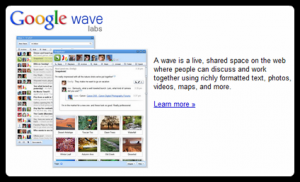
That’s where Google Wave comes in. It’s a strange little offering, a program hovering somewhere between email and chat, between Docs and Blogger. It’s half-finished and not terribly polished, and surprisingly difficult to explain.

To the storyteller, though, it’s as good as a muse. Here’s everything you need to know about it:

Google Wave enables, enriches, and preserves conversations.

It’s inspiration in compiled bytecode. You need to check it out. Come back tomorrow and I’ll explain exactly what features of Google Wave make it so useful for writers.

Photo courtesy Google Wave. (Thanks Google Wave!)