Skip to content

Reader Response Questions (Creative Writing Exercise)

This week we talked about figuring out what you need to fix in your writing, and what to do with the feedback your readers give you, but there’s an important overlap between those two that I didn’t discuss out all: asking your readers about the things you know you need to fix.

I’ll probably dedicate a whole blog post to the topic someday, but while these thoughts are fresh on our minds, let’s go ahead and get started in the right direction. Think about your current work in progress, whether that’s the fourth novel in a 25-book series, or just a blog you post to occasionally. Figure out what you’re worried about, in terms of the writing. Does your grammar bother your readership? What about organization and clarity? Or maybe your goals are higher than that, and you need to know if your posts are eliciting the proper emotional response, or if your characters seem as real as best friends.

Sit down and think about what it is you want your writing to do, and then make a list — ask your readers if you’ve succeeded. Make your questions open-ended, encouraging longer and thought-out answers, but make them specific, too. Some of my favorites are, “What was your favorite scene? What’s something from the story that you’ve found yourself thinking about even when you weren’t reading? Which character did you find the most engaging, and why?”

You’ll be amazed how many people read your book and think, “It’s good” is a satisfactory answer. Not all of your readers are going to want to fill out a book report, but some of them are going to feel unqualified to give their honest opinions, even when they do have them. Providing a list of specific questions gives them a place to start, and provokes them to actually voice their opinions.

This exercise doesn’t really deserve a section on the discussion board, but it’s information that’s well worth sharing. So click through to the comment and tell us what questions strike you as the most helpful. That can be an incredible resource for all of us.

Keep it Yours

Good feedback gives you direction. The actual path is up to you.

Good feedback gives you direction. The actual path is up to you.

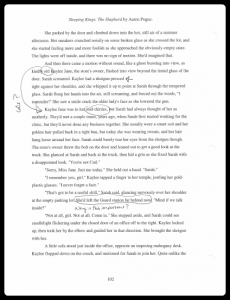
A few weeks ago I was at a local coffee shop with a couple of the girls in my writer’s group — my sister Shannon and my wife’s friend Becca. Becca was inching up on the end of her first novel and starting to think hard about the rewriting process. I offered to do a mark-up for her, and my sister described her own experience with one of my critiques.

“It was good,” she said, with a grimace at the memory of all that red ink. “They were all good suggestions, but it was hard to know what to do with them. If I just made every change he proposed, sure, the sentences were better, but it didn’t feel like my book anymore.”

Becca nodded, because that had been a concern for her, too. And I nodded, because what Shannon pointed out was a very real problem.

Red Flags and Smiley Faces

And the problem is complicated. As a new writer ready to start on revision, it’s difficult to know what’s wrong with your story, and sometimes even more difficult to know why it’s wrong. A good mark-up will reveal both of those things, but then it’s still up to you to figure out what to do with them.

Actually…y’know, it’s a whole lot like a scene in Becca’s novel when her characters go rock climbing. The main character is climbing for the first time, and she wonders how the others are able to scamper up what looks like a perfectly smooth rock face. When she gets up there, though, she finds all the ledges and crevices, all the little handholds and footrests she needs to make her way up.

That’s incredibly like the experience of rewriting. It starts off as a frightening bluff, an insurmountable task, but once you can find where to grab on and get started, it’s a pretty straightforward process.

The process is making your story better. And the handholds are all the jagged edges in your story, the things that stick out — good or bad. Those are the things that your readers are going to comment on. Maybe they’ll draw a little smiley face when your story makes them smile. Maybe they’ll mention how much they loved a particular character. Maybe they’ll say a certain scene left them feeling like they were right there, in the room.

If they’re really helpful, they’ll also throw in the red flags. They’ll tell you which phrases you used too often, or which characters really didn’t work. They’ll tell you when you got a real-world fact wrong, and when you lost their interest. None of those are things you want in your story, but they’ll be there. They’re an inherent part of rough drafts. Just count yourself lucky you’ve got someone to help you find them.

Learn from the Experts

In Becca’s story, her novice climber got to watch some experts scale the cliff first, before she ever took a run at it. They showed her one way to do it, a possible path up, and that gave her the confidence to get started at all. When she went to climb, though, she didn’t grab exactly the same handholds, she didn’t put her feet in exactly the same spots. They gave her an idea what to look out for, a general path to take, but in the end it was up to her to make the climb.

And that’s the answer to my little sister’s concern. That’s the difference between getting an editor and a ghost-writer. Every reader is capable of giving you feedback that hints at your problems (at your handholds and footholds). A good editor will go through your book page-by-page, scanning that rough cliff face and flagging every possible nook, then show you a path straight to the top. Your job isn’t to ride on their shoulders, though. Your job is to learn from their climb and then make your own.

Maybe I’m spending too much time in the metaphor. Let me say it plainly. When you get feedback on your novel — and I mean full mark-up, “I’d change this sentence so it reads like this” — every item your editor marks on the page is a legitimate concern. It’s a red flag or a smiley face, and it’s a spot you’ll probably need to visit on your journey through the revision.

The actual changes though, the suggested rewrites…that’s the expert climber scaling the cliff ahead of you. That’s how they would do it. When I marked up Shannon’s novel I found a sentence that looked like this:

All my friends, only two of which seemed sad to see me go, were behind in that world.

I told her I would rewrite it like this:

All my friends were behind in that world, although only two of them had seemed sad to see me go.

That doesn’t mean my way is the right way. That means that, when I read her sentence, I stumbled over it. Something was wrong with it. The value of my suggested change isn’t that it tells her how she should write, but just that it tells her what was wrong.

The aside confused the (otherwise pretty powerful) statement of the sentence. When she was writing, she put the words down on the page in the order that they occurred to her, not necessarily the order that most clearly conveyed the melancholy of her character’s thoughts. In essence, my suggestion was that she focus on simpler and clearer sentence structures for sentences like this that conveyed deep emotion.

But what would you do with that advice? If I read your book and that was my feedback, “You need to focus on simpler and clearer sentence structures for sentences that convey deep emotion,” you’d be left feeling pretty blank. Same thing if I tell you, “Use more active verbs,” or “Show, don’t tell.” The purpose of a good mark-up is to flag some good solid examples.

Make the Climb

Your job, then, is to figure out how you’re going to fix it. You now know what things need fixing, and why they need fixing, and you’ve even seen some examples of how someone else would fix them. All that’s left is to get in there and do it.

With experience you’ll get better and better at spotting those things on your own. You’ll learn exactly how you like to say it — in a way that gets smiley faces from your readers — so you no longer need someone else to demonstrate a path. You’ll get to the point you’re better and better at spotting your own handholds, too, until going along with someone else becomes more a luxury than a necessity.

You can’t start there, though. Nobody’s an expert rock climber their first time up the cliff, and nobody writes perfect prose when they take their first stab at it. You’ve got to practice, you’ve got to learn from people who know what they’re doing, and then just keep trying it, again and again and again, until you find yourself halfway up a mountain and realize it’s all become perfectly natural to you.

That’s when it will become yours. Everything up to that is simply training.

What I Learned about Writing this Week…from Brandon Sanderson

Courtney Cantrell's weekly writing advice

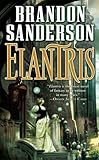
Once upon a time, I started reading the epic fantasy series The Wheel of Time (WoT) by Robert Jordan. Sadly, Mr. Jordan passed away before he could complete the series; however, author Brandon Sanderson is in the process of carrying on Jordan’s work. I have yet to read anything Sanderson has written for WoT, but I recently got my hands on a copy of his high fantasy novel Elantris and thought I’d give it a whirl to see if I like him.

I like him.

With Elantris, Sanderson has constructed a fantastical world so detailed, even the composition of characters’ names is directly linked to the intricate culture he has invented. The Elantrian world’s rich history provides a solid foundation for the events taking place in the story. Characters grapple with what they often consider dull traditions–which nevertheless appear vibrant to the reader because of their originality and otherness. And every character comes complete with gems of personal history that sparkle because they’re cut with precision and polished with care.

The beauty of it is, Sanderson reveals this wealth of backstory not in exposition, but in the characters’ interactions with each other and with their environment. As his characters go about their lives, reacting to each other as their individual personalities dictate, the author drops hints and leaves clues. He marks the path of the story with breadcrumbs that are delicious morsels of history to whet the reader’s appetite for more. He does not drop a four hundred pound loaf of pumpernickel in the reader’s way and expect said reader to chew a tunnel through the center. That, my inklings, is too big a mouthful for even this voracious reader to swallow.

So that’s what I learned from Mr. Sanderson this week: Don’t blockade your story with unappetizing chunks of explanation. Feed your readers the backstory one tasty little piece at a time. Take care not to treat your readers like children–no need for the airplane-into-hangar game–but be equally attentive to how much they can chew and swallow at one time. If you’re not sensitive to your readers’ need for well-proportioned bites, you might find yourself in possession of a story that’s congealing on the plate with no one interested in sitting down for a meal.

One forkful of yummy story at a time…and with every paragraph, sentence, and word, leave them hungry and demanding more.

And that’s WILAWriTWe!

(Furthermore, the FCC wants me to tell you that if you click on any of the links in this post, and if you buy a product, This Starving Artist will get a few bucks. Consider it your small contribution to The Arts! ;o)

Photo credit Julie V. Photography.

Make it Better

Read, rewrite, revise, and edit. Make your work the best it can be.

Read, rewrite, revise, and edit. Make your work the best it can be.

My little sister is a busy woman. She’s a photographer, a part-time novelist, a dedicated housewife, and a mother of two active little girls. She somehow finds time in all that to read voraciously, and even to blog sporadically. A couple weeks ago those last two activities overlapped a little bit when she wrote a blog post about the hundred books she’d read in 2009. Then, to her great surprise, one of the authors on the list commented on her blog!

She was ecstatic. She called to let me know about it, and I went to read the post in question, and right away I winced. One of her favorite authors found her blog, and found it all riddled with terrible writing. I’d have been mortified. To be fair, I’m easily mortified and she’s got a pretty forgiving audience. More importantly, she’s got better things to do with her time than policing passive voice.

Still, her big brother is a writing professor now, so I had to lecture her about it. I met her for dinner and said, “It’s time for you to start taking your writing seriously. It’s time for you to start proofreading!”

She just frowned and said, “But I do! That’s the thing. I don’t know how to make it better!”

Start with Style

One of the most important things you can do to improve your writing is to have paid attention back in high school. Unfortunately that requires an incredibly awkward verb tense and a time machine, so it’s not really a great solution. More to the point, it requires a perspective and sense of judgment you probably didn’t have in high school, because unless you’re writing academic papers, you’re probably much better off ignoring some of those grammar rules.

The thing is, there’s a big difference between ignoring the rules and being ignorant of them. All those stupid lessons you glossed over in high school exist for real, concrete reasons. If you know those reasons, you can make the occasional judgment call to break them. If you don’t really understand, though, you’re making that call with flawed judgment.

The nice thing is that real life doesn’t require you to go back and get an A in every high school class. Real life just requires you to learn the stuff that would actually be useful to you now. And there are resources out there to help with that. If you do well with textbooks, dig out your copy of The Little, Brown Handbook or Strunk and White’s Elements of Style. Chances are good you’ve got one gathering dust on the bottom shelf of a bookcase somewhere, because those two books between them are some of the most informative and helpful instruction on English grammar ever written. Find one of those, dust it off, and start brushing up.

If you’d prefer a more casual tone, look around for articles or blog posts by grammarians like June Casagrande (author of the fun and funny Grammar Snobs Are Great Big Meanies, which is effectively the Style Guide for UnstressedSyllables.com). It doesn’t have to be dry and didactic — pick a teacher whose style works for you. Do pick a teacher, though, and start learning all the rules you didn’t bother with before.

Read it in Stages

Once you know how to tell the difference between a verb and a participle, between singular subjects and plural conjugations — and, more importantly, why to care — it’s time to clean up your work. It’s always a good idea to reread anything you’ve written before publishing it to an audience (even if it’s just an email to your mom), and the more times you review it, the better it will be.

Carlos picked up on that back when he read my Works-in-Progress chart, but most experienced writers are in the habit of reviewing their work not only multiple times, but in multiple ways. As a novelist, I might dedicate one stage to fixing grammar, one stage to characterization, and another one to plot. If you’re still working on basics, you might dedicate one stage to fixing your verb tense — past, present, or future, it should be the same throughout your document — and another one to paragraph length and smooth transitions.

Whatever your problem areas are, consider dedicating at least one full mark-up to each.

Learn Your Weaknesses

Of course, before you can do that, you need to know what your problem areas are. Lucky for you, that’s the easy part.

Examine Your Blind Spots

I already recommended revisiting Elements of Style, but even if you never read anything but this blog, you’re studying writing. In the process, you’re going to come across references to rules you know nothing about, whether that’s subject/verb agreement or the proper use of subjunctive case. Even if you’re following the incredibly permissive style of Grammar Snobs, you’re occasionally going to stub your toe on some rule or technicality that you know nothing about.

When that happens, pay attention! Chances are good that rules you’ve never heard of are rules you’re breaking. Get in the habit of learning. There’s no better way to learn good writing techniques than to apply those techniques — again and again — to your own documents, especially when it’s work you actually care about.

Trust Your Ear

I do realize that getting you back to school is going to be a hard sell, and even if I’ve got you convinced, it isn’t going to do anything to help your writing now. If you want to instantly get better at editing and revising your own documents, I’ve got a one-step guaranteed method for you:

  1. Read it out loud.

It’s easy to forget, living in one of the most literate societies the world has ever seen, but every written word is a direct representation of spoken language. It’s not a vague connection, it’s not even two different symbols both pointing to the same idea — written words are graphic representations of the spoken words (that ultimately point back to ideas).

Your readers jump through those hoops every time they glance at your document. A voice in their head converts all of your letters and symbols into sound, and then tries to build meaning out of it. It’s your job, as a writer, to direct that voice. It’s your job to manage not just the words on the page, but also the imagined sounds in your readers’ brains.

Does that sound intimidating? I guess it could, but at least it’s specific. What I’ve really said there is the same thing your English teachers tried to get across to you every time they scribbled “poor transitions” or “flow” or just “awkward” in your margins. What they were talking about was the difference between the ideas you’d put together, and the way those ideas sounded when read by the voice inside your teacher’s head.

So how to handle that? Commit your writing to voice. Read it out loud. I know you wrote it. I know you’re a competent reader. I know you probably struggled through the arduous process of learning how to read silently a long, long time ago, and that’s so much more convenient and efficient than reading aloud.

Do it anyway. Read your stuff out loud. You’ll hear grammar errors you can’t spot on the page. You’ll notice which words you use too often (or too close together). You’ll realize which sentences butt awkwardly against enough other, and need smooth transitions between them.

You’ll also slow down, and in the process you’ll catch a lot of easy mistakes you’d miss when reading silently — typos and word inversions and even homophone errors that are so easy to overlook when you’re speedreading.

Get Feedback

Of course, the best way to learn what your writing sounds like inside someone else’s head is to get that person to read it for you. When it comes right down to it, there’s no way for you to look at your document entirely objectively — you already know what the document is getting at, you know why you organized it the way you did, and you already possess all the information it’s trying to convey. To get a real analysis of its effectiveness, you have to hand it to someone else.

The good news is that there’s always someone willing to criticize anything you’re willing to care about (trust me, I’ve tested that claim extensively). Not all of them are going to be qualified critics or ideal readers, but everything they have to say is valuable, once you learn how to use it. (I’ll talk about that more on Thursday.)

In the meantime, search out those people who do give immediately helpful advice. Find the smartest, pickiest person in your target audience, and ask where your weaknesses are. Find a friend who really knows his or her stuff, and get some detailed markup. Lacking that, ask everyone for feedback, and look for consistent patterns.

When you know what’s wrong, you’re ready to make it better. Exactly how varies from case to case, writer to writer, audience to audience. That’s a lot of what I want to talk about here, though, and if you’ve got specific questions feel free to ask. Leave a message in the comments or send me an email, and let me know what you’d like to improve. I’ll help in any way I can.

Document Critique (Technical Writing Exercise)

Business Writing Exercise

Business Writing Exercise

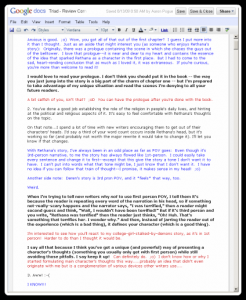
This week we’re going to discuss techniques in getting and giving useful criticism, so it might be tempting to put off today’s assignment until you’ve read tomorrow’s article. I’d recommend that you go ahead and do your best job now, and then try again after you’ve read the week’s lessons. See what changes, what gets better, and what gets easier.

The actual assignment, though, is to critique one of your own documents. Pick something you’ve written recently and write a short analysis of the document’s quality and craftsmanship.

Start by reading through your document, and then write one to three paragraphs of analysis on each of the following topics:

  • Clarity of communication – organization, transitions, good introduction and conclusion, etc.
  • Effectiveness of the message – strength of the argument, connection to the reader, etc.
  • Elements of style – punctuation, grammar, sentence structure, etc.

Refer to or quote the document where appropriate.

If it’s a document you can share, link to the original. If it’s a document worth rewriting, fix the problems you identify and then link the revised draft. Even if you don’t want to do that, share your critique on the discussion board. We can all benefit by seeing other writers’ analysis, just as much as by seeing their work.

Playing Cards (Creative Writing Exercise)

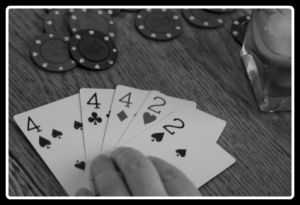
Let’s have some fun with the writing exercise this time. All that talk about cards on the table has me thinking about the serious drama in every hand of poker.

So that’s your job this week. Sit down at the poker table with four of your characters — whether you make up new ones for this assignment or mix and match from your works in progress. In 300-600 words, tell us about one hand, maybe just one round of bidding, but make it intense.

Maybe it’s relationship drama among the players, or financial drama for our gambling addict protagonist. Maybe it’s international espionage coming to a head at the high-stakes table, or a deeply introspective consideration of morality, expressed as an extended metaphor.

Whatever your story, show it on the camera. Practice revealing your characters through their actions, not explanations, and give your readers just the hints they need to figure out everybody’s hands (literally or figuratively, depending on your plot).

Then, when you’re done, put your cards on the table. Share your scene with us on the discussion board, and we’ll let you know what we think.

Courtney’s Work-In-Progress Update

Courtney Cantrell shares her work in progress

Moments ago, I finished mapping out what I have left to do before I have a complete first draft of SHADOWS AFTER MIDNIGHT. Or whatever the working title is.

1. I need to fill in the gaps of story in chapters 4, 5, 7, and 14.

2. I need to write Chapter 8.

3. I need to go through the whole document and delete all the “extras” I didn’t backspace out of existence during National Novel Writing Month. (By the way, it flabbergasts me that I can consistently manage to write 50,000 words every November, yet I struggle the rest of the year to pen more than 10k every six weeks. Ahh….what a little pressure won’t do for a hapless writer’s motivation!)

4. I need to make final decisions regarding the placement of several bits of demonic inter-chapteral monologue.

In the meantime, I’ve decided to marry chapters 8 and 9. Lest you think I’ve converted to bigamy, I mean that I am bringing those two chapters together in wedded bliss, to have and to hold, may death do them part, ad infinitum. I predict they will be very happy together and spawn many a joyful reader.

Oh, and yesterday I finished writing the novel’s climax, simultaneously breaking 60,000 words. “The End,” here I come!

I’ll keep you posted.

Photo credit Julie V. Photography.

Cards on the Table

Tip your hand, don't show it! (Photo by Shannon Iverson)

Tip your hand, don't show it! (Photo by Shannon Iverson)

When I was in Middle School some of the older kids in our youth group went off to camp and came back fascinated with a new card game called Mao. I don’t know if you’ve played it, and I don’t know that we were playing according to standard rules, but the game became wildly popular at all our youth events for months after.

It’s a cruel and capricious game. The rules are arbitrary and punishing, made up game-to-game (or even hand-to-hand) by the dealer, or “Mao Master.” The goal of the game is to get rid of the cards in your hand, but the Mao Master can give a player an extra card at any time, for any offense. I’m pretty sure I’m the one who implemented “card for not having enough cards,” and “card for having too many cards.”

Yeah. We played this game for fun.

Show, Don’t Tell

Writing advice can often feel a lot like that cruel little game. You might have run into that yourself, from time to time. One person tells you to use strong and varied language, but someone else exhorts you to throw your thesaurus in the trash. One person tells you to develop your unique voice, make your prose conversational, but someone else tells you to fix your comma splices and get rid of those awful sentence fragments.

Some of the most frustrating examples of this are in some of the most common writing advice, especially in the phrase, “Show, don’t tell.” It’s vague and unhelpful, but you’ll hear those words again and again and the harder you try to do it, the more people might complain about it.

I’ll write an article soon explaining how best to use that phrase (both as a writer and as an editor), but today I want to talk about the difficulty of hitting that moving target.

Beauty in Brevity

I’m sure you’ve heard the phrase “efficiency of language” given as high praise. There is a beauty, a special kind of magic, in saying something profound in a handful of words.

When I’m advising new writers, I find myself again and again saying, “Get out of the characer’s head!” Tell us the story. Tell us what happens. I get frustrated with too much introspection, too much explanation.

I get just as frustrated with too much description. I’ve already complained about Stephen King, and I could be just as vicious concerning the late Robert Jordan’s pages-long descriptions of every character’s every bit of clothing. It’s agonizingly detailed, and it shatters the flow of the story.

Clarity is King

Of course, even as I say that, I know there are people who love Stephen King precisely for his detailed visual descriptions. Jordan’s fame came from his worldbuilding — his engaging sets and the amazingly real (but novel) societies and cultures. Part of the problem is that every reader is different, every audience varied, so there is no one right way to write.

It is important to make your story clear, though. Make it real to your reader. Your job is to provide as much detail as necessary to make your story bloom, in perfect clarity, in your reader’s mind. You’ll get to choose, to some extent, which readers are your readers, and most of the time the right way to do that is to pick readers like you. Write the level of detail you like in a novel, and don’t waste too much effort tweaking to please people with fundamentally different taste.

Focus on the Story

Ultimately, though, your job is to tell a story. Your readers come to you not for your genius turns of phrase, not for your lovely dress designs, but for your story. Whether you’re chasing brevity or clarity, you should be doing it to better tell your story. Make it a tale. Make it an engaging experience on every page.

Sometimes it’s tempting to tell your readers what else is going on, or what has gone before. Sometimes it’s tempting to tell your readers why your characters are doing what they’re doing, or why an obstacle has arisen. That’s when “Show, don’t tell” matters most. It’s better to tell your story than tell about your story.

I call that sort of writing “cards on the table” because it’s like playing a round of poker with your hand face-up. Maybe you’re doing it out of generosity, but it ruins the game. Readers want to figure it out. Part of the experience of reading a story is looking for the subtext, guessing at ulterior motives, reading people.

It’s fair to think of it just like a poker game. It’s a game you want your readers to win, sure, but you’ve got to play according to the rules. So give your characters tells — your love interest hesitates before she says, “I love you, too.” Your villain flashes the barest hint of a smile before he shakes his head and says, “A bitter tragedy.”

You don’t have to say why, just say what they do, and leave it to your readers to call the bluffs.

What I Learned about Writing this Week…from…well, Me

Courtney Cantrell's weekly writing advice

As soon as I sat down to write this post, I found myself facing the combined conundrums (conundra?) of the intimidating blank page (which Aaron has made less intimidating here) and the question of what I’m going to do with the long title attached to this weekly segment.

Don’t get me wrong. I love said title. Said title leapt into my heart, burrowed its way to the center, and took up permanent residence in my endocardium the moment Aaron mentioned said title. However, in addition to my instant amorous affection, I also felt the immediate need to gift my wordy inamorata with a fond nickname, that we might enjoy each other’s company unhindered by any hint of verbose bulkiness.

Hence, I delved into my formidable powers of creation and came up with an acronymic nickname for this weekly segment: WILAWriTWe [wil-uh-RIT-wee]. I considered trying to give you the International Phonetic Alphabet notation, but that’s really too ambitious even for my standards. I haven’t done IPA notation for anything since college–and for all of our good health and sanity, I don’t believe I should start again now.

Maybe next week.

But, as I am so wont to do, I digress. WILAWriTWe it is…and WILAWriTWe from Me is that I enjoy anthropomorphizing phrases and giving them cutesy nicknames. Oh, and I like acronyms. This really is self-explanatory, and I really don’t think you needed me to tell you this.

But wait, you say. This weekly post is supposed to be about what I learn from actual published writers*, n’est-ce pas? That, Gentle Reader, is what you’re here for, isn’t it? Well? Innit?

Okay, fine. You don’t have to roll your eyes. I hear ya loud and clear. And as I’m an accommodating sort (most of the time), I’ll give you what you’re looking for. But still, I get the satisfaction of knowing that my very first WILAWriTWe post was all about ME, and you can’t take that away from me, mwah-ha-ha-ha-haaaaaa–

*ahem*

Okay. For real now.

WILAWriTWe…from Dean Koontz

Dean Koontz has been one of my preferred authors for going on twenty years. It’s interesting to go back and re-read some of my first Koontz favorites and track how his writing style has changed and grown over time. That isn’t the point of this particular post, or I would go into it further, as there are some beneficial lessons we writers can learn from observing the “greats” (and I put that in quotation marks because I won’t assume each of my gentle readers is as enamored of Mr. Koontz as I am) and analyzing how their writing evolves through their experience (often from one work to the next). Our own craft should undergo the same metamorphosis, if we’re doing our jobs well. But that, my inklings, is another story and shall be told another time.

Right now, I’m approximately ninety pages from finishing Koontz’s ODD HOURS, the fourth novel in a series spun around a psychic young man appropriately named Odd Thomas. Describing Odd as a character would be yet another blog post in its own right; suffice it for now to say that I find him fascinating, amusing, heart-warming, endearing, and many other positive words suffixed with -ing. What I’m currently interested in, and WILAWritWe from Mr. Koontz’s novel is something to which I myself am not adhering as I write what you are reading now, and that something is this:

Simplicity.

The voice of the character Odd Thomas–both in his narration (for it is a first-person-point-of-view novel) and in his dialogue–is straightforward and…well, simple. Koontz doesn’t let his main character ramble unnecessarily. He describes the character’s surroundings in direct terms. He leaves out the pesky embellishments of adverbs. He makes every word count.

And that, Gentle Reader, is an ability each of us writers must develop. The old imperative comes into play here: Keep It Simple, Stupid! (KISS–another acronym! Woot!) You don’t have to use big words. You don’t have to put a gajillion subordinate clauses into your character’s mouth, when all she’s trying to do is ask the vendor on the corner where to find the nearest self-cleaning Porta Potti. Your character has something he wants to say–and feeding him over-intellectualized psychobabble will do nothing but paralyze him and make your story die a quiet, unremarked-upon death.

We want no quiet, unremarked-upon deaths. If somebody in your story is gonna die, we want them to go out in such a way that makes everybody perk up and pay attention. We especially want your readers (gentle or otherwise) to pay attention. And the best way to make your reader sit up and grip your book so tightly that pages crinkle and knuckles whiten is to banish the frills and allow your characters to have their say without you getting in their way. At the risk of offending: Sometimes, we writers just need to KISS off.

And that’s WILAWritWe!

*Or from movies. Or from people around me. Or from my cat. Really, I’m allowed to share WILAWriTWe from anything and everything, so by sharing something gleaned from my observations of Me, I wasn’t actually breaking any rules. You only thought you could point at me the iron finger of accusation. Foiled again! Ha!

(But wait! There’s more! If you click on any of the links in this post, and if you buy a product, This Starving Artist will get a few bucks. Consider it your small contribution to The Arts. ;o)

Photo credit Julie V. Photography.

Finish Strong

A good bookend reflects the beginning....

A good bookend reflects the beginning....

I taught a Technical Writing course to a bunch of college kids last fall (stop me if you’ve heard this story). The purpose was to get them ready for the business writing they’d have to do in their professional careers, so I spent a semester teaching them about resumes and project proposals, memos and business letters, and before every class I’d put in hours figuring out my lecture. At every step of the way I wanted to make sure they understood all aspects of the documents they were working — when to use them, how to write them, why to care.

Then it came time for the final exam, and I had one of my brilliant ideas. Instead of giving them some big multiple-choice test, I decided to have them demonstrate, in a more practical way, the things they’d been learning all along. I told them a couple weeks in advance what to expect, then when the final exam period rolled around, I had them convert some assigned information into a clearly-defined document type (in this case, a wiki). The twist was that this time I wouldn’t tell them how. It was all up to them to figure it out.

I figured by that point they wouldn’t have any trouble. I’d shown them the process plenty of times. I’d dumped a ton of detailed examples on them, so I was confident my students could handle the challenge. So confident, in fact, that I didn’t do any preparation for that class period. I didn’t brush up on the wiki format, didn’t put together any general guidelines or notes…didn’t even really stop to consider all the things that could go wrong. I just showed up to class, told them where to find their source material and how much time they had to make me a wiki out of it, and then I sat down at my desk to watch brilliance happen.

You could have heard a pin drop in the silence that followed. I waited for them to sprint into action — or at least start talking it through — but no one moved. Sixteen pairs of eyes stayed fixed on me, waiting for the instructions I hadn’t bothered to prepare.

How to Write a Conclusion

How’s that for a happy ending? After fifteen weeks of teaching these kids — guiding them from total obliviousness through all the major topics, techniques, and types of technical writing — I got to their most important class (grade-wise), and my final, lasting impression, and let them fall flat on their faces.

How often have you made the same mistake, in your writing? You figured you’d explained the issue well enough in your introduction, you’d provided all of the relevant information in your body paragraphs. Your readers could figure it out, right? They’re all smart people. So what’s the point of laboring over a conclusion that’s probably not even necessary?

The point is to avoid those blank stares. The point is to drive your readers to action (not vague confusion). A good conclusion finishes the message you’ve been building throughout the document. It’s your last word to your students before they walk out that door forever. What are they going to think of you, and of what you’ve had to say?

The key to writing strong conclusions, just like good introductions, is to think about your readers. Consider their experience as they approach the end of your document, and tell them what they need to know to get the most out of your work.

Some Examples

How do you know what your readers need? A good writer takes some tips from his document type.

  • If you’re writing a story, your reader needs resolution
  • If you’re writing a humorous anecdote, your reader needs a punchline.
  • If you’re writing a persuasive piece, your reader needs a call to action.
  • If you’re writing an essay, your reader needs to know what’s the point.

More than that, your resolution should be a part of your overall document structure. It’s not a separate note tacked on to the end but an integral piece of the overall document design. In other words, you should be writing toward your resolution from the very beginning of the document.

The Conclusion in the Body

Think about your conclusion when you’re choosing your organization method. When you’re figuring out which supporting ideas you want to include in the body of your document, remember that your conclusion should flow out of those ideas, not just be a restatement of them.

That’s a common problem new writers have, and I hinted at it back when I introduced this series. If you find yourself asking, “Didn’t I already say all this?” go back and check the document body. Chances are good you already wrote the conclusion — as your final body point.

The problem with that is that you probably weren’t in “Conclusion Mode.” You were still dumping information, not guiding your reader to the end of your message. In that case, you’re going to need to either cut out that final point and rewrite it in your conclusion, or work on revising the body paragraph to make sure it does everything a conclusion needs to do.

The real way to make conclusions easier in the future is to learn how to write a document that supports a conclusion, and make sure the final bits end up in the right place. Learn to recognize the difference between supporting evidence and your argument’s point, and save that point to use as the meat of your document’s conclusion.

The Conclusion in the Intro

Of course, it’s not just about what you say, but also about how you say it. That’s part of what I meant when I talked about “Conclusion Mode.” There are some style tricks you can use to make sure your conclusion has the right feel for your reader. That’s almost as important as the information, creating a sense of closure and purpose to the overall document.

A call to action achieves that well, but one of the most powerful techniques for wrapping up a document smoothly is the callback — sometimes referred to as bookending — when you refer back to your introduction to tie your whole message into one cohesive bundle.

To do that well, you have to do it on purpose. Write an introduction that draws the reader in, but leave it open. Find ways to keep it in the reader’s mind throughout the body, so it’s still fresh when you turn back to it.

The End

That was my saving grace, in the Tech Writing final. I’d started out the first class by dividing them into groups, each specialized in certain aspects of documentation, and kept that up throughout the semester. On that last day, as quiet seconds stretched into awkward minutes, those groups suddenly pulled together. The guys on the back row figured out the system, the group on the left came up with a method, and the group on the right put it into practice. It took them the whole class period, but by the time it was over, they’d made something amazing.

When you do it right, sometimes the end just takes care of itself.