Skip to content

My Experience with the Conscious Me Pre-Writing Challenge

I'm participating in the Conscious Me Pre-Writing Challenge. Learn more.

I'm participating in the Conscious Me Pre-Writing Challenge. Learn more.

This year, I participated in the first annual Conscious Me Pre-Writing Challenge. Not only did I participate…I won it. If you have no idea what I’m talking about, check out my detailed description of the challenge and its rules. If you’ve already read through one of my weekly posts on the topic you can skip down to the bottom to get my description of week 4 and my endnotes. In this article I’m rewriting (and significantly trimming down) the whole experience in light of my successful conclusion.

Anyway, this challenge is all about Writing it Early, which I talked about at the start of the challenge. That’s something you need to work on, whether you’re a blogger, a novelist, or anyone else who has to do serious writing from time to time. It always feels like a hassle, a necessary evil — or maybe you see it as a luxury you can’t afford — but it’s one of the best things you can do to make your work better (and, ultimately, to make it easier and less stressful).

That’s a big claim, and one that needs backing up. Lucky for me, my experience with the Pre-Writing Challenge provides some excellent evidence.

Prologue

I started Unstressed Syllables last December with a heaping tablespoon of ambition and a pinch of planning. My first three articles were my mission statement, my site design, and my about page. I wrote them on the fly, settled into a schedule, and got to work writing down all the writing advice I’d been sharing with friends and family for years.

I’m a professional writer. It’s what I do. So putting ideas on paper was never a struggle for me, and that initial burst of energy was worth at least a month of blog posts. Maybe six weeks. By the end of January, though, I was starting to run low on energy and ideas. I was finishing up my posts later and later. I was looking with longing on the list of all my other projects that I’d put on hold.

Edging into February, I found myself barely finishing posts before their deadlines, staying up late nights just so I could claim I’d published on “Tuesday” (because 11:59 counts). I’d have to spend the whole next day cleaning up the mistakes I’d made, and hoping my readers hadn’t seen it yet (how sad is that?). It was exhausting and it was stressful. Every post was work.

Then Carlos came around with his big idea, suggesting what started out as an accountability agreement and blossomed into the Pre-Writing Challenge. Just as I was at the point of hating every minute I spent writing for my blog, Carlos suggested I commit to spending a whole lot more minutes. I scoffed at the thought of it, especially with a four-day weekend out-of-state looming over me, and some serious overtime at work for the next month or two.

Carlos asked me directly for my help, though. Even then, I only agreed to it because Carlos and I are friends, we got into this blogging business together, and I felt like I owed him. I figured there was a 50/50 chance it would ruin our friendship.

It didn’t. It revived my blog.

Prep Week

I got back from my trip five days before the official kickoff of the month-long challenge. When he was making up the rules, Carlos had scheduled a little bit of prep time to get ready, mainly so we could get some promotional and explanatory material up on our sites, but we all intended to use that time to get a small head start, too. For me, that mostly just meant getting caught up.

I got home on a Monday night, with a post due (and totally unwritten) for that day, and another (also unwritten) for the next, and two more due before the end of the week. Not only that, but as one of the requirements of the challenge, I needed to get a challenge page written that described my goals for the project (meaning the specific two weeks’ worth of articles I wanted to get written). I was nowhere near that organized.

I had to be, though. I dashed off a writing exercise to meet my requirement for Monday, stayed up late writing the next day’s article, and then spent all day at work Tuesday thinking about how I could possibly manage the Challenge. The answer I came up with was a spreadsheet in Google Docs — a blog posting schedule with columns representing days of the week, and rows representing the six weeks of the challenge.

That changed everything. In one night I went from scoffing at the challenge, seeing it as an arduous sacrifice I would struggle through for a friend, to genuine optimism. Several of the articles I’d dreamed up just to fill out the spreadsheet had me anxious to get started, then and there, and for the first time in weeks I found myself excited about writing for the blog. I spent the rest of the week getting ready, and that excitement only grew.

The Challenge

The Challenge itself was 30 days of writing, four weeks to write six weeks’ worth of material. My first priority was just to get back into a regular writing schedule, to get back to writing my regular blog posts at least a day before their deadlines. The spreadsheet helped with that (and, of course, the forethought that went with it). Within the first week I was back on schedule.

Week 2 featured a post that required some feedback from an expert source (which meant a fairly slow email exchange), but I tackled that as one of my early pre-writing posts, so I had it done with plenty of time for feedback and correction. Because I gave myself that time, the article went live looking just the way I wanted it to. That success alone repaid all the effort I’d put into the challenge so far.

By the end of week 2, I was two weeks ahead, but I’d also used up most of the ideas I’d been thinking about for months. Now I was into new territory, working on topics I’d just made up to fill out my spreadsheet. I also started running into problems with scheduling.

When I came up with an outstanding idea for a new post (and one that would need to be published quickly), I had to bump my carefully structured schedule, and just as I got that settled, another change came along. Week 3, I learned the very important skill of rearranging a posting schedule — keeping it strong, but flexible.

In week 4, all I had to do was get it done. Any novelist will tell you that can be an agonizing challenge, though. The closer you get to the end, the more resistance you find. There are so many details that have to be sorted out, so many promises that have to be fulfilled, and that constant nagging suspicion that you haven’t quite done enough.

You get that in the last week of the Challenge, but it’s an experience I’m familiar with, and three years of participating in National Novel Writing Month have taught me how to just get it done.

So I did. Wednesday afternoon, with an incredibly busy weekend of Real Life stuff looming, I typed up a handwritten post, polished some of the rough edges off a draft I’d written a week ago, slapped some illustrations around willy-nilly, and called it done. I popped into Twitter to brag about it to everyone I knew.

The Benefits

That sense of victory was real. And it lingered. Thursday morning, swamped with a To Do list a mile long, it suddenly hit me that I didn’t need to worry about my blog. I wasn’t getting behind. I hadn’t forgotten to review the day’s post before it went live. Everything was fine.

That’s a deep and powerful sense of comfort, for the blogger. It sneaks up on you, and I still find myself panicking from time to time. Sometimes I get all the way to my WordPress Dashboard before I remember. Everything is fine.

There’s more than that. Everything is better. I’m confident every post I wrote this month was better than the ones I was writing (frantic, frustrated, and fearful) in those first hectic weeks of February. I’ve spent more time thinking about them, more time reviewing them, more time linking up internal references and picking perfect pictures for illustration. The Challenge was a real commitment, and a lot of work, but the reward is a better blog, top to bottom, and a better experience blogging to boot.

I can’t overstate that last point, either. Everything is easier, and everything is more fun. These days, when I have some time to write, I look over the three or four weeks of topics I’ve already got in my spreadsheet and pick the one that sounds most fun. There’s nothing I have to get written. I write for fun, and there’s room for error. There’s room to scrap an idea that just didn’t turn out, without ruining my week. I can put my focus where it needs to be: on doing what I do well, and helping the people I want to help. That’s fun.

That’s the benefit of the challenge. That’s the benefit of writing it early, made real. Make the time, get it done, and feel some of that victory for yourself. It’s so worth the effort.

Pre-Writing Challenge Weekly Updates

I'm participating in the Conscious Me Pre-Writing Challenge. Learn more.

I'm participating in the Conscious Me Pre-Writing Challenge. Learn more.

It’s done! The final week of the Conscious Me Pre-Writing Challenge is done, and I finished it up with a bang! If you have no idea what I’m talking about, check out my detailed description of the challenge and its rules. If you’ve already read through this mighty, long-coursing document once, feel free to skip down to the section heading “Week 4” for just the new stuff.

Anyway, this challenge is all about Writing it Early, which I talked about a few weeks ago, just as I was getting started. I thought it might be beneficial to you guys, my readers, to hear about my experiences throughout the challenge, since this whole process is an amazing exercise in daily writing, and in taking your blog seriously — two things you should definitely be working on.

I first sat down and wrote this post mid-way through the second week of the four week challenge. I updated it at the end of week 3, and I’m throwing in some comments at the end of Week 4 now. For my final analysis, check out the (much shorter) rewrite and review I did here. It’ll have the same illustration, and maybe a similar opening, but it should be a mostly new read. It’s also the last of these posts you’ll see in your RSS Reader.

One note: this is going to be a long one. Even when it was only half-finished, it was already twice as long as my regular articles, and it doesn’t contain any direct writing advice. If you feel like skipping it, by all means skip it. If you’d like to see what it’s like keeping a blog like this running, though, read on.

Prologue

Back on February 10th, Carlos published a guest post on Website-in-a-Weekend suggesting that every blogger should always keep some posts in reserve. Write ahead, he said, for all the reasons I spelled out in “Write it Early, Review it Late” and more.

Given the audience of Website-in-a-Weekend, everything he had to say struck a chord, and half a dozen commenters piped up to say they really needed to get in the habit of doing exactly as Carlos suggested. I didn’t say as much, but I felt the same way. I’d felt the same way ever since I reviewed his post a month earlier, but I’d never done anything about it. That last bit was a common theme, too. We all know we need to work ahead, we need to give ourselves time to review and revise, but as creative people, we’re all in the habit of procrastinating.

When the conversation turned that direction, Carlos offered an accountability agreement with one or two people and the response was so strong that he decided we needed to make a support group out of it. Within an hour, he turned that idea into the Pre-Writing Challenge, and by the next day he had some ground rules and a mailing list. He asked me for help coordinating that (mainly by providing space on my discussion board for us all to discuss the challenge and share notes), so I could hardly sit out of the challenge.

So I agreed. Problem was, all of this really started moving on Thursday (the 11th), and I had a four-day trip to Little Rock planned for the weekend, to visit with family. So while the rest of the contenders were gearing up, building landing pages, planning out their posting schedules, and chatting in the forums, I was on the road to Arkansas. I didn’t really even get started until Tuesday the 16th.

That was still early, though. The challenge officially began on Friday the 19th, but we were all supposed to have certain information prepared before then, including landing pages (as I mentioned before), site descriptions and author bios and profile photos for everyone else to host, and a detailed goal for the project. For me — for what I’m doing here — that last one was the most work. I needed to spend four weeks writing two extra weeks’ worth of material, but everything I write here builds on itself. I couldn’t come up with any distinct material to develop outside the regular posting schedule, so I knew I’d have to figure out my entire posting schedule, out to the end of the challenge and beyond, before I’d know what my personal goal was going to be.

So that’s what I did, all night Tuesday evening. I sat on the couch in the living room while my daughter danced and spun and my wife watched old episodes of Dead Zone, and I worked on a spreadsheet. I made it in Google Docs, using rows for weeks and columns for days, and made up a color key to track what I’d accomplished. By the end of the night, it looked like this:
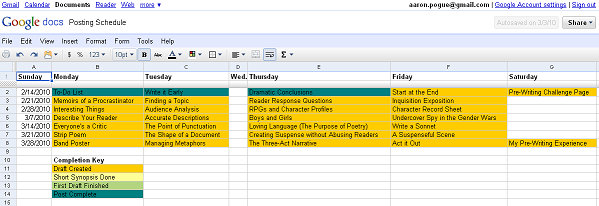
Posting Schedule 0There’s no need to strain your eyes trying to read the small print — it’s the colors that matter. Orange indicated a post that had a title (and nothing else). Yellow meant I’d started writing on it, light green that I’d finished a full draft, and dark green that the post was completely finished, and ready to publish. In the chart above, you can see that only three posts were done, and that first week was the week of the 14th (so, when I filled it in on Tuesday the 16th, I had all of a 2-day lead to work with, since that Thursday’s post was already done).

Just coming up with the titles was a challenge, though. I needed to figure out how they fit together, how they would build on each other, and make up at least a guess as to the contents of each topic, to avoid too much overlap or too little content, day to day. It forced me to think about my weekly writing exercises, too — something I’d just been throwing together the night before, up until then.

It was a lot of work. It was energizing, though. By the time I was done, just making up a bunch of names, I really felt like I’d accomplished something. Everything I was doing with the blog suddenly felt more solid. More real. I could gaze into the future, and see the blog still there, still churning content and serving readers. For a two-month-old blog, that kind of confidence means a lot (even if it’s only a peek six weeks in the future).

See…I’d spent most of those two months feeling excited about the project, but also constantly dangling over the edge of failure. I’ve started a lot of projects in my time, and I’ve never had a terrible dedication to hard work and intense effort. That’s what serious blogging is, though. So Unstressed Syllables felt fragile, even when friends and family told me it was valuable from the start. It felt like a trial run, even when I started getting visits (and praise, even) from strangers. I woke up every morning knowing I had to get a post finished today, and if I didn’t, the dream of the site probably wouldn’t survive to the weekend.

One silly color-coded spreadsheet changed all that. That Tuesday night, my bedtime came and went, and I sat moving cells around, tweaking titles, and second-guessing writing assignments until I felt like I really had something I could work toward. Then I shared the spreadsheet with Carlos, just because I was so proud, and I called it a night.

It took me the rest of the week to get my challenge page built and filled out, to get my site information to the other contestants, and I knew I had a busy weekend coming up, with family coming in from three states to celebrate my daughter’s birthday. I made the commitment anyway. I’m an old pro at NaNoWriMo, an event that takes place in a month that includes not only Thanksgiving, but also my own birthday, so I’ve long since learned that big projects have to coexist with life disturbances. I sighed about it some, but I went ahead.

And I’m glad I did.

Week 1

My goal for the challenge was just to change those bottom two rows on the chart to green. I couldn’t really do that without filling in most of the rows that came before, though — and those rows that came before would be coming due pretty rapidly. So I started at the front, at the top of the list, and worked my way across. I filled out the first week with rough drafts.

On Sunday night, after my family had all gone home and the festivities were over, I sat with my laptop while my wife watched Glee and I filled out the writing exercise for Monday, just as I had for weeks before. When I got done, I was all ready to put the work away and play a game, but before I did I spotted the Google Docs tab open in my browser. I clicked over to my posting schedule, and smiled as I changed Monday’s post from orange to dark green.

Tuesday’s post still smoldered next to it, though. It just said, “Finding a Topic,” but it was a post I’d been thinking a lot about for the last week. That was the one that translated “Write what you know” into useful advice, and I felt like it had a lot to offer everyone participating in the challenge. I nodded to myself, suddenly determined, and opened WordPress back up. Before I went to bed Sunday night, I was another day ahead.

On Monday, when I had some time to write, I went back to my posting schedule. That Thursday’s post, “RPGs and Character Profiles,” was just a rehash of some information I’d shared with a couple of writer friends back in November. I wanted to capture it in writing, but there weren’t any new ideas there. So I went to WordPress, and I wrote the post. Just like that, I was nearly a week ahead. Friday’s writing exercise flowed naturally out of the article, so I went ahead and scribbled that down, too.

The writing exercises were always going to be the easiest. I knew that from the start, and when I saw how little effort it took to finish off the week, I flowed right on into Monday of the next week. Another twenty minutes, and another writing exercise was done. Then I started skipping. I did rough drafts of writing exercises all the way out to the middle of March. At last, I had some green.

It was encouraging. Instead of stressing every night about my deadlines, I was half a week into the challenge and already a full week ahead on my schedule. I didn’t get to work much Tuesday, but that didn’t bother me. I was ahead. Then on Wednesday, when I did have some times, I didn’t really feel like writing the next consecutive post (the one that would go up the following Tuesday), so I skipped it. I went ahead to next Thursday’s which sounded like more fun, and flew through it.

On Thursday I tackled the one I’d skipped, “Audience Analysis,” but I needed some feedback from Dad to get it exactly right. No problem! I drafted what I could, then sent him an email, knowing I had four days still to get it sorted out. If I’d waited until the next Monday night to write it, I’d have had to go on instincts, and publish it with a list of questions that Dad ended up telling me was “exactly backwards.” Instead I had time to get it right, and I got in a couple extra revisions in the meantime.

By the start of the day on Friday, exactly one week into the challenge, I was having a lot more fun writing for my blog than I ever had before. It was easier, it was less stressful, and the quality was better. I wasn’t actually ahead anymore, though. I had some drafts done, but my only finished post was one writing exercise for late March. I recognized that, going into the weekend, and determined to come out of it with a lot more green.
Posting Schedule 1Week 2

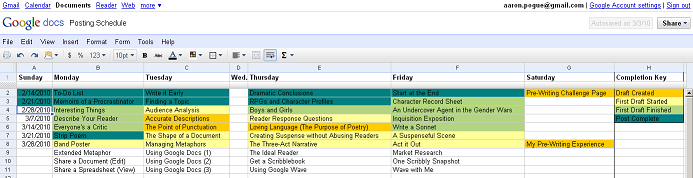
I managed it, too. My wife took the kids to Kansas, for a big baby shower with her family, and left me home to get some work done. I made the most of my time alone, and by the end of the day Sunday I had two full weeks of dark green. It meant I had to skip goofing off with my best friend on Saturday afternoon — he did come over, but ended up spending a couple hours over on the other couch reading, while I tapped away on my laptop.

It also meant putting off video games and stupid movies on Sunday, spending my time instead crawling around Flickr looking for suitable illustrations. I got my feedback from Dad, though, and finished out Tuesday’s post. I figured out how to introduce Thursday’s, and how to finish off my “Reader Response Questions” post.

I went through all those articles one by one, filling them out up to my word count, and then flagging them as light green (finished first draft) over on my spreadsheet. Then I went back through them again, adding metadata, picking excerpts for my newsletter, assigning categories and tags, rereading in the preview window and fixing all my little typos. Then, one by one, I got to change them to dark green, and with each one done, I felt better about myself.

Then a funny thing happened. Last night, I was sitting on the couch with my wife, watching Glee with the laptop closed, watching Lost with my full attention, and then suddenly it hit me. I groaned aloud, and when my wife asked what was up, I said, “I’ve got a blog post due tomorrow, and I haven’t reviewed it yet.” It was already late, but the post was scheduled to publish before I was scheduled to wake up, so it was something I had to do.

Two weeks ago, I would have been saying, “I haven’t written it yet.” So already I was in better shape. It was still an awful feeling, knowing I was late, knowing I had to scramble to do something I should have given real time to.

So I pulled out my laptop while she went to bed. I opened up WordPress, clicked through to the next day’s post, and immediately recognized the photo I’d added on Sunday. I started scrolling through the text, but it was quite familiar. Courtney had reviewed it last Thursday, and I’d read it aloud to my wife Sunday night. It was done. I think I caught a typo, maybe fixed an agreement error, but it was done. Instead of staying up late to review my post, I clicked over to Twitter and posted a proud announcement.

Really excited about tomorrow’s post. I wrote it last week for the #Prewriting challenge, and just reviewed it. Awesome stuff.

Then I shut down for the night, and went to bed. I did get more writing done yesterday, too — another first draft finished, and another post started today, and that leaves me with not a single orange cell on the page. That’s a good place to be. It’ll only get better, too.
Posting Schedule 2

Week 3

A lot happened in week 3. I sped forward on the challenge. I finished off all the posts that would be published during the challenge, so for the first time I got to start engaging the ones I’d committed to as my goal.

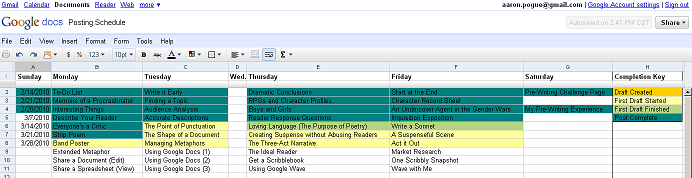
On the chart I’ve shared, the goal posts are the ones to the right of the dates 3/21 and 3/28. In the image above (from the end of week 2), you can see that all but one of those is yellow. I’ll add my chart for week 3 below, but I’m prepared to give a little bit of a spoiler here: that’s changed.

In fact, during week 3, I completed half of my challenge posts. I tied the ribbon on two of my four articles, and two of my four exercises. They’re good, too. I could feel that when I was finally typing them up, because these were articles I’d come up nearly a month ago, titles I’d been glancing at every hour or so for week, so even though I was busy working on the earlier posts, these eight had been very much on my mind. When I finally sat down to write them, they just flowed.

It was magnificent.

It also forced me to confront one of the issues that was brought up back in those long-ago comment threads when the Pre-Writing Challenge was first born: I hate having to wait. Several commenters said as much. When I’ve got something good, something finished, something I’d like to share with my readers, I hate having to wait for it.

It’s good for me. Everything about this challenge has been a positive experience, and I know for a fact that my blog is healthier because of it. It’s still agony, though. The worst was week 3’s Thursday post, “Reader Response Questions,” which ended up being just a love letter to my adorable wife.

I wrote that three weeks ago! I wanted it to be a surprise, though, for our anniversary. So I kept it my little secret, and I waited, but every time I popped into WordPress to check up on my pending posts, I’d skim that one and just shake with nervous excitement. I wanted to see it up. I wanted to see Trish’s reaction!

There was also some nervousness there — how would my readers respond? — but that turned out pretty unfounded. It proved to be a popular post.

I did supplant one of my original challenge articles (and the writing exercise that went with it), pushing those two back to the end of April. Why? Because right at the end of week 2, Carlos introduced me to this awesome blog, a perfect resource for my readers, and I just had to share it with them.

I couldn’t wait two or three or four weeks to trickle through my current plans! I had to share it right away. I’ve got a schedule, though, and I stuck to it. It’s a creative writing article, which means it has to go up on Thursday. This Thursday was already taken with the anniversary post, so I slotted the new one in for next week (Thursday of week 4), and bumped everything else to make that happen.

It’s going to be a good one. Watch for it!

Anyway, as I stick to the challenge, as I cultivate and groom my posting schedule and casually pluck the ripest-looking post from the list whenever I find myself with some writing time…it’s getting better and better. Every day it gets easier.

There was a time when this challenge seemed impossible, but as I’ve done it, as I’ve made room in my life for the work that needed doing it has become, instead of an obligation, a liberation. The forethought, the planning, the extra effort all combine to create efficiency and effectiveness and elegance out of what would otherwise have been frantic and sloppy.

That takes me back to some of my earliest writing advice, Building with Words. It’s all about deliberate structure, and making something that can stand strong. Week 3 sees me within four posts of completing the challenge, and those should be easy ones all. Check back next week to see how they go.
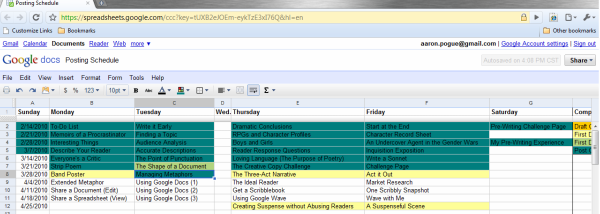
Posting Schedule 3

Week 4

By week 4, I only had four new posts to write. I hit my writing exercises first, and knocked them right out. Maybe half an hour total to get both done. Then I got one article done over the weekend (scribbled in a scribblebook), and the other one cleaned up Wednesday afternoon.

I hit Publish on that one, then dove right back into my list of Posts to see what else I needed to do…and it took me a while to realize I was finished. I clicked over to my Posting Schedule, updated the post I’d just finished, and then everything was dark green, top to bottom.
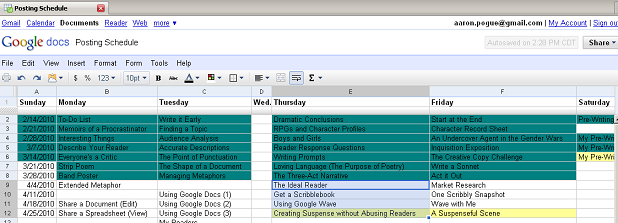
Posting Schedule 4

I posted a jubilant Tweet and sent a notification off to Carlos. Then I closed my web browser, and moved my attention on to another project.

Over the weekend, I wrote up a brief update for Carlos, and then did a complete rewrite of this post so Carlos could include it on his blog as a guest post. Consequently, that rewrite (much trimmed down, and more to the point) has gained the official title (and link) “My Experience with the Conscious Me Pre-Writing Challenge.” To facilitate that, this one is now “Weekly Updates.” I hope that doesn’t mess up anybody’s links.

Thanks for all your comments, and your support throughout the experience. It’s been an incredibly good one, and you can find my final thoughts by clicking on that link above. Now that my blog is rolling smoothly along, I’m looking forward to some big new projects, including the upcoming Blog Maintenance Challenge (by Dave Doolin), and even putting together an e-Book Challenge of my own. I’ll keep you posted as that comes around.

The Creative Copy Challenge (Creative Writing Exercise)

The lovely Kelley, writing at a coffee shop

Creative Writing Exercise

Today’s exercise barely deserves a blog post at all, since I already spilled the beans in yesterday’s article.

Still, in case you didn’t make it to the end, I’ll say it again: Go over to the Creative Copy Challenge blog, and write a short story. Use all the words, format them so we can find them, and then come back here and post a link to your comment (once it gets approved by the moderators).

Here’s some pointers, from an old pro at CCC (me):

  • Double-space between paragraphs (hit Enter twice). Even though it shows space between paragraphs in the comment box, those don’t show up once the comment is posted.
  • They do intend to collect these submissions (or the best of them, anyway) into e-Books for sale on their site. If that offends your artistic integrity, post your story on your own blog,  instead of in their comments. Either way, to get the most out of the writing prompt you should be doing disposable fiction anyway.
  • I recommend picking the word or phrase that looks most awkward to you, and starting with that (instead of trying to shoehorn it in later). That’s how I’ve done all of mine.
  • If you want to get all the words down in the smallest space possible (which is what most of the challengers do), don’t worry too much about making it sound natural.
  • If you want to make it feel natural, give yourself 2-3 paragraphs per word. You won’t always need them, but it makes it easier to pretend you will.

And, since I’ve barely touched my word count for today, I’ll include my very first submission as an example (and just to show off). When you’ve got yours done, copy it here, or just link us to your comment. We’ll all swing by and show our support.

The Visitor

The kitchen stank of burned butternut and soy sauce. She had the fire out, now, but smoke still hung all over the place. Karen turned her back on the stove, a self-critical smile playing on her lips, and shook her head. She waved a hand in front of her face, but it didn’t do much good. She sighed.

Then, to her surprise, the front door opened. Karen caught a flash of her daughter’s red hair, way across the kitchen, as she came in. Skipping classes, maybe, or just released early. Karen was in no mood to chastise right now, though. She stepped through the doorway into the laundry room and cupboard, to find an old towel to clean up the mess she’d made putting out the fire, and called over her shoulder, “Hi Amy. Sorry about the smoke. What are you doing home?”

One word stopped her in her tracks, halfway through the door. “Mom.” She heard the quaver in her daughter’s voice, not three paces away, and she felt the weight of it in that one syllable. Her breath caught, and she turned slowly, like a hunter afraid of spooking his prey.

Her daughter was there, just inside the kitchen, and behind her stood a young man, tall and slick, with a fanatic look in his eyes and a possessive hand on Amy’s shoulder. She could see the skin pale white where his fingertips dug into the girl’s collarbone, and Karen knew something was very, very wrong.

“What’s going on?” she asked softly.

The young man shook his head. “Nothing you need to worry about, Mom.” She flinched at the familiarity in the name, paired with his menacing tone. It was cold, distant…barely human. His eyes were alive, though, thick with malice. “Amy and I have got some stuff to sort out. That’s all.” His nostrils flared in irritation. “She didn’t think you’d be home.”

“I’m sorry, Mom,” Amy said quietly, but fell silent when his grip on her shoulder tightened. She took a deep breath, and with her eyes locked on the floor, she said, “Please, Mom. Just go shopping or something. We need to talk.”

Karen barked a sarcastic laugh, then immediately regretted it when Amy flinched again. “I’m not going anywhere!” she said. “What’s going on here?”
Amy met her eyes, then, and Karen could see her daughter’s tears. Amy whispered softly, “Please….”

The young man tried to help. “Everything’s fine, Miss Kane.” His lips pinched together in what must have been a smile. “We just need to talk. Give us some time, would ya?” He stepped closer, propelling Amy ahead of him, so that he could loom over Karen, too.

He snatched up her car keys from beside the stove, and pressed them into Karen’s left hand, dropped his voice to a whisper. “Go grab some air. By the time you get back, we’ll have everything sorted out.  I promise.”

The teeth of the keys dug into her palm, and the stench of his breath burned more strongly in her nose than the smoke still in the air. Her heart raced, but she kept her face calm. He was dangerous, she could tell that much, and she couldn’t let him hurt her daughter.

She had survived worse than this. The pinprick sting of a honeybee had sent her to the hospital at eight, allergies nearly killing her, but she’d come through. She’d fallen through the ice skating on her uncle’s pond at twelve, and when they finally dragged her out she’d spent four and a half minutes still as a stone, breathless, lifeless. She’d come back, though. She’d survived pneumonia, two car accidents, and childbearing for goodness sake! After that, she’d felt damn near invincible.

But this…this was different. It wasn’t physical pain. It wasn’t fear for her own safety. It was little Amy. Her daughter, her princess, her cupcake.

She felt the muscles in her jaw tense, felt her eyes go cold, but the thug wasn’t paying her a bit of attention. She was still standing half in the laundry room, half in the kitchen, and out of his sight she raised her right hand to the countertop in the cupboard, and silently closed her fingers on the rubber grip of a claw hammer resting there.

She took a breath, and turned to face him.

Photo credit Julie V. Photography.

Writing Prompts

The Creative Copy Challenge Main Page

The Creative Copy Challenge Main Page

You might have heard this story before, but when I was in fifth grade my teacher gave us an assignment to write a one-page story using at least half of our spelling words for the week. To give us a starting point, he suspended a recorder (the musical instrument) from the ceiling by a string, and told us to write about that.

I wrote eight pages, and used every word in the list. I invented a detective agency in Los Angeles, Washington, and a gruff ex-cop dedicated to tracking down the city’s darker elements. He put an end to the terrifying reign of The Flute, a walking, talking, psychopathic flute (I wasn’t familiar enough with my woodwinds to know I’d gotten it wrong). My hero saved a lovely dame in the process, and made a name for himself that would lead to a whole series of absurd detective stories. Oh, and as a shocking message to the city’s criminal underworld, the mayor ordered the slain flute be strung up by its neck from a streetlight in the city center.

That story got me a parent/teacher conference and a trip to the school counselor. It also revealed to me, with a sudden and terrible conviction, that I was supposed to be a writer.

The Creative Copy Challenge

That was a turning point in my life, and it’s an incredibly special memory to me. I was reminded of it again last week when Carlos shared the link to a new blog he’d stumbled across, the Creative Copy Challenge. From their About page:

What is this site?

The coolness of this site is its simplicity.

We create blog posts that contain 10 random words or phrases.

In the comment section, you create and submit a cohesive, creative short story tying all the words together.

Why do this?

It’s our goal to offer the creative community a simple, quick way to crush writer’s block and unleash their creative muses. We believe this site provides just that.

Give it a try, but be warned; once you start, it’s hard to stop it’s so addictive. Besides, are you going to let 10 little random words stump you? Will you just take a peek and leave without “proving” how creative you are by commenting? We hope not.

That’s what we call a “writing prompt.” Writer’s Digest offers regular writing prompts, and most creative writing courses are built at least partially around them. The goal is to get you out of your languishing manuscript and just get you writing. They usually do that by creating a scene you haven’t thought about before, forcing you to start fresh, make something happen, and then get on with your work.

Getting the Most out of Writing Prompts

As you’ve probably noticed, that’s a big part of what I do with my writing exercises. It’s not my goal to have 100% participation every week, but just to have something out there that can get you moving, on that day when you realize you’ve been spinning your wheels and getting nowhere.

That’s the boring, everyday purpose of writing prompts. The wonderful side effect, of course, is that from time to time you stumble onto something amazing. I had to do something similar to the Creative Copy Challenge at an Honors Group lunch back in college, when a visiting speaker instructed everyone to write a poem titled “Autobiography of My Life with Jesus,” and throw in some key phrases. Mine ended up one of the best poems I’ve ever written. Now the stories I’ve been writing for CCC have me wanting to start a new mainstream thriller, and those silly little stories I wrote back in fifth grade launched me down this path in the first place.

So take them seriously. Make writing prompts a part of your life. As I said, I’m not expecting you to do every single writing exercise I post, but I do strongly encourage you to get in the habit of picking up the gauntlet whenever you stumble across a writing prompt that might have something to offer. Maybe you follow the rules to the letter. Maybe you don’t. Maybe you repurpose the exercise to create something you wanted to do anyway (like a blog post or a contest submission), or maybe you just scratch something down, get in and get out and get on with your life.

However you use your writing prompts…use them. And definitely check out the Creative Copy Challenge. It’s fun, and they’ve got an awesome little community going. Click through, say hi, and post something. Then come back here tomorrow and post a link in the comments, because that’s definitely going to be the writing exercise for this week!

What I Learned about Writing this Week…from Stephen King

Courtney Cantrell's weekly writing advice.

Courtney Cantrell's weekly writing advice.

To writers and/or Stephen King fans, his book On Writing: A Memoir of the Craft (a title I do hope is self-explanatory) might seem the most obvious source of WILAWriTWe material. Yet nay, my dearest inklings, my King-related thoughts for today come not from his how-to, but rather from one of his how-dids. Or maybe I should call it a how-didn’t. By the time I finish writing this, I might have a clearer picture, and so might you–but I’m still not going to change my previous sentence, because I like it, and this is my article, and I don’t have to kill my darlings if I don’t wanna. Nyah.

*ahem* < /digression >

A Trunk Novel — And No, We’re not Discussing Trees

In his foreword to Richard Bachman’s Blaze, King reveals that the book is a “trunk novel,” a (completed?) manuscript that languished for years (approximately thirty, to be inexact) in a metaphorical trunk that was, in reality, a cardboard box. Trimming the fat: As Bachman, King penned Blaze, didn’t like it, stuck it in a box, and left it there for three decades. I won’t rehash his whole foreword, so go read it if you want the specifics of how he ended up finding the single copy again and publishing it. My point is that King rediscovered an old work, found it to have merit, and decided to do something with it.

Skeletons in the Closet?

If you’re a writer, and if you’ve been doing your writing thing for at least a few years, chances are you are in possession of a trunk novel. Or a trunk short story or five. Or a bunch of trunk poems. (I keep mine in a bright red binder labeled “Courtney’s Poetry” in shimmery blue letters with stars. It makes them seem less trunkish.) Whatever your writing forte, you are likely secreting a stash of material you never show to anybody because it’s just too _____________________. Yeah, you know the adjectives that fill in the blank. You’ve repeated them to yourself a hundred times over, and you’ve used them to convince yourself that those particular storiespoemsnovels aren’t worth your efforttimebother. Those scribblings are the creativity skeletons of your dark and fecund writing closet, and you’re never going to show them to anybody, because you know one-hundred percent for gobsmacking certain that if you let anybody catch even a glimpse of the first line, pointing and laughter shall ensue, and you shall never ever recover, ad infinitum period.

But.

You know what a skeleton is?

It’s a framework. And you can grow meat on it.

He Led Me around among the Bones

You just read the heading above this paragraph. That heading is a quote from the Old Testament of the Christian Bible. Ezekiel 37:2, to be exact (this time). When I talk about putting literary meat on the bones of your trunk skeleton, I picture a God-breathed miracle of Old Testament magnitude. Writer, you shall prophesy to these bones, and they’re gonna grow muscles and flesh and skin, and they’re gonna walk around, can I get an Amen? Testify!

King wrote Blaze, disliked it heartily, and put it away for thirty years. But when he picked it up again, having learned more about his craft, his audience, his fellow humans, and (most importantly?) himself, he realized that this story had potential. But he didn’t just take what was there, make a few editorial marks, and then try to shop it to his agent and editor. No, he stripped it down to its marrow and re-grew it from there. By that, I mean he re-wrote it. And when that Indefinable Something Which Gives Life put breath into Blaze, the story didn’t just rattle and hum and clatter about. It arose and walked and, at least for Yours Truly, started telling a tale to make the mind ponder and the heart ache. King’s story went from dusty, dry, forgotten bones to breathing, walking, vibrant life. And, my precious inklings, the skeletons in your writer’s trunk can do that, too.

And the Breath Came into Them

You’re thinking of a story right now. You’re thinking of one of those skeletons. You haven’t looked at it in a long time; maybe it’s been years since you read a word of it. But you’ve thought of it before now. It returns to you at odd times, when you’re least expecting it. It calls to you from the darkness in which you have hidden it. You consider it to be ______________–fill in with one of those adjectives you use to convince yourself you should never reveal these bones to a living soul–and yet, the death-dry voice of this story just won’t leave you alone. Writer, you know there’s something to that story. You know there’s a minuscule spark flickering in those trunk-dark depths. You can feel it. And you know what? I can tell you this for sure: Until you take that story out and give it a chance, it’s never going to leave you alone.

So take it out. Rummage around in your hoard of forgotten treasures, find the key to your writer’s trunk (or blue-lettered, red folder), unlock the lid, fling it open, and LET THAT STORY OUT FOR PETE’S SAKE! Read it! Mark it up! Re-write it! Strip it down to the marrow in which that spark of life resides, and then build it up again until it is the vibrant, breathing, living creature it was meant to be in the first place. Put muscles on those bones. Grow the skin over the flesh. Breathe life into the lungs until that work of written art stands on its feet and is ready to march out and conquer the hearts of the reading world. You can do this because it is what you are made to do.

The skeleton in your writer’s trunk is waiting for you. Make it stop haunting you. Give it the breath of life, and let it go out and live.

And that’s WILAWriTWe.

(Click on a link, buy something from Amazon, and provide me with a few pennies that I might purchase more books and learn from them and impart to you more of my ponderings!)

Photo credit Courtney Cantrell.

The Point of Punctuation

Behold, the mighty interrobang!

Behold, the mighty interrobang!

One of my best friends is a Physician’s Assistant and, as it happens, my main caregiver. Last winter sometime she opened up a chat session with me over GMail and asked how I was doing. I said, “I’m sick. Something nasty.”

She said, “Oh yeah? Us too!” She and her husband had been ailing with something for a couple days, and she’d just figured out what it was.

She told me all about it, dwelling on the symptoms for some time which were fairly harmless but pretty dramatic in their presentation. After hearing all about it, I shuddered and said, “Yeah, I definitely don’t have that.”

Problem was, she missed the “don’t,” and with good reason. I’ve got a touch of hypochondria, after all, so it was reasonable enough for her to think I’d instantly self-diagnosed. She laughed at me. She passed the joke on to her husband, even, before I had a chance to correct her misunderstanding. Then that story became the joke, where my reputation for pessimism was so powerful it overwhelmed the words I’d spoken.

My own caregiver was ready to laugh at my concern! That’s a problem, and it was one of my own making. A healthy dose of caution is a good thing, but if you overdo it too often, it becomes counterproductive.  Like so many things in life, the key is discretion, moderation.

Exclamation Marks

It’s the same way in writing, of course. I’ve talked about finding balance in descriptive detail before, just as an example, but there’s certainly many more ways it’s true: balancing exposition against narrative, technical accuracy against brevity, clear prose against a finished draft. Those are pretty big-picture concerns, but it gets down to the fine details, too. Word length, sentence composition, punctuation marks….

There’s a novel by Terry Pratchett, Masquerade, which is a humorous retelling of The Phantom of the Opera. Late in the story, the theater owners receive a message from the phantom saying….

Ahahahahaha! Ahahahaha! Aahahaha!

BEWARE!!!!!


Yrs sincerely,

The Opera Ghost

The inspector considers the note, and says solemnly:

What sort of person sits down and writes a maniacal laugh? And all those exclamation marks, you notice? Five? A sure sign of someone who wears his underpants on his head.

There’s a good lesson there. Don’t ever stack exclamation marks, unless you’re doing it as a joke. Multiple marks don’t really increase the effect of the first one — they do the opposite, in fact. Even if they’re not stacked, even if they’re spread through the document, the more times you use exclamation marks, the less seriously your reader is going to take them.

That’s such an important concept that, in technical writing, they teach us to barely use exclamation marks at all. It’s not because our material is dry and boring (believe it or not, some tech writing is about fascinating things). No. We avoid using exclamation marks in body text so that they’ll stand out when we use them in Warnings.

The Warning is an important tool for technical writers. We use Cautions to talk about actions that might cause damage to equipment, maybe some inconvenience to the user or even loss of property, but Warnings are special. Warnings are for things that can cause injury or death.

That’s a big deal. We might use bold formatting and inset margins to make it stand out, sometimes even colored font, but one of the most effective tools to make it matter to readers is the exclamation mark.

Or, more accurately, the rare exclamation mark. Exclamation marks can change the meaning of a sentence, but only if they’re used right. Only if they’re an occasional deviation from the usual, boring ol’ period.

Alchemy Again

That change is the part that matters. That’s the whole point of punctuation — to transform words into meaning. Capitalization, sentence marks, unit indicators, question marks, spaces for goodness’ sake, appositive commas, conjunctive commas, and the glorious, invaluable, hardworking serial comma all work together to turn a block of text into a stream of meaning.

Consider the following characters:

itsnotmagicitssciencereadingistheprocessthattransformscharactersintothoughtbutproperpunctuationisacatalyst

Spaces help. Spaces between words are punctuation (and punctuation you don’t get in several older languages, as I learned about five minutes before I dropped out of Latin). As soon as I break that text up into words, you can read it.

its not magic its science reading is the process that transforms characters into thought but proper punctuation is a catalyst

Or, I should say, you can read it quickly. With context or patience, you could figure out that first block of characters on your own, converting letters into words, but the spaces speed up that transformation.

That’s what punctuation does for you, and you can see it even more in a properly punctuated sentence. Spaces make words, but it’s the marks that make clauses, sentences, paragraphs.

It’s not magic, it’s science. Reading is the process that transforms characters into thought, but proper punctuation is a catalyst.

The point of technical writing is to perform that alchemy — to invest your time, once, to write it well, so that the same material can be read again and again (countless times, by countless readers), and easily understood. Proper punctuation effectively and dramatically helps you achieve that end.

So use it. Learn your tools, and put them to work for you. Learn the rules of apostrophes and commas, learn the standards of capitalization and abbreviation, and learn to get the most out of the words you put on paper. It’ll make sure you’re understood, make sure your hard work is effective, and might even save you getting laughed at.

Everyone’s a Critic (Technical Writing Exercise)

Business Writing Exercise

Business Writing Exercise

I’ve talked before about finding topics to write about, and mentioned then that a great source of blog posts is other blog posts, or specifically other items on the internet. Link to a page, give some context and some personal value, and you’ve got a legitimate article of your own. Then last week we talked about accurate descriptions, and if you squint a little, you can see an overlap between those two that makes for excellent posting material.

That’s your assignment this week: squint a little. Actually, no, your assignment this week is to provide me detailed feedback and practice borrowing others’ inspiration, all at one go. I want you to pick an article on UnstressedSyllables.com and critique it on your blog. Write 300-900 words analyzing the presentation, the content, the readability, the skimmability, the applicability, even the statistical distribution of non-E vowels. Go back to my advice in “What Should You Write About?” and figure out what you should write about, when you’re describing my blog.

Because, ultimately, that’s what a good critique is: an accurate description of something you’ve read. Pick an article, that I’ve written (with my background, and my purposes, and to my imagined audience), and then describe that article as it strikes you (with your background, and your purposes, and to your audience). You don’t have to be nice, but you should be specific. Say something useful.

Then link it here. Don’t be shy. I’ve spoken again and again about the value of good feedback, and this week’s exercise is absolutely a sneaky trick on my part to get some free feedback. Put a link to your blog post in the comments, and you’ll be making Unstressed Syllables better, even as you’re adding a free post to your blog. Everyone wins.

Inquisition Exposition (Creative Writing Exercise)

There used to be a funny show called Whose Line is it Anyway? It was originally a British performance comedy, and then they brought it to the U. S. in a gameshow format with Drew Carey as the host. The whole show was improv, with a random mix of games to challenge the performers.

This week’s article was on Reader Response Questions, but we’ve already done a weekly writing exercise on those, so I thought we should take a page out of Drew Carey’s book and try to make something entertaining. We’re going to do our best to participate in a game they played called “Questions.”

For your exercise, I want you to write a scene that’s all dialogue. The gameshow featured two characters, but you can put as many as you want in the scene. They’re only allowed to ask questions, though. That’s the gimmick. You’ve got to convey information (and do your best to make it feel natural) with nothing but questions.

We’re not professional improvists (unless Cindy drops by, anyway), so I’ll cut you a break. You’re allowed one sentence of attribution per question. So you could say something like this:

“What is that? A gun?” Paul asked, edging toward the door.

“Are you surprised?” Dino said, with an angry chuckle. “Where do you think you’re going, anyway?” He waved the gun as he said it, and Paul froze in place.

That last sentence is bordering on too much, but I’m being generous. Still, take it as a challenge, and see just how much you can say, without saying anything directly. It’s excellent practice on several facets of your storytelling, and it should be a fun game at the same time.

Reader Response Questions

My ideal reader (photo by Julie Velez of Phoxie Photo)

My ideal reader

Today’s post is more a story than a lecture, but it’s a story rich with writing advice. It harkens back to a creative writing exercise from January, and foreshadows a worthwhile topic for future discussion. It’s also a pretty sweet story, when it comes right down to it.

Anyway, one of the phrases you’ll learn in any serious creative writing class is “the ideal reader.” Or, more accurately, “your ideal reader.” As I said, I’ll need to dedicate a whole blog post eventually to what exactly that is, but in brief, it’s a phrase that refers to the perfect audience for whatever it is you are writing. If you’re writing high fantasy, it’s a reader who loves high fantasy. If you’re writing near-future science-fiction cop drama romances, it’s a reader who craves just one more page of near-future science-fiction cop drama romance.

It’s more than just genre readers, though. If you’re writing for women, your ideal reader is a woman. If you’re writing for young adults, your ideal reader is aged 18-25 (or however they classify young adults these days). If you’re writing a philosophical allegory rich with literary allusion, your ideal reader probably has a college degree. The ideal reader is an intensely focused, deeply personal thing and, like so many ideals, is entirely imaginary. It’s an incredibly useful device, but it’s not an actual person. Still, when I was taking all those college courses I got in the habit of talking about “my ideal reader,” and that got me in a little bit of trouble.

Why? Because my wife has never taken any serious creative writing class. Back when we were still newly married and I’d start talking about my “ideal reader” (who clearly wasn’t her), that bugged her. In those days I was writing mid-grade high fantasy targeted at adolescent males, so she really wasn’t my ideal reader, but I’d never taken the time to explain the concept to her.

Reader Response Questions

She didn’t really let me know she was bothered, either. Instead, she fixed the problem on her own. She decided she would become my ideal reader. Without saying a word about it to me, she committed to reading everything I wrote — blog posts, story snippets, first drafts of truly atrocious novels, she read it all. Not only that, she wanted to give me good feedback. She picked up, along the way, that the whole point of an ideal reader was to provide direction, and she wanted to be able to do that.

So several years ago, when I finished my second novel, she asked to read the rough draft. I printed it out for her, and the very next morning she got out a stack of Post-It notes and set to reviewing it. A chapter or two in, she called me up at work and asked, “Okay, what do you want to know?”

“I’d just like your honest feedback,” I said. “Tell me what you think.”

“But what specifically? Do you have any questions? What are you worried about? What are you trying to do? Give me a list of questions, and I’ll answer them.”

If you’re reading my blog, you’ve got an idea what that list ended up looking like. If you’re guessing it was  pages long, and detailed, you’re right. After all, I obsess about this stuff all the time. I started it off with a disclaimer, though. I said, “There are just some topics for discussion, some issues. I certainly don’t expect you to answer them all, I just wanted to give you an idea of a direction.” A little while later I got an email back saying she’d gotten my list, and politely thanking me for it.

My Ideal Reader

It took her about a week to read through the novel, making copious notes. Every day I’d come home to find the binder sitting out on the end of a couch, or lying open on the kitchen counter, new Post-Its decorating the edges. Every night she’d take the binder to bed with her, marking up more pages before she fell asleep. I noticed the little plastic pocket on the back of the binder had a print-out in it, too — my questionnaire, several pages stapled in the top corner, and every now and then she’d pull that out and glance back through my questions, before diving back into the book.

She finished the book during the day on a Thursday, and called me up at work. “I’m done,” she said.

I asked the first question I always ask, fear in my heart. “Did you like it?”

“Yeah,” she said. I started to ask more, but she cut me off. “I’ve got us a babysitter for tomorrow night. I thought maybe we could go out to dinner, and talk all about it. You can ask me any questions you’ve got, and I’ll answer as best I can.”

I grinned at the thought of it, and told her, “It’s a date.”

The next night, I took her to my favorite steak place, and she brought along the binder. We went inside, got our table and ordered our drinks, and then she pulled the binder out on the table and flipped it open. There was something new inside the front pocket, too — a little lined notepad. She pulled that out, and I saw on the first line she’d written out my first question.

The book is divided roughly into three sections: Jason’s childhood, Jason’s adolescence in the City, and Jason as king. Of these three sections, which one was your favorite? Which one was your least favorite? Why?

All of that in her pretty handwriting, in black pen — and beneath it in blue, her answer. Half a page of answer. I’ve taken Lit. Class essay tests that were less work than my questionnaire, and I certainly hadn’t expected her to answer every question. But she did, on page after page of that little notepad, and as soon as she started into her first answer, I fell in love with her all over again.

We’ve been married for eleven years this Saturday, and I couldn’t hope for anyone better. She’s an adorable woman, an admirable mother, an excellent wife, and more and more, every day, my ideal reader. As your writing coach, I advise you to get one, too. Find somebody willing to tolerate your questions, someone interested in the vast array of things you have to say, and how you say them. Someone willing to contribute quietly, to encourage patiently, and comment thoughtfully.

It’ll take some time, and probably some training, but it’s wonderful. Find somebody. Stay away from Trish, though! She’s taken.

Photo credit Julie V. Photography.

What I Learned about Writing this Week…from Sue Monk Kidd

Courtney Cantrell's weekly writing advice.

Courtney Cantrell's weekly writing advice.

This week, my dearest inklings, I find myself seventy-four pages into Sue Monk Kidd’s The Secret Life of Bees and enjoying it beyond words. But since the point of this article is to share with you–in words, no less–what I am learning from what I am reading, I give you here my attempt to coalesce my swirling and delighted impressions into something not only legible but also helpful to you.

More Than Academia

I don’t want to tell you too much about the story, because this novel is getting a high READ THIS! recommendation from me, and I want you to read it for yourselves. If you pick up a copy at the bookstore, the blurb on the back describes a tale set in a predominantly racist South Carolina of 1964. The protagonists are fourteen-year-old Lily, who is white, and housekeeper Rosaleen, who is black. Together, they’re on the run from the prejudiced law and on the hunt for the secret behind the death of Lily’s mother.

The depth and breadth of racism depicted in this novel boggle my mind; but I don’t wish to digress into a diatribe about politics and history. Instead, I am thinking about words that conjure images in the reader’s mind. I am thinking about phrases that kindle feelings in the reader’s heart. I am thinking about lyrical language that transports the reader into a realm at the furthest remove from the mundane. There are ways of saying things, and then there are ways of saying things. Kidd’s writing reminds me of the latter. Her prose is neither flowery nor frilly–but it is full. She uses fresh verbs instead of clichés. She doesn’t name the feelings of her characters; she communicates emotions through sensory images. The metaphor and the simile are her close companions, but she allows the reader to know them gradually.

Put In Some Poetry

Most of us have heard the writing advice: simplify, simplify, simplify. Sound advice, to be sure…but so easy to misapply. When I try to simplify my own writing, I must guard against slipping into simplistic, lest my prose degenerate into SVO, SVO, SVO, ad infinitum. Kidd reminds me that I can craft something beautiful without compressing it into spare and dull. I can also adorn my writing with poetic language that doesn’t turn my prose into something so ornate it’s vulgar. Have I stumbled upon a paradox here, one that is true because of its self-contradictory nature? Perhaps. At the very least, I’m coming closer to making sense out of the vivid concoction of word and color which Kidd’s novel is stirring in my mind.

What I am certain of is this: Kidd hems her prose with poetry, and her appliqué is never too flashy for simple company. Here are a few examples from The Secret Life of Bees that illustrate what I mean:

The main character, Lily, does not tell the reader that she feels reverent. Instead, she says, “Silence…hovered over my head, beauty multiplying in the air, the trees so transparent I felt I could see through to something pure inside them.”

A woman’s face is “corrugated with a thousand caramel wrinkles.”

This is one of my favorite phrases so far: “a torture chamber of food staples.”

Lily isn’t simply bored. Boredom “poisons” her.

The sky “puckers” with light.

To describe anger, Kidd writes, “…the air turned raw and full of welts.”

I could provide you with samples from each of the seventy-four pages I have read so far–but I would be robbing you of the pleasure of your own literary discoveries, as well as edging into the dangerous territory of copyright infringement. So, Gentle Readers, my recommendation stands. Get your hands on copies of The Secret Life of Bees and see if the poetry in Kidd’s prose inspires you to simplify yet beautify your own writing. I know it’s making my fingers itch to start editing a certain first draft I recently finished… (What? Is that a Work-In-Progress Update I see?)

And that’s WILAWritWe!

(Help fund the college tuition of my future children! Click a link above and buy something from Amazon!)

Photo credit Courtney Cantrell.