Skip to content

Market Research (Creative Writing Exercise)

The lovely Kelley, writing at a coffee shop

Creative Writing Exercise

Last week, in my article about writing a good synopsis for your story, I talked about my Technical Writing semester project that involved sixteen full weeks of research and documentation concerning the target market for my first novel. That’s a little bit overboard.

Still, I talked yesterday about the incredible benefits of writing directly to an ideal reader, and I’ve talked again and again about the importance of audience analysis for a writer. When it comes right down to it, your story — no matter how good it is — has to have a market if it’s going to thrive.

The good news is that it probably does have a market. There’s an awful lot of readers out there — more now than ever — and with the impending collapse of the New York Publishing Houses as gatekeepers, people are getting better and better at finding the books that appeal to their individual tastes. The bad news is that, unless you’ve written a very genre piece in a genre you know really well, or actively worked to target a particular market, you probably haven’t completely written your story to please the market that’s craving it.

Weird, I know. It’s a problem I’m facing with the Ghost Targets series, and several of the writers I coach are going to run into it sooner or later. They’ve all written really neat stories with either vague categorization, or in a category they don’t really read. That’s exciting — it’s always good to stretch outside your comfort zones — but it’s also extra work. To make a story grow into anything other than a draft manuscript, you’ve got to shape it to its audience.

So that’s your job this week. Talk to me about your work-in-progress (I know you want to), but tell me specifically about the kind of readers who are going to love it. Tell me which buttons it pushes, which old themes it borrows heavily, which popular books it resembles, and how it compares against them. If you don’t know the answers to all those questions, look them up. If you can’t come up with sufficient answers, even after you research the markets you think it matches, maybe you’ve got another rewrite in store.

Don’t despair. That’s a good thing. It’s easy to rewrite and rewrite and rewrite out of perfectionism, or just nervous energy, hoping someday it will be “good enough.” That’s exhausting. Rewriting to achieve a specific, measurable purpose (with a clear and well-researched plan) is a much more rewarding process. Your ideal reader will thank you for it.

Photo credit Julie V. Photography.

The Ideal Reader

Google Docs: The final cure for people reading over your shoulder.

Google Docs: The final cure for people reading over your shoulder.

I’ve talked a bit about writing novels in Google Docs now, and mentioned it often enough that you must know I’m completely smitten. I’ve been using it to write my novels for the last two years. I started doing that entirely for portability, because (as I said Tuesday) I work on lots of different computers.

I didn’t fall in love with it, though, until I started sharing my documents with readers. There’s a special magic in watching someone read something you’ve written, and Google Docs allowed me to do that without creeping them out, or pestering them with questions (or, just as bad, answers).

I got so addicted to the feeling that I started sharing out works-in-progress with some of my best test readers. There were times when I’d find myself working on a book, adding paragraphs as quickly as I could, and moments after I had one finished I’d already have a comment on it from a reader.

That got worse when I was writing Gods Tomorrow, and my friend Toby was hooked on the plot. As I approached the big climactic scene, three short chapters from the end of the book, I was plugging along and noticed in the top right corner, “Also viewing: Toby.” I smiled to myself, and kept going.

When I took a quick bathroom break, I came back to find an email from him, asking why I’d stopped. We exchanged a couple emails, and he let me know that he was glued to his monitor, refreshing it constantly to find out what happened next. Then he told me to stop wasting time writing emails and get back to the story!

It was exhilarating. I usually tire every couple thousand words and need some sort of break or distraction. Not that day, though! I knew he was hanging on my every word, desperate for resolution, and I could hardly let him down. So I worked for hours, sprinting through my scene list, diving deep in the most exciting part of the book.

At last, my energy waned. I couldn’t possibly keep that up forever. But poor Toby was waiting on the other end. He needed some closure, and I could hardly just leave him hanging. So, half out of mercy and half out of mischief, I started a new paragraph mid-scene.

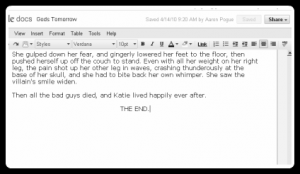
“Then all the bay guys died, and Katie lived happily ever after. THE END.”

I left it there, and got some rest. When I came back to it the next day, I saw that paragraph, chuckled, and replaced it with the rest of the scene (and then, in a fit of productivity, the end of the book). I forgot to let Toby know, though.

Then over the course of the next week, I spotted some small flaws in that ending, so on Thursday or Friday I went back through and cleaned it up a lot, polished it to perfection.

Then over that weekend I was chatting with Toby. The topic of the book came up, and I said off-hand, “Oh, I reworked the ending a lot. It makes a lot more sense now.”

His brows came down, all angry, and he snapped at me, “Well I should hope so!”

Audience Analysis Gone Wild

As long as you’re not abusing your readers like that, there is a special magic in seeing how your writing affects them. That’s because we all want to be good. We want to write the scene that inspires laughter (or tears), to write the pages that just can’t be put down.

The only way to do that is to connect with a reader. That’s why it helps so much to watch them read — not just because you get to enjoy the thrill when you see that connection happen, but also because you get to see when the connection falters, when your reader sets the book aside to tell you about something that happened on their drive over, or when a huge plot twist doesn’t elicit a “Wow!” That’s an opportunity to get better, and it’s often much more valuable than the feedback readers can put into words.

Once you’ve got that feedback, though, you still have to figure out what to do with it. You know what needs to change, but you don’t necessarily know how to improve it. Luckily, those who have gone before have provided an answer. What you need, they teach us, is a tool to convert wrong words into right words, a working model that you can test your story against. It’s super useful, and it’s got a name.

The Ideal Reader.

The Ideal Reader

This isn’t the first time you’ve heard that name. I mentioned it before, only to subvert my lesson by talking about my girlfriend. There was an excellent description of the concept in that post, though.

One of the phrases you’ll learn in any serious creative writing class is “the ideal reader.” Or, more accurately, “your ideal reader.” In brief, it’s a phrase that refers to the perfect audience for whatever it is you are writing. If you’re writing high fantasy, it’s a reader who loves high fantasy. If you’re writing near-future science-fiction cop drama romances, it’s a reader who craves just one more page of near-future science-fiction cop drama romance.

It’s more than just genre readers, though. If you’re writing for women, your ideal reader is a woman. If you’re writing for young adults, your ideal reader is aged 18-25 (or however they classify young adults these days). If you’re writing a philosophical allegory rich with literary allusion, your ideal reader probably has a college degree. The ideal reader is an intensely focused, deeply personal thing and, like so many ideals, is entirely imaginary. It’s an incredibly useful device, but it’s not an actual person.

That last bit is important (even though I muddied the waters a little bit with that last post). The ideal reader isn’t just your best test reader. The ideal reader is a target for you to aim at, again and again, in a constant effort to improve your accuracy.

Targeted Style

The reason you need to improve your accuracy is because the target is tiny. Remember that sense of connection I mentioned earlier? That’s incredibly special precisely because it’s so rare. Most writers can’t make connections like that with most readers. The key here is in that old refrain: You can please some of the people all of the time, or all of the people some of the time.

If you want to be a great writer, you can’t settle for pleasing all of your readers some of the time. Why? Because the moment you stop pleasing them, they’re going to put the book down. If they put it down often enough, eventually they’ll just leave it down. As soon as that happens, you’ve lost the very readers that you weakened your message to please.

Far better to focus on the ones you would have kept — the ones predisposed to like reading the sort of stuff you like writing. Focus on them, zoom in real close, and write the version of your story that your fans would want to read.

The ideal reader exists for that. Figure out who your ideal reader is — figure out what kind of story your most devoted fans will love best — and write that story directly to your imaginary friend. Write it like that’s the only person who’ll ever read it. Use your own voice, open up, and tell the tale you want to tell, as well as you can possibly tell it.

Let’s Get Real

Imagine the effect that will have on your actual readers. Sure, it’ll alienate some of them. Maybe your best friend will roll his eyes at some of the sentimentality, or your grandma will blush at the language. That’s okay, they’re not your demographic. The people you’re talking to, the people who overlap with your Ideal Reader, will absolutely love it.

Why? Because it speaks to them. By focusing on one perfect reader, you open yourself up to create a personal, one-on-one connection with every reader. So the readers who stick around, the ones who like your style, will feel like you’re connecting with them personally, individually. That sort of writing creates loyalty. It creates true fans.

And while you’re doing that, you’re also turning yourself into the kind of writer who deserves fans. By narrowing your audience, by speaking directly and openly, you begin to stand out from the crowd. You’re not just another pretty voice speaking Happy Ever Afters (or a tired cynic repeating boring realities). Now you’re a unique voice — an artistic style.

Now you’re a storyteller.

What I Learned about Writing this Week…from Heroes

Courtney Cantrell's weekly writing advice

Courtney Cantrell's weekly writing advice

Many, many moons ago (approximately eight months, to be inexact), someone informed me I would enjoy the sci-fi TV series Heroes. I suspect most of you will be familiar with it, but just to summarize:

In Heroes, a group of people? segment of humanity? emerging new race? discover that they possess superhuman abilities. Some of them are good guys, some of them are bad guys, and all of them are possessed of quirkiness appealing to my sense of whimsy.  The show follows their impact on each other and on the world at large.  Shazam!

One Leitmotif of the show is “Save the cheerleader, save the world.” The cheerleader in question is one Claire Bennet, whose superpower is the ability to heal from any wound. Especially during the first two seasons, Claire is the fulcrum on which the entire world of Heroes turns. I cannot emphasize this point enough without going into a play-by-play of the show’s action; just take my word for it that Claire is what triggers the sizzle, zip, and zowie. Without her — her history, her actions, her personal growth — the show would be mighty lacking in said zowie, and that would just be all kinds of unfortunate.

About three episodes into watching the first season (okay, maybe during the second half of the first episode), I was hooked. I am now three episodes away from finishing Season 4 and dreading being caught up — but at the same time, I’m feeling a bit frustrated by a development concerning Claire. You see, suddenly, after three-and-a-half seasons, the writers of the show have Claire exploring a relationship with her lesbian roommate.

Things that make ya go hmmm.  From this viewer’s perspective, that development is coming completely out of nowhere.

The Importance of Being Consistent

I suppose one could make a case that sexual orientation is something that many people don’t figure out until they — like Claire — leave home, go to college, and start connecting with people who are different from their life experiences thus far. But in Claire’s case, she has already left home multiple times and met people who are vastly different from anyone she has ever known. Throughout the first three seasons, she was consistent in her interest in boys — at least, as consistent as she could be while on the run from government agents and psychopaths. Her every romantic involvement has been with someone of the male persuasion. Now, all of a sudden, without a single hint over the course of three-and-a-half seasons, she’s starting to feel interested in girls? Sorry, writers, but I don’t buy it.

Characters develop. I know that.  Characters change. That’s of fundamental importance in every story — because a story in which the characters don’t change is a dead story. It’s on its way to The Great Big Nowhere, and at breakneck speed. If a TV show’s characters never change, grow, learn, develop, then most viewers will drop that show from one week to the next. (That’s what I do, anyway; I don’t have time to coddle.) In the same way, if your characters don’t change, they will stagnate. A stagnant story wafts the stench of inertia. Nothing will make a reader drop a story faster.

In the TV show Heroes, Claire Bennet is changing as a result of growing up. That change is necessary. That change is good. So why am I perturbed over her relationship with her roommate? Shouldn’t I be rejoicing that this character is proving she’s anything but stinky stagnant? Shouldn’t I be thrilled to see that her choices in this are moving the story forward?

The answer to this, my dear inklings, is a resounding No. Why? Because this particular change in Claire is not consistent with what the writers have shown me thus far.

Know When To Hold ‘Em

When it comes to stories and the development of characters, I’m pretty gullible. I’ll admit it. If a writer drops a few hints here and there to prepare my subconscious, I will believe anything about the characters. And I do mean anything. Show me a couple of random, apparently unconnected thought associations in Chapter Three, and by Chapter Six I’ll be ready to believe your character is a latent telepath. Give me a brief glimpse of your character pulling the wings off a fly as a child, and by the climax of the story, I’ll accept the horrible reality of his psychopathic tendencies. Let me see her hand lingering a moment too long on the bare shoulder of her confidante, and by the time I read “The End,” I’ll believe that she’s been in love with the other girl for years.

But change something fundamental about the character from one chapter to the next, and you’ve lost me. Because that kind of change is not legit in writing. It’s unbelievable. It creates distance between the viewer/writer and the story. It’s an artificial way of changing a character. It’s deus ex machina (yes, you’ve read that term on this blog before) at its worst. To put it bluntly: It’s sloppy writing, it’s lazy, and it’s cheap.

Do not — I repeat — DO NOT do this to your readers. Ever. It disappoints and alienates them.

Aaron has talked about putting your cards on the table. As writers, you must must MUST be willing to do this. No, you don’t have to blare your character’s sexual preference from the rooftops…but you do have to show me a hint — early on! — that it’s not boys she gets giggly over. Yeah, you can wait until after the story’s climax to reveal that her favorite color is blue — but color preference likely isn’t going to be important enough to change the course of your story. Sexual preference, however, is a big thing in our society. So are things like political preference, religious beliefs, social class, family history, and mental state, to name just a few. No matter what world your story is set in, these particulars have enough punch and pizazz to knock your readers out or to dazzle them.  (One might say these details put the ¡ay, caramba! into the zowie. If one wanted to say such, that is.)

Me, I’d rather have a reader with a sparkle in her eye than one who’s got a shiner and is going to toss my story out of the ring the second she regains consciousness.

If we want our stories to be believable, we must know our characters, and we must be consistent. Our readers deserve nothing less.  (And they definitely want the caramba-ed zowie.  Trust me.)

And that, my dears, is WILAWriTWe!

(Click a link, share some of your hard-earned cash with Amazon, and feed a writer!)

P.S. My most enamored thanks to Julie for the new photo you see at the top of this post! Lemme tell ya, this lady can click. She had me relaxed and just being me by the second shot — not to mention that her work makes you want to step through into every image and just be there. Check out her galleries — I predict you’ll heart them with gusto! I do.

How to Choose Your Writing Software (Part 1)

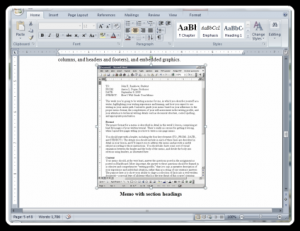
A screenshot of a Word 2003 document in a screenshot of a Word 2007 document in an ePub PDF. Cool.

A screenshot of a Word 2003 document in a screenshot of a Word 2007 document in some dynamically generated HTML. Cool.

Last fall, as I’ve said before, I had the opportunity to teach Technical Writing to a bunch of Computer Science students. It was what we called a “hybrid online course” — a Tuesday/Thursday class, but we only met in the classroom on Tuesdays. Then on Thursdays they would visit the class’s website, get the week’s assignment, and get a tutorial I’d written teaching them how to do the assignment.

We’d originally set the class up that way as a convenience for me (so I didn’t have to take off from work two afternoons a week). The Thursday tutorial became one of the most challenging parts of teaching the course, though. I’d spend the whole weekend prepping for my Tuesday lecture, spend Tuesday night decompressing and then all day Wednesday at work, and by the time I had a moment’s free time, I was already pushing it to get the document done in time for my 1:00 deadline the following day. Way too often I spent my lunch break Thursday sitting at my desk at work, frantically finishing up a document to upload before the scheduled class period.

That got to me. You already know I’m a fan of getting it done early, and every Thursday I was hitting “Publish” knowing there was something I’d missed, something I could have said better.

Finally, one Tuesday afternoon, it was so much on my mind that I decided to poll the class. I stepped up to the front of the room and said, “Okay, who all read the tutorial for this week?” Every hand went up. Then I asked the question I was dreading. “What was wrong with it?”

No one said a word. After a moment I clarified the question. “Did it make sense?” Lots of nods, which weren’t too helpful. “What was missing? What did you still need to know?” Nothing.

“Was any of it confusing?” Some shaking of heads. I sighed. After a moment, I got a little frustrated and said, “Can you tell me something that bothered you about the tutorial? Anything?”

A full thirty seconds of silence followed that, but I waited them out. At last, at the back of the room, one tentative hand went up. I nodded to him, and he asked with a frown. “What was with the screenshots? Are you really using Word ’98?”

The Tools I Use

When you write as much as I do, you get used to working with a lot of different tools (and you quickly learn how to make do with all of them). I’m not going to spend a lot of time teaching you how to use any one particular kind of software, because there’s plenty of words out there on that already, and whichever one I decided to teach you, I’d be alienating a big chunk of my audience.

Instead, I’m going to make sure you do know what’s out there, and I’m going to help you pick the right one for your purpose. Word processors these days are packed with hundreds of features that even professional writers don’t ever touch. The real trick is to figure out exactly what set of resources you need, and pick a program that can do those things well. Everything else is just glitter.

For what it’s worth, I wasn’t using Word ’98. The screenshots were from Word 2003. Admittedly, that’s still a seven-year-old piece of software that’s at least four revisions out-of-date. It’s the mandate where I work, though — for all I know, it might well be Federal law.

It doesn’t matter a lot. I wrote my second novel (and all my many college papers) in Word ’98, so I know its features front-to-back. I used 2002 and 2003 at my first job (and, yeah, 2003 at my current job). I use 2007 at home. That’s hardly all, though.

I also use Open Office from time to time (a free open-source clone that does a pretty good job emulating the older versions of Word). It feels a little unpolished, compared to the Microsoft product, but it’s an awful lot cheaper. It also features some powerful automation tools that are a lot nicer to work with than Microsoft’s Visual Basic for Applications, but you’re not going to care about that unless you’re a programmers.

Sometimes all the features in those big fancy word processors just end up getting in the way. In fact, once you’re doing advanced work, it actually happens more often than you might think. I make liberal use of Notepad (Microsoft’s bundled text editor), but my go-to guy for pure text manipulation is EditPad Pro by JGSoft. It’s amazingly useful.

That’s not the end of the list, either. In fact, it’s still missing the biggest player (by volume, anyway). For the last year or two, I spend more time writing and editing online than I do in any installed word processor or text editor. Obviously you know I work in WordPress, which is a fantastic editing interface for blog posts, but all my serious writing happens in Google Docs.

Do you know Google Docs? If not, come back next week. And the week after. And probably the week after that. I’m going to do a whole series on Google Docs. That’s how much I love the product.

Of course, all the writing I do requires more than a little graphical work by way of support. I’m formally trained in Photoshop and Illustrator, but for the stuff I need to do, I can usually get by with Paint (another Windows built-in). More and more, just like with Google Docs, I find myself popping over to Picnik.com to process my illustrations. I’ve used that to set up all the illustrations you’ve seen at Unstressed Syllables. (The framed border I use is theirs.)

Are You Designing for Paper?

When you’re deciding which software to use for any given project, the first question you’ve got to ask yourself is, “Am I designing for paper?” Is your stuff going to be printed, or will it be forever digital? If it is going to be printed, how good does it need to look?

Traditional feature-packed word processors exist to make words look good on paper. If that’s something you need, then they’re fabulous. If it’s not, then a lot of their tricks and shortcuts and assumptions can easily get in the way of your writing.

Technical Writers still need to design pages, most places. So do aspiring novelists, who need to be able to prepare immaculate submission packages to send off to super-critical agents.

If you’re happy with 50,000 words of body text paragraphs, interrupted by the occasional centered chapter heading, that you can get away with in any software you choose. But if you want to be able to design a neighborhood association flyer that you can print off in your office and fold in your living room, you’re looking for some pretty advanced page formatting.

Of course, there’s times when your answer can change even over the course of a single project. You might find yourself writing drafts in Google Docs (or just the WordPress Dashboard), but then when you’re ready to print them off you’ll transition them into an honest-to-goodness word processor. Now, whether you should use Microsoft Word or Open Office or Pages, that’s a separate matter. The feature set is pretty similar, but the rightness of any given program depends on your personal taste, familiarity, price, and platform. You should choose one, though, and learn how to use it.

Do You Work at More than One Computer?

Still, for the vast majority of writers these days, a purely digital format will do the job. That’s what you’re looking at in WordPress, for instance, which certainly lets you change font and character format, but repositions your column width all willy-nilly and never once suggests a page break.

You gain some simplicity there, but you lose a lot of features. (In the interest of full disclosure, I should point out that you can still recreate all those page effects in a purely digital format, it’s just a lot more work.) As a serious writer, I couldn’t possibly make myself recommend that you give up all those feature just to gain “simplicity.”

There’s more to it than that, though. I already admitted above that I do a ton of work in Google Docs (which is exactly the sort of “50,000 words of body text paragraphs, interrupted by occasional chapter headings” software I was talking about). In fact, I described precisely my method at the end of the last section — I write everything in Google Docs (or, more and more, Google Wave). That’s because I work on half a dozen different machines, each with its own My Documents folder, its own software configuration, and its own rules concerning what sort of files I can work with.

Keeping a document saved to a format that can work seamlessly among all those different types of software can be a hassle. Even worse is trying to keep up with the most recent version of a document, as it bounces back and forth among them all. Most of the digital-only editing tools out there are “cloud services” — which is to say that they are storing every document on a remote server (redundantly backed up and deeply protected against accidental loss or corruption).

That means whenever I want to tack a couple more pages onto my work-in-progress, I can just pop over to Google Docs, open it up (from any computer that has internet access), and I’m automatically working on the most recent version of that document. Any changes I make are saved to the cloud, so if I opened the same document an hour later at a different location, on a different computer, it would be fully updated and ready to go.

That’s a huge feature for most writers.

It’s not the end of the conversation, though. There’s a whole lot more still to be said, but I’m well out of words for today’s post. If you’re at all interested, come back next week for my checklist of absolute feature requirements for good writing software, and a couple recommendations for specific programs in specific situations.

Blog Schedule (Technical Writing Exercise)

Business Writing Exercise

Business Writing Exercise

You’ve had most of a week now to get started on your blog posting schedule. If you’ve followed through on that, today’s writing exercise will take you five minutes. If you haven’t, today’s writing exercise is another kick in the pants to get you started.

One of the big benefits of a regular posting schedule is consistency — not just in timing, but also in content. There’s a good chance, no matter what sort of blog you have, that you’re making a number of different kinds of posts. On my old personal blog, I’d sometimes post journal entries, sometimes post comments that struck me as clever, sometimes post rambling essays, and sometimes post project updates.

Everything you’re posting probably has a place, on your blog and in the interests of your readers, but you can make it a lot easier on your readers if you let them know what to expect when they see a new item in their RSS reader. We do a little bit of that with categories and tags, and I even tried a handful of different ways of expressing it in the blog post titles. Most of the really successful bloggers out there divide their content by time, though, and that works really well.

Here at Unstressed Syllables, I follow the same pattern every week:

  • Monday – Technical Writing Exercise
  • Tuesday – Technical Writing Article
  • Wednesday – Courtney’s WILAWriTWe
  • Thursday – Creative Writing Article
  • Friday – Creative Writing Exercise

That pattern emerged from my very first, halfhearted attempt at scheduling my blog, and I had it handy when I decided to do a detailed blog post schedule. That makes it easier for me to develop new blog post ideas, because I know exactly which types of ideas I need to come up with, every week. The schedule also makes it a lot easier for me to follow through, though. I can visually track the train of thought my blog is going to produce, post to post, and shuffle and tweak to get the best possible effect.

So your assignment this week is to finish your spreadsheet (if you haven’t yet), and tell us in the comments what you discover from that process. I want to know what your schedule actually is (whether that’s “I try to do one post a week,” or a detailed daily breakdown like I did above). Then, in addition to that, I want to know what you’re going to write about next week. Give me topics or titles, either one works for me, but demonstrate that you’ve actually done your homework.

If you want to get the most out of it, put a little marketing spin on all of that. Describe a posting schedule we’d like to follow, and tell us about some blog posts we’d really like to read. Who knows? Maybe you’ll pick up some new followers in the comments.

Pitch and Tagline (Creative Writing Exercise)

The lovely Kelley, writing at a coffee shop

Creative Writing Exercise

We talked yesterday about the many different ways you need to be able to describe your story (and you’ll need something similar if you’re working on a blog, or an e-Book, or any other big writing project).

In that article, I recommended starting with the hardest description and working your way toward the shorter ones. That offers all kinds of benefits in terms of the consistency, focus, and strength of your message, but it’s got one big drawback: it’s a lot of work. It’s easy to get overwhelmed by that first task, and never get started.

So today we’re going to set aside my advice for a moment, and do the functional equivalent of a writing prompt. We’re going to do something fun and low-stress to abolish that terrifying blank-page feeling, and get us moving. We’re going to start with the pitch and tagline.

That should be the most interesting, energy-packed version of your story description. It’s some fun marketing material, rather than a grueling blueprint of your story architecture. Tell us, briefly, what your story is about. What makes your story special? What about it is going to grab our interest? You’ve got two to four paragraphs (fewer than 200 words), so keep it focused.

In other words, brag. Tell us what made you fall in love with this story, and maybe we’ll fall in love, too. I’ve seen it happened.

Go ahead and make up your tagline, too. One sentence, short and to the point, capturing the spirit of the work. Make it a comment on this post. Actually, start with your tagline, to catch our attention, then follow up with your pitch, to seal the deal. If you do it right, you could easily get some test readers out of this.

(And then when you’re done with all that…set those two aside, and go back to the beginning. Work the process. You’ll be glad you did.)

Photo credit Julie V. Photography.

The Art of the Plot Synopsis

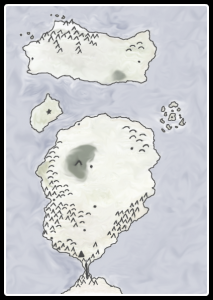
My fantasy world, in all its glory.

My fantasy world, in all its glory.

I’ve talked a lot about the Technical Writing class I taught last fall, but I’ve rarely said a word about the time I took that class, eight years back. One of the coolest parts of that class (both times) was the big bad Semester Project. Every student has to pick a topic early in the semester, prepare a proposal and a couple progress reports, defend the proposal before the professor, develop a major documentation product, and finally give a report to the class at the end of the semester.

When I went through that course, I was waist-deep in my second big rewrite of my second novel, and gearing up for my first serious bid for publication. So for my documentation product, I put together a formal market analysis and submission package for my novel. I spent the whole semester researching agents and editors, practicing query letters and refining my plot synopsis. It was one of the most useful projects I did in my entire college career. I enjoyed every moment of it, right up until the end.

At the end, as I said, I had to do a presentation. Public speaking has never been my strong suit, but I kept telling myself, “On this topic, I’m an expert. I’m the expert. There’s nothing to worry about.”

Then the time came for my presentation, and I stepped up to the front of the class — a class filled almost entirely with Engineering and Business Majors.

I put up my first slide — a badass drawing of a growling dragon that I hoped to use as cover art — and all it got was a blank stare. I said, “For my project, I prepared a promotional packet for my fantasy novel, Taming Fire. It’s the story of an orphan boy who just wants to join the army, but ends up riding dragons and battling with some of the world’s most powerful wizards….”

This was before Harry Potter and the Lord of the Rings movies brought fantasy mainstream. It was before Napoleon Dynamite shone a bright light on the miserable life of the truly excellent nerd. I met the eyes of everyone in the audience, as I’d been trained to do, and I saw bafflement and confusion. Somebody snickered. In that moment, I felt like such a little dork, talking to these engineers and businesspeople about my private fairytale. I had two more minutes of synopsis to give, though, before I was supposed to transition to the actual project — my research, the documents I’d written, and what I’d learned. Two minutes of dragons and dwarves and elves and magic.

Those were probably the longest, most painful two minutes of my life so far. It was brutal.

Story Summaries

There’s an easy lesson to be made here about audience analysis, but I want to talk more specifically about story descriptions. The saddest part of that story is that I’d spent the whole semester studying synopses, refining my story description, reworking it in new formats, but even after all that work, it was my story description that brought me down.

I could have come up with a description of the project that wouldn’t have left me feeling so stupid in that crowd. I didn’t, because I’d spent so long thinking about and writing to agents deeply entrenched in the fantasy genre. That’s where the audience analysis comes in. It also points to another need most new writers overlook: your book needs a good description. In fact, it needs several.

Why? Because people are going to ask. Even if it’s not for a class presentation, at some point someone’s going to ask you to describe what your book is about. That can — and should — be a magical moment. That’s an audience interested in this things you’ve been working so hard on. If you’re not prepared, though, it can be almost as awkward as my presentation was.

So start with that. Arm yourself up against the circumstance. Figure out exactly how you would describe your book to someone who’s not in your target market. Write it down. Aim for two or three pages, but if it’s shorter than that (or longer), that’s fine. Whatever it is, though, make sure it accurately describes your project, and that it does so in a way you would be comfortable sharing with a stranger.

When you’ve done that, you’ve done the hard work. You’ve captured, in a handful of pages, what your story is. You’re not relying on genre lingo or artificially easy comparisons to do the heavy lifting. You do still have some work to do, because (when it comes right down to it) that synopsis is the least useful one you’ll ever write.

It’s a fantastic starting point, though.

The Many Types of Plot Synopsis

The other types of book description all exist for very specific purposes. They include (and these are just my names for them):

  • The complete synopsis (or scene list)
  • The long synopsis (which is usually two to five pages)
  • The short synopsis (one full page)
  • The pitch (two to four paragraphs)
  • The tagline
  • The formula compare (something like, “It’s Rivendell meets Friends.”)

That’s a lot of different descriptions, and even though they vary in length, it’s usually not too easy to convert one into another. That’s because, as I said, they serve different purposes. For all of them, I would start with your audience-neutral description you did first, and work from there.

The Scene List

A scene list is primarily useful as a prewriting or editing tool. It forces you to map out the actual structure of your story, down to the very building blocks, and then gives you an easy place to spot errors or weak points, to tinker and rearrange.

To make a scene list, you start at the very beginning of your story, and write one to two paragraphs describing what happens in every scene. When you’re finished, you’ll have your entire plot down on paper — every twist and every turn — without all that messy set design, characterization, and description.

I have known of some editors or agents who wanted, essentially, a scene list when they requested a synopsis. That’s because some editors and agents want to know how well you can build a story, not just how pretty your words are. Nothing reveals your ability with story structure more clearly than a complete scene list.

The Long Synopsis

Actually, that’s the purpose of all three synopsis types — to show how good you are at building a book (or, anyway, how well this one is built). The problem is, a scene list can be a tedious affair, and every agent or editor I’ve ever known is just ridiculously busy.

As a result, most of them want something shorter than a scene list (which could easily run to fifteen or twenty pages). Instead of accounting for every brick in the wall, they just want a scale model. You job is to convey the shape of your novel, including the beginning, the major obstacles along the way, and the end.

Yes. The end. Writing a solid climax and satisfying resolution is one of the hardest parts of storytelling, so you have to tell the end. Worried about it seeming flat and boring? Good. Work hard at making it sound just as powerful and interesting as it really is, even if you’ve only got a page to do so.

The Short Synopsis

You should really be doing that for the whole book anyway, and when you get to the short synopsis, you’ve only got one page for all of it.

When it comes to the short synopsis, you can think of it more like the stuff you’d find on the back cover of a paperback. It’s almost marketing material, drumming up a powerful intro and characterization, hinting at a world, and suggesting a direction for the plot. Give yourself two-thirds of a page to do all that, then start a new paragraph and give away the ending. Briefly sum up the plot (the middle), and the climax and denouement (the end).

This is probably what most agents are looking for when they ask you to attach a “synopsis” to your query letter. Ninety-five percent of the time, they’re either looking for this, or the long synopsis I described above (which is why it’s good to go ahead and prepare them both).

Figuring out which one a particular agent prefers can take some serious research, and sometimes it’s just plain impossible. In those cases, I’d just go with the one you think better sells your storytelling.

The Pitch

Once you’ve got the short synopsis done, you’re nearly finished. The rest are much shorter, starting with the pitch.

The pitch is most of the body of a query letter. It is, in essence, your book’s elevator pitch. It’s two to four paragraphs that express, to an audience already prepared to appreciate it, exactly what is awesome about your book. It’s very much a sales pitch, and if you undersell your book in the query letter, chances are the agent won’t ever bother reading the attached synopsis.

On the bright side, though, once you’ve got your pitch perfect, you have already finished writing most of your query letter — a task many authors dread.

The Tagline and the Formula Compare

That just leaves your one-liners. A tagline is the one-sentence description you might see on a movie poster. Something like,

“In a world overrun by flying fish, only a maniac paperboy stands a chance.”

Or (and this one is near and dear to my heart),

“It’s like 1984, but happy.”

I like to use the tagline as the second sentence in my query letter (following close on the heels of, “I’d like you to represent my novel”). Then I personalize, give some qualifications, and follow up with the pitch. That’s your whole query letter, in a nutshell.

The formula compare is similar to the tagline, but more cynical. The formula compare suggests any new story can be described as a (sometimes clever) combination of two known stories. “It’s Cinderella meets Die Hard,” or “It’s Twilight, but with vampires.” Something along those lines.

The formula compare is lousy marketing copy, but it’s incredibly helpful shorthand. At the very least, you should come up with a comparison you like, so you can offer it as an alternative when someone describes your work with one you don’t.

Photo credit Aaron Pogue.

What I Learned about Writing this Week…from Cormac McCarthy

Courtney Cantrell's weekly writing advice.

Courtney Cantrell's weekly writing advice.

Cormac McCarthy is one of my new favorite authors, because he uses words like “chary” and “excelsior.”

Off the top of my head, I’m not even sure anymore what those words mean. I looked them up when I first read them; but, as my English teacher friend Pam says, you gotta experience a new word in ten different contexts before it becomes part of your vocabulary. So I think I have 7.5 experiences to go for chary, and 8.5 for excelsior. Give or take a few tenths of a point. At any rate, whatever their meanings, those two are lovely-sounding words, and I invite you to seek and find them in the dictionary nearest you.

Pure and Simple

As I read McCarthy’s The Road, I just had to drop my jaw at how the man uses words. Lest this article transmogrify into nothing more than a McCarthy-rave, let me just say: READ THIS! McCarthy is a master of vivid detail and excellent characterization in a minimalist style. Talk about stripping your prose — McCarthy even does away with quotation marks and apostrophes, which I’m sure has all you purists out there howling with indignation. (I whimpered a bit at first, myself.) Still–if you’re looking for fiction trimmed of all fat and frills, I doubt you’ll find a leaner example than McCarthy’s bleak post-apocalypse.

Don’t worry. I am not digressing, as I am so oft wont to do. McCarthy’s minimalism is the staff paper on which he composes the sheer elegance that grips me so. His every sentence draws your mind and your heart on to the next–a cadence of lovely words arranged in perfect chord structure. When you pick apart his melody, you find individual notes beautiful in and of themselves:

intestate
shrunken
ensepulchred
davits
sludge
swag
loess
torsional
vermiculate

Don’t those just sound cool?!?

Pure and Simple?

Unusual words, like the ones above, are like chocolate to me. Sweet. Rich. Satisfying. But I recognize that even I, chocoholic that I am, do not benefit from overindulgence. McCarthy enthralls us with a word melody as smooth and delectable as chocolate–but he is a master story composer. Not every writer has yet learned how to combine those exotic words in such a way as to bring forth elegance. Some of us are ready to put notes to paper. Some of us are making our first cautious forays into simple word melodies. Some of us are still whamming away at a snare drum with a stick and thinking it sounds like Neal Peart. To make it a practical point: It sounds a lot better for me to say “cut the crap” than it does for me to advise you to “eschew obfuscation.” If I were a Cormac McCarthy, maybe I’d have the clout to eschew, but I’m not there yet.

Those chocolatey, outlandish words sound lovely–but if we writers don’t know how to use them, or if our readers just don’t know them, our writing is going to sound garish at best, dissonant at worst. I don’t know, maybe some of you are going for avante-garde dissonance; if so, I wish you all the modern, abstract best. For the rest of us, if we’re going to write stories that taste and sound good to our readers’ hearts, we’re gonna have to spend time reading at the feet of the masters. We need to spend hours upon days in the practice room, tweaking our word melodies and experimenting with sentence composition. We have the freedom and skill to play with the music of our writing–and we have the obligation to do so. It’s the only way we’ll learn first to imitate our masters, then equal them, and, finally, surpass them.

Purity. Simplicity.

In The Road, McCarthy uses two other words I particularly enjoy listening to: “illucid,” which I think he made up; and “crozzled,” which seems to be a term from northeastern American dialects. He not only composes beautiful sentences, he even invents words to fit his own cadences. I can’t give you the definitions of illucid and crozzled. But I can invite you to listen to them. Say them to yourself in your head. Speak them aloud so you can taste them. Illucid is smooth on the tongue; crozzled might be a piece of dark chocolate with nuts in it. You don’t need to hear the definitions. Just hear the words themselves, and you’ll know what they mean.

The ability to make that kind of word music happen–that’s the kind of mastery I want.

And that’s WILAWriTWe.

(If you click any of the above links, they’ll take you to Amazon. If you purchase any product in the same browser session, you’ll be helping me buy more chocolate. Just sayin’.)

Photo credit Courtney Cantrell.

Take Control of Your Blog Posting Schedule

Keep control, and get where you need to be. (Photo courtesy Julie Velez of Phoxie Photo.)

Last week, I spent a surprising amount of time talking about a bridge. It’s no surprise that particular example sprang to mind. Bridges have had some special significance in my life so far.

When I was seventeen, I spent an evening hanging out at my girlfriend’s house, all the way across town. It was edging into winter, and in spite of the threat of some inclement weather, I let the compelling sentiments of “Baby It’s Cold Outside” convince me to stay late. Afternoon stretched to evening, and all of a sudden I realized it was dark outside, and I wasn’t going to make my curfew.

So I rushed home, newly licensed and driving a rear-wheel drive baby Japanese pickup truck (it was, I dunno, a sixteenth-ton pickup, maybe?). Right around the time I got up onto the highway, I started noticing that half the raindrops hitting my windshield were really snowflakes. Another mile down, I flew onto a bridge, and instantly I started fishtailing. I jerked my wheel hard against the direction of the skid (oops), and when that didn’t fix the problem, I freaked out and slammed on the brakes (oops).

I ended up pinballing back and forth from guardrail to guardrail, totally out of control, and skidded to a stop just short of the thirty-foot dropoff at the far end of the bridge. If I’d been on time, I’d have been home in bed, enjoying a good book. Instead I spent the next two hours shivering in the snow, waiting for a tow truck and filling out a police report.

Five years later — in college now, and still driving that same pickup — I had Memorial Day plans to go visit my parents in Little Rock, but that’s a long drive from Oklahoma City. Worse still, I forgot to gas up on the way out of town, so halfway there the little orange fuel pump lit up on my dashboard. I left the interstate, and rolled blindly down state highways for half an hour, terrified the truck might choke to a stop at any moment, before I finally found a rusty old gas station where I could fill up. By the time I got back to the interstate, I’d burned an entire hour on a detour.

And it got worse, ten miles down the road I hit the worst traffic jam I’d ever seen — cars and trucks and semis all parked on the road, and I could see that it stretched for miles. I slammed to a stop, threw myself back against the seat in frustration, and flipped on the radio to try to get an idea how far away the wreck was.

It wasn’t a wreck though. A barge had slammed into the supports of a bridge over the Arkansas river and taken the bridge down. If I’d been on time, I’d have been in the river. Instead, I spent the next two hours creeping with the rest of the holiday traffic along a narrow, twisting detour, and whispering prayers of thanks that I was still alive.

Taking Control

Obviously both of those experiences stick strong in my memory, and what really stands out to me is the similarity, and the inversion. In both cases, I nearly died in a situation I had no control over. The difference, though, is that the one that hurt more — physically, emotionally, and financially — was the ice.

And the frustrating thing, the lesson that has stuck with me, is that I should have had control. If I’d known what I was doing, I likely could have regained some traction, tapped the brakes to get to a safer speed, and gotten home safe in spite of the storm. I don’t know how many people have lectured me about everything I did wrong that night, but the lesson has stuck.

Life can really mess you up when you’re not in control, but half the time it’s your own fault that you’re not.

That’s a lesson I’ve had to learn several times, actually. And you’d better believe it’s a lesson with applications to writers! I’ve muddled hundreds of pages into a novel with an unworkable plot because I never bothered to take control of the story structure (or even think about it at all). I’ve spent years at a time not writing at all because I just didn’t have time, and those were some of the worst years of my life. At some point, I finally realized I was in control of that, too. I made the time to write, and I made my life better, too.

If you’re not careful, if you just let life happen, it can drop you places you really don’t want to be. My most recent experience with that was about…oh, six or seven weeks ago.

Writing to a Schedule

I’ve said before that one of the biggest challenges of blogging is writing to a regular deadline. It wears you down, and if you’ve read my final write-up of the Pre-Writing Challenge, you know that I hit a point at the beginning of February where I was so worn out by my deadlines here at Unstressed Syllables that I was ready to call it quits. I hated it.

The problem is, a regular posting schedule is one of the most important things you can do to make a blog successful. I did some serious research before I started here, and blogger after blogger after blogger will tell you that consistency creates readers, and every missed deadline costs you a reader. That makes sense to me, but then digging a little deeper, you’ll find that the very next rule for building a blog is, “post often.”

Ugh. Most people say daily (and many of them suggest multiple posts daily), but I knew I couldn’t do that. I settled on four posts a week, and even that tore me up. Every deadline wore me down, until I was ready to quit altogether. Maybe you’ve experienced the same thing.

You want to know the answer? The trick? If you’ve read my updates on the Challenge, you already know. For that matter, if you just read the section headings for this article, you know. The answer is to take control. Take control of your blog posting schedule, instead of drifting helplessly into your deadlines, and your blog will blossom and come to life again. Not only that, but you’ll learn to love it, too.

Scheduling in a Spreadsheet

For my part, I used a spreadsheet to take control. It was a desperation maneuver, the only possible method I could see to fulfilling my commitment to the Pre-Writing Challenge, but in just a few minutes, it completely changed my blogging experience.

From my weekly updates post:

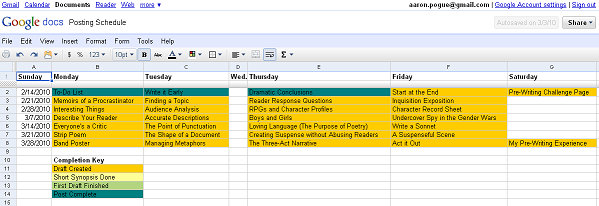
All night Tuesday evening, I sat on the couch in the living room while my daughter danced and spun and my wife watched old episodes of Dead Zone, and I worked on a spreadsheet. I made it in Google Docs, using rows for weeks and columns for days, and made up a color key to track what I’d accomplished. By the end of the night, it looked like this:

Posting Schedule 0

There’s no need to strain your eyes trying to read the small print — it’s the colors that matter. Orange indicated a post that had a title (and nothing else). Yellow meant I’d started writing on it, light green that I’d finished a full draft, and dark green that the post was completely finished, and ready to publish. In the chart above, you can see that only three posts were done.

Just coming up with the titles was a challenge, though. I needed to figure out how they fit together, how they would build on each other, and make up at least a guess as to the contents of each topic, to avoid too much overlap or too little content, day to day.

It was a lot of work. It was energizing, though. By the time I was done, just making up a bunch of names, I really felt like I’d accomplished something. Everything I was doing with the blog suddenly felt more solid. More real.

In other words, for the first time since I’d started blogging, I was in control. If you want to read a more detailed description of my experience, check out that post. It’s got screenshots of my schedule every week through the end of the Challenge, so you can watch the progress.

In spite of its length, that proved to be a really popular blog post (for the people participating in the Challenge anyway). More than that, it became an inspiration. Carlos copied my spreadsheet and used it to get organized. So did Eleanor (another Challenger), and Dave Doolin from Website-in-a-Weekend.

Dave eventually said that the spreadsheet was the most useful part of the Challenge. Carlos said of it, “your methods saved my ass in this challenge and it’s only getting better even though the challenge is over.”

It works. It’s a little thing, a simple thing, but it saves lives. Don’t give up on your posting schedule. Start one, if you don’t have one. Then map it out. You can do this in Microsoft Excel or OpenOffice’s spreadsheet tool or any of a dozen other ways. You can use rows and columns of Post-It Notes on your office wall.

We all used Google Docs for ours, and if you’re not already familiar with that product, you should be. I’ll put together a thorough introduction to it for you in a couple weeks. For now, in whatever way you can, get started. Take control, and watch your blog grow.

Photo credit Julie V. Photography.

Extended Metaphor (Technical Writing Exercise)

Business Writing Exercise

Business Writing Exercise

Remember last week’s article about the bridge? No! Metaphors! It was about metaphors. But I built it on one metaphor, and carried that one through the whole article.

Clever, huh?

No, I don’t really believe you missed that. That technique is called an extended metaphor, though, and I wanted to make a big deal out of it, because now I want you to do one. If that makes you feel really clever, all the better.

This week, I want you to develop an excellent example of an extended metaphor. You’ll have to deal with all the problems I mentioned in last week’s article, but it gets harder because you’ll have to deal with them again and again, every time you go back to that well. You can do it, though. The whole trick is to spend some serious time thinking about your metaphor before you start, pick one that really works, and only talk about the aspects of it that do work.

Then weave it into a blog post. Make it about any topic you want — maybe your day at the zoo with the kids reminded you of a stroll through Dante’s Inferno, or maybe flying a helicopter in headwinds is like preparing a delicious plate of fugu. Whatever it is you want to talk about this week, back it up with a really strong metaphor.

Try for a blog post of at least 300 words, with at least two sections (so you’re applying the metaphor in at least a couple different contexts). Make it feel natural, make it look easy, then come back here and share a link with us in the comments.