Skip to content

What Should You Write About?

Write what you know, even if it's something somebody else wrote....

Write what you know, even if it's something somebody else wrote....

I’m part of a small monthly writing group that Courtney started six months ago. We usually meet at her house, and just talk about our lives and the issues we run into as writers. Most of us are in our early thirties, but one of the guys in the group is a college kid. If I were in his situation, I’d be terrified of playing writer with all the grown-ups, but he doesn’t have that problem. He’s clever, cool, and confident, and with good reason. He’s an incredibly talented individual.

The problem he keeps running into — and I don’t think I’m violating any confidences here — is that his attention wanders. He writes short stories and poetry. He paints. He’s got so many things he wants to work on, it’s incredibly difficult to force himself to ignore everything else long enough to get a book written. That’s the curse of most artists, the constant allure of new projects that shine with all the promise (and none of the tedium) of the work we’re currently mired in.

So when he brought that up at our last meeting, I knew exactly what he was talking about. I had a solution for him, too: start another new project.

No, really. I told him the same thing I told you a couple weeks ago. Start a blog. It makes writing a habit. Not only that, it makes writing for a specific project a habit, while still allowing the newness of each individual blog post to temper that tedium a little bit. It seemed to me like a great solution to his problem, but he looked at me blankly for a bit and said, “What would I write about?”

“Your life, maybe? Some people enjoy keeping a journal, just to keep friends and family up to date–”

He shook his head. He was quiet for a minute, while I tried to come up with a good alternative, then he looked up and said, “Can I write about songs?” He laid out a little bit of a plan, the kind of things he would write about, and the whole group agreed that sounded awesome. He went home and started his blog the next day.

Write What You Know

He’s following one of the oldest rules in writing: write what you know. I doubt he was thinking of those words when he picked his topic, though. When I first heard that rule, I tried to follow it by peopling my fantasy novels with the kids in my Middle School. It didn’t work. Most creative writers wrestle with bridging the distance between their normal lives and the fantastic stories they want to tell, and this rule is a constant source of consternation for them.

It took me ten years of writing before I discovered it, but here’s a tip for any new creative writers out there:

“Write what you know” isn’t for you.

Or…well, it is, but it’s an afterthought. It’s way down the flow chart you should be following to make a story. For creative writers, “Write what you know” is about making believable flavor and depth, but most of the time it’s not the core of a story.

I’m not talking to the creative writers today, though. I’m writing to the bloggers, the business writers, and for you guys, “Write what you know” is your bread and butter. “Write what you know” is the answer to questions you haven’t even considered yet.

Technical writing is all about translating understanding — it’s about converting expert information into a more easily accessible format. Whenever you’re writing, your job is to take some things you understand, that your readers don’t, and help your readers understand them.

Maybe that’s just a matter of bringing something to light. That’s what my friend is doing with his song lyrics site — he’s sharing the revelations he finds in music with people who could benefit from that insight. He pays attention, so you don’t have to!

On the other hand, maybe you’re a genuine expert on a topic, and you want to teach. That’s what I’m trying to do with Unstressed Syllables, and that’s the focus I bring to my blog posts every week. When it’s time to choose a topic, I try to find something I know, something that could be useful to my readers, and then I work on saying that in a way that doesn’t require my extensive education and experience to understand.

Free Translation Services

Then again, maybe you’re just an enthusiast. There’s no reason for that to stop you. As a Technical Writer, I work every day with Electrical Engineers whose understanding of complex systems could put me to shame. It’s not my job to understand everything they know — it’s my job to pay attention to what they have to say, and find a way to say it that is more accessible to my audience (in this case, technicians who have to do the maintenance). I tell people my job is to listen to engineers explaining how something works, and then translate it into English.

You can do the same thing with your blog post or your report — find an expert you can understand, borrow their knowledge, and reformat it for your audience. Provide context, provide illustrations and summary overviews, provide commentary! Half of the content on the internet is just people pointing their readers to articles already posted elsewhere.

Whatever you’re doing, though, add your own value to it. Add your own expertise. Tell your readers why to care, how to respond, or just what you think. You can see that in every post on The Solace of Melody. It’s got to be a little intimidating, posting a couple stanzas of the cleverest lyrics he can think of, and then trying to find something of his own to say that even comes close to measuring up.

But, y’know, without that there would be no value to the blog at all. Without that, he’d have nothing more than another site listing song lyrics. Instead, every post starts with a topic he cares about, something powerful enough to move him, and follows through with his own thoughts. He’s writing what he knows, and he’s getting better and better at it with every post.

That’s your job, too. Find something you care about. Find something you can translate to your readers. Whether that’s a running log of your personal experiences (microblogging or journaling), or a niche news site focusing on the things you’re interested in, your whole focus should be on making something you understand accessible to the people reading your site. If you’ve done that, you’ve succeeded.
Memoirs of a Procrastinator (Technical Writing Exercise)

Business Writing Exercise

Business Writing Exercise

Last week I talked about the benefits of writing early, instead of waiting until the last possible moment. I also admitted that I’d spent my entire college career waiting until the last possible moment, and that I’d done pretty well with it.

This week, I want you to tell me the same thing. I asked you to write a post a couple weeks ago describing your writing process, but this week I want you to share a story with us. Tell us about a time when you barely finished a project (bonus points if it was a writing project, but it doesn’t have to be).

We’ve all got our war stories, and they’re usually pretty fun to drag out from time to time. This week you’ve got a good excuse. Brag about the one you got away with. Make it a post on your blog, 300-900 words, and share a link with us here in the comments.

If you want, you can even point back to this post (or last week’s article), to explain why you’re doing it. That should be good for fifty words or so, if you need them.

Courtney’s Work-in-Progress Update

Courtney Cantrell shares her work in progress

The book is a paranormal novel entitled SHADOWS AFTER MIDNIGHT.

Sometimes, it’s also called SHADOWS BURNING DARK.

Peter is the main character.

When he was ten years old, Peter was inadvertently responsible for the death of his cousin, Adam.

Adam’s twin sister, Rebekah, has hated Peter ever since. Or so Peter thinks.

Rebekah just slapped Peter’s brother Daniel across the face.

I’m not entirely sure why.

I’m almost finished with Chapter 8.

I am so close to finishing this first draft, I can almost taste it!!!

I’ll keep you posted!

Photo credit Julie V. Photography.

Start at the End (Creative Writing Exercise)

Yesterday’s post was all about conclusions, and while I’ve said a couple times that the beginning of a story can be a lot of fun, the end is what it’s all about.

So this week, I want you to start at the end. Take all the in-between, all the hard work and daily writing, and just pretend it’s already finished and done. This week I want you to share with us the dramatic, action-packed end of a story. Make it the best scene you can, for whatever genre you’re writing in — make it exciting or emotional, decisive or devastating.

Maybe you’ve written a dozen novels already, or maybe you’re still toiling toward the end of your first one. Either way, take some pleasure in the experience of finishing a story. Hit us with a climax, tie up some imaginary loose ends, and then follow it up with the two most satisfying words in all of writing.

This should be a fun exercise, but don’t think that’s all it is. It’s also progress, toward a legitimate “The End” of your own. Countless amazing stories have been written just so the writer could get to a pre-determined climax. I’ve known some good ones to start with what felt like an ending, too. Whatever you come up with, it’s something you can build into a story somewhere down the line.

For now, share it with us as-is. Endings are more fun than middles anyway, so we’ll have fun reading whatever you’re willing to share.

Satisfying Resolutions

You owe your readers resolution, so make sure to write the end before you write, "The End."

You owe your readers resolution, so make sure to write the end before you write, "The End."

One cold Christmas Eve when I was little — let’s say twelve — my dad got home from work and the whole family rushed to pack the van with all our bags, and all our presents, so we could get down to Dallas at a reasonable time. We were leaving from Wichita with a six hour drive ahead of us, and it was already dark out, so we threw our stuff in and then scrabbled for seats so we could get on the road.

Mom and Dad had the front seats, of course, and my sisters grabbed the captain’s chairs in the middle, so that left me sharing the back bench with big boxes wrapped in crinkly paper. That far back, I couldn’t really participate in any of their conversations, or even really hear the radio, so I wedged myself in the back corner, leaned my head against the cold window, and fell asleep.

An hour down the road, Dad pulled into a truck stop on the turnpike to top off the tank. Before he went in to pay, he called into the car, “Anyone wants anything to eat or drink, you better get in and get it now.” My sisters sprang to their feet and headed to the door, but when he heard nothing from me, he called back, “Hey Aaron! You coming?’

“He can’t hear you way back there,” Mom reminded him gently, as she headed inside.

“He’s sleeping anyway,” my older sister said, so Dad just shrugged and went in with the rest of them.

I woke up a few minutes later, probably startled by the sudden silence, and my eyes were killing me. I wore contacts in those days, the flimsy disposable kind, and they had a bad habit of drying into a crisp torture device if I ever drifted off with them in. So I ran inside to change them in the bathroom, while the rest of my family was browsing the junk food aisles.

While I was taking them out, though, one of the contacts fell on the floor — in a truck stop men’s room. I’d heard such horror stories about eye infections, I just left it there, and went ahead and threw the other one in the trash, too. After all, I had a new pair out in my bag. I could make it through the night without them, and just put in fresh contacts for Christmas morning. I nodded to myself, satisfied with the plan, and headed to the van.

But the van wasn’t there.

I found an empty spot where it was supposed to be. My vision was bad enough that I second guessed myself, and turned to the next spot over, but it had an old rust-red Cadillac in it, and the spot on the other side had a Jeep. I stepped back up onto the curb to make sure I’d come out the right entrance from the convenience store, but I felt a rising panic. It was dark, and I was alone. I told myself I was being silly, that I’d just miscounted the parking spots. I imagined them sitting in the van two spots down, watching me, laughing.

They weren’t. They were at the far end of the lot, pushing forty as they rushed up the on-ramp onto the interstate. Just to be safe, Dad called back over his shoulder, “Everyone in?” He didn’t count quite enough yesses, so he called again, “Aaron? You back there?”

“He can’t hear you way back there,” Mom reminded him gently, as she settled in for the long drive.

“He’s sleeping anyway,” my older sister said, so Dad just shrugged and headed for Dallas.

Resolution: Climax and Denouement

Last week we talked about the Conflict Resolution Cycle, and the structure of a story. You’ve got all of that, in the story up above. The Big Event was Dad’s arrival for our hasty trip to Dallas. My first obstacle was finding a place to sit, and my second was waking up to an empty van with crusty contacts scraping at my eyes. The third, the climax, was the realization that I’d been abandoned, forty miles from home with my family rushing toward the state line.

So what’s missing? The end. The end! That’s the most important part!

Every story is, in a way, a contractual agreement between the writer and the reader. Your readers give up their valuable time to read your story, and in exchange they expect you to give them a story — a satisfying beginning, middle, and end. That means you’ve got to do more than make interesting characters and conflict. You’re responsible for building a valuable conclusion, too.

There’s basically two parts to the end, the climax, and the denouement. Climax is easy — it’s an obstacle. It’s usually bigger than the others, but it behaves in exactly the same way as all the obstacles you’ve been working on since page one. The denouement is a little trickier, though.

It’s a big fancy French word, and everybody’s heard it at some point. To keep things simple, “denouement” is often described as resolution of the plot. It’s everything that comes after the climax. It’s tying up loose ends. Essentially, it’s everything you have to say, after you’ve finished telling your story. This, again, is where “get in late, get out early” comes into play. There’s inevitably some information that has to be added, for the reader’s sanity.

The climax allows the protagonist to resolve his conflict, but it rarely happens instantly. If your Big Event was a proposal, then your climax could just as easily be a wedding or a breakup — or even just a conversation, but it had better be a good one. Let’s say it’s a wedding, and that big, dramatic, scene-ending “I do” packs a lot of punch and gives the protagonist the chance to stop worrying about all the obstacles that have been faced for the last three hundred pages.

It doesn’t end them all, though. Some of the arguments between bride and groom still have too much lingering effect, some of the relationships with family and exes are still up in the air. The resolution of the climax slows things down, but the denouement gives you the chance to let your readers know how it ends up.

This is your chance to shine as a writer, because you want to tie up as much as possible, in as short a space as possible. I can’t tell you how, exactly, because it’s different story-by-story, but focus on keeping it short and sweet. Tell what has to be told, and then put that “The End” stamp on the page as soon as you can.

Choosing Your Climax

I skipped over it above, but to be fair, the climax can be tricky, too. If you don’t know where your story is going, if you don’t know from the start what the end is going to be, it can be hard to find that perfect moment that brings everything crashing back to normal.

Generally, if you’re having trouble, it’s a good idea to try to balance the climax against the Big Event. A proposal and a wedding balance well. A proposal and a conversation about how screwed up our life has become in these last few months…it’s going to be tough to make that balance. It can be done, but you’ve got to manage your narrative a lot more effectively.

Don’t get me wrong, you can go wherever you want with your story. It’s true that most of the time a Big Event forecasts a Climax. A proposal forecasts a wedding, and alien warships showing up over his townhouse forecast an unexpected and unlikely but truly heroic victory over superior technological forces. You can see the balance there, and that’s easy to write to. If your characters are strong enough, you can make a unique and interesting story out of even the most cliché plot formula, but you don’t have to be bound by that. Tell the story you want to tell. I only point out balance because it can help you find your structure if you don’t know where to look. Looking closely at your Big Event can often recommend a Climax for you.

Your Goals Aren’t the Same as Your Protagonist’s Goals

The most important thing to remember as you build your story’s plot is this: your protagonist isn’t in it for the sake of the story. Your protagonist isn’t making the decisions that will make for the most interesting tale or the most spectacular climax. He just wants this story to be over.

In my story above, I didn’t slip stealthily past my parents on my way to the bathroom. That would have made an interesting story far more likely to happen, but it wasn’t my goal. I certainly didn’t want to be left alone out there. All I wanted was to get to Dallas, and get that trip over with. Of course, that story wouldn’t have been very interesting.

When you’re making up a story, the obstacles you create are the things that force your protagonist into an interesting story. I mentioned this principle last week, but it bears repeating here because, the closer you get to the climax, the easier it is for you to get caught up in your own story and forget it. If you allow your character to casually participate in the drama of the story, shouting his challenge for a hand-to-hand fight when he could just as easily shoot the villain dead, you’re going to lose your readers.

If you want him to do that, you’ve got to build it into his character — make it an honor issue for him, and the fact that he has superior arms becomes an obstacle. Or have him run out of ammo, have his gun jam, and that’s an obstacle he overcomes with a challenge (maybe playing on the villain’s honor).

Just remember, we’ve all seen enough bad movies, and read enough bad books, that we know how the story is supposed to go. Your story can follow the formula to the letter, or it can break every convention. Either way can make for a really good story. Either way, though, make sure your character isn’t just going along with the formula. It’s unnatural, and it undermines everything you’re doing.

Because, in the end, your readers are going to connect with the protagonist. Your readers should feel empathy and sympathy for him, and they should be just as troubled by the conflict as he is. They should be hoping for resolution, and it’s your job as a writer to provide them a description of his honest, dedicated search for resolution, including every obstacle along the way, every effort that went wrong, and what he did to overcome them. The better job you do telling that story, the more excited your readers will feel when he gets past that last obstacle and returns his life to normal. Even if it’s not a happy ending, it’s a great relief to have the conflict over and done with.

And, in case you’re wondering, they did come back and get me. It took them twenty miles or so before they realized I was missing, and that meant another twenty miles back to the rest stop, and by the time they showed up I’d pretty much resigned myself to living out my days as a half-blind truck stop hobo. But we made it to Grandma’s around two in the morning, and I lived to tell the tale (which I do, frequently, as the only fitting punishment).

What I Learned about Writing this Week…from Observation

Courtney Cantrell's weekly writing advice.

Courtney Cantrell's weekly writing advice.

Her mouth opens wide in a huge smile that draws every eye in the room.

His nervous habit: narrating for everyone in the room what’s happening on the TV screen.

When she feels melancholy, she hums “Amazing Grace” and Metallica’s “Nothing Else Matters.”

When she feels happy, she hums ’80s rock ballads.

His right eyelid droops lower than the left, but you don’t notice it unless you love him.

She goes to Walmart wearing perfect makeup–but with curlers in her hair, and she lifts her chin and grins when people laugh.

The less he knows you, the more he talks; you know he’s at his ease with you when he doesn’t say a word.

He curses audibly into his cell phone in the grocery store parking lot.

His pinstripe suit is pressed and lint-free–but when he bends over, his pantlegs ride up to reveal mismatched socks.

She holds his hand from the car to the ice cream parlor, but her fingers drop his the moment his other hand reaches for the door.

The left corner of her mouth curls upward when she reads her newest text message.

She cartwheels through the living room when the adult conversation turns serious.

He holds eye contact with you as you’re talking, but he blinks and smiles and looks away the instant before the stare becomes uncomfortable.

He must always be the loudest person in the room.

They do their laundry in the middle of the night at apartment complexes where they do not live.

A piece of hair above his left ear is longer than the rest, and he plays with it when he’s uncertain.

She tucks her hair behind her ears when she’s tired.

Before each of the early steps of his healing process, he retreats into a shell in which there is no light.

While driving, she brakes randomly because precipitation and dusk frighten her.

She uses hand sanitizer precisely seventeen minutes into the sermon.

He nods in all the wrong places.

The nail polish on her right hand is always chipped. (The left hand is flawless.)

She asks the husband if he has seen the latest theater release, but she ignores the wife completely.

In conversation, she uses her hands more than she uses her mouth.

He offers you a cup of coffee before he asks how you are.

Watch them when they do not know you’re watching.

And that’s WILAWriTWe.

Photo credit Courtney Cantrell.

Write it Early, Review it Late

Plan ahead to improve your writing

Plan ahead to improve your writing

I’ve talked a bit before about my blog-posted serial novel, Sleeping Kings. While my official posting schedule changed from time to time, the most common schedule over the course of that project was one 1,500-word scene every Monday, Wednesday, and Friday.

That project was my first foray into real-world fiction (everything I’d done before had been traditional fantasy). It juggled five POV-protagonists, and frequently forced me to guess at details I’d have to adhere to in future scenes (and sometimes retcon like a madman). In the end, it produced a 180,000-word manuscript, which is a big ol’ beast. Even with all of that, the biggest challenge of the entire project was midnight, Monday/Wednesday/Friday.

That’s the biggest challenge of any blogging project: keeping up with the blog’s posting schedule. Really, it’s just a regularly recurring version of what is the biggest challenge for every writer: writing to a deadline.

The Midnight Panic

Even though the Sleeping Kings blog is years in my past, that old midnight panic has been much on my mind lately, as I’ve committed myself once again to a blog with a regular posting schedule. I started strong, with Unstressed Syllables…but then, we always start strong. Recently I’ve started slipping a little, and last weekend’s holiday trip out of state was the final straw.

We drove all day Friday to get to Little Rock in time for a big dinner with family. After that I watched the kids while my wife got in some much-deserved scrapbooking time with my mom, and by the time I got the kids all in bed, finished up a conversation with my dad, and hauled out the laptop to get online, I realize it was already after 10:30. In that instant, I remembered. In the dark, quiet house, when I was the only one still awake and illuminated only by the glow from my laptop’s monitor, I remembered the frantic scramble to get a post written, to get it “good enough,” and to get it online before the clock rolled to tomorrow.

And as that memory hit me, I shook my head and asked myself the same thing I kept asking myself way back then, “Why do I do this to myself?”

After all, the deadline wasn’t a surprise. I’ve been doing a Creative Writing Exercise every Friday for six weeks now! It wasn’t that I was stuck for content, either. I knew two week ago that the exercise for Friday was going to be “The Big Event.” The problem was all on me. I’d just flat-out failed to make the time, to sit down and write my post.

Writing to a Deadline

That’s not just a problem for bloggers. It’s a problem for technical writers and engineers, too. I encounter it at work all the time, with closing time looming. It’s a problem for anyone who has to write for a deadline. Heck, for most college students, it’s a way of life.

There are techniques for handling that last minute writing, skills you can learn to make it as good as possible, but in the end that’s all just damage control.

You cannot write your best quality work unless you write it early.

This is coming from an English major who wrote all his papers at the last minute and got an A on pretty much every one of them. Maybe you had the same experience in college. I’ve now been writing and correcting documents in the real world for eight years, though, and I can tell you that what worked in college isn’t good enough in the real world.

A lot of the things your English professors obsessed over aren’t terribly important in the business world, but there’s also things they let you get away with that could end up costing you a lot of money. Or a job. When it comes to any sort of writing you’re doing that matters, you can take this rule for granted: If’ you’ve just written it, you’ve written it wrong.

Fresh Eyes

There’s several reasons for that. The biggest of them is your inability to catch the mistakes you’ve made. When you review your own document, it’s incredibly difficult to see what’s actually on the page, instead of what you meant to put on the page.

Giving yourself some time between writing and reviewing does make that a little easier. Editors refer to this effect as “fresh eyes,” saying that if you come back to a document after a day or a week, you’ll catch things with fresh eyes that you glossed right over before. Then again, editors also know the only truly fresh eyes are those that don’t belong to the writer.

That’s another matter altogether. I’ve talked several times about the value of getting good feedback, but getting feedback at all takes times. If you want to have any hope of getting and incorporating criticism before a deadline, you’re going to have to do your writing way in advance.

Brain Stew

Catching errors isn’t the only benefit of writing early, though. Giving yourself some extra time to think about the document doesn’t just make it “less bad,” it often makes it much better. That’s because of an effect I like to call “brain stew.”

When you’re cooking, you learn pretty quickly that one of the most important ingredients in any recipe is time. Not thyme, actual time. Every recipe calls for it in some specified amount, and getting it wrong will ruin an otherwise perfect dish. A lot of my favorite recipes aren’t really any good at all until they’ve been allowed to simmer, to stew, often for hours after all the kitchen work has been done.

Writing’s the same way. When you throw together a draft of a novel, even if you’re self-editing along the way and working to make the best possible first draft, you’ve still only got a bunch of raw materials in the pot. It’s only then that they really start cooking. Any writer can tell you that putting “The End” on paper doesn’t do a thing to stop you thinking about the document. It’s still stewing in the back of your mind.

The supporting ideas break down and mix together, the argument distills, the structure comes to a rolling boil, all while you’re driving home from work or sleeping soundly or watching a rerun of House. Then at some point, hours or days later, some really fantastic ideas come out of all that consideration. For most of my college career, those ideas were just coming together around the time my professor was reading my paper, days after the dish had been served. In other words, way too late.

As I said before, that’s not a huge problem in school. Professors are used to grading last-minute papers. It matters in the real world, though, when the things you’re writing start shaping your life. When your boss is reading your self-evaluation, or when the bank’s loan officer is reading your business proposal, you want them sampling the very best version of your work. That’s reason enough, right there, to get it done early, and give your brain stew some time to get it perfect.

The Special Challenges of Blogging

Of course, blogging has its own challenges. It’s hard to make every post as good as it can be, when you’re still stewing on the last three posts you wrote and you’ve got two more to do before the weekend. All too often, we take that as an excuse to cut it down. When you’ve got to get four articles done a week, it just makes sense to get accustomed to the midnight panic, and do everything at the last minute.

The real solution, though, is to write completely outside your posting schedule. Write every post so far in advance that you’ve finished stewing on it, you’ve looked at it with fresh eyes more than once, and you’ve finished getting reviews on it. I learned that with Sleeping Kings, and when I finally got into a rhythm and finished that project, I was writing my scenes a full month in advance. It was agonizing at times listening to my readers’ questions and concerns and knowing the answers were coming, knowing they were already down on paper (and often really cool), but that my readers wouldn’t know that for two weeks.

That was better than the frustration of slipping, though. That was better than the midnight panic, and the compromise (when Monday/Wednesday/Friday became Tuesday/Thursday, and even those were usually a day or two late), and way better than the frustration of going months at a time without writing.

I found again and again that writing to a deadline, on the deadline, was too stressful to keep up at all. When I got ahead, though, it was easy. It was fun. It was the project I’d wanted to do in the first place.

The Conscious Me Pre-Writing Challenge

The sad thing is, I learned that lesson and then I lost it. I’m right back there, all over again, with Unstressed Syllables. I spent the weekend overwhelmed, wrestling with my posting schedule, thinking about compromising (and putting posts up late), and then Carlos saved the day.

My friend Carlos is working on a personal development blog that he started around the same time as Unstressed Syllables. Last week he wrote a guest post on some of the same principles in this article, and in the excited discussion that followed, he proposed a plan for a big pre-writing challenge. His goal is to get two full weeks’ worth of posts stockpiled, and he’s determined to get all the bloggers he knows to participate. It’s an ambitious goal, with a big group dedicated to support and advice and accountability — really, in a lot of ways, it’s like National Novel Writing Month, and you know I’ve got nothing but good things to say about that program.

So I’m in. If you’re a blogger (and, if you’ve been around for more than a week, you should be), consider joining in. You can find details here, and watch this page for updates on how I’m doing.

To-Do List (Technical Writing Exercise)

Business Writing Exercise

Business Writing Exercise

One of the rules of good technical writing goes, “Always include a paragraph of normal body text after every heading.”

Paragraphs in tech writing are allowed to be pretty short (which is to say, a sentence can do), but that rule is a pretty fast one. If you have a section heading, you ought to immediately follow it with a paragraph introducing the contents of the section.

Why does this matter? Tables and lists. A lot of the time it’s tempting to let our headings do the work for us, so if you’ve got a list of required materials, it’s all too easy to drop in a boldface “Required Materials” and then hit enter and start building the list. Most of the time, it’s worth taking a moment to give some context to the list. Tell the reader how it’s organized, tell the reader what assumptions you made when compiling the list, tell the reader what to do with the items in the list.

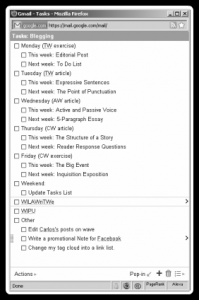
That’s what this rule is all about, and it’s one you need to start practicing. We’re going to get that practice this week with a good old-fashioned To-Do List. Make a list of all the projects you’re working on right now, all the stuff you need to get done, but spend some time formatting it and packing in information to make it useful to a reader other than you.

Divide your to-do list into at least three categories. Give a brief introductory paragraph at the beginning (probably just explaining you’re doing this because of this exercise), and then include section headers for each of the categories. Follow these headers with some sort of introduction to each section, and then include your list items.

This is some fantastic practice. It’s also a great opportunity to brag to the world about all the things you’ve got going on. Share your To Do list with us on the discussion board, or even right here in the comments.

Courtney’s Work-in-Progress Update

Courtney Cantrell shares her work in progress

Last week, I blogged about how writing for Unstressed Syllables has helped me up my WIP wordcount. One of the unfortunate side effects of working more diligently on my WIP is that I haven’t taken some of the WIP time to give you a WIPU. And if you’re already tired of acronyms, please forgive me–because I suspect this might be an ASoP.*

So, without further ADO**, I give you my Work-in-Progress Update. I decided to take the list from my last update and…um…update it. Yeah.

1. I need to fill in the gaps of story in chapters 4, 5, 7 and 14.
I thought I had also finished with Chapter 7. But when I next opened the document and checked back over my work, I discovered that I’d cheated. Shock and dismay! I can’t tell you the details of how I cheated, because that would mean retelling more of the story than I want to get into right now. Suffice it to say that I knew I’d cheated because a section of the chapter progressed from one conflict to another with no transition material. Sometimes, I can make such a leap without throwing the reader off. Sometimes, that can be a good technique for moving from one chapter to the next (as long as the next chapter contains even the briefest explanation of what happened in-between). However, for such a jump to take place in the middle of a chapter isn’t the best idea. It only confuses the reader and obviates my laziness: When I wrote this particular scene, I was eager to move forward and didn’t take the time to let the story flow the way it needed to. Now, I must rectify this.

2. I need to write Chapter 8.
I don’t want to write Chapter 8. It will contain a conversation I don’t want to have to write. The characters aren’t going to like it, which means I don’t like it. But if I don’t write it, I will repeat the error of Chapter 7–only on a grander and less-easily-fixable scale.

In this business we call writing, there is no room for laziness.

3. I need to go through the whole document and delete all the “extras” I didn’t backspace out of existence during National Novel Writing Month.
Done! Woot, I rock, and all that funky stuff.

4. I need to make final decisions regarding the placement of several bits of demonic inter-chapteral monologue.
This won’t happen until all the chapters are complete. That’s why this point on my WIPTDL*** occupies the final position and always will occupy the final position. The points that come before are both mutable and moveable.

I intend to knock out chapter 7 and tackle 8 before Saturday graces us with her presence. Chapter 14 must languish in incompleteness for now. I’ll keep you posted!

*Acronym Sort of Post
**Anxious Dog Owners? Arbitrary Door Opener? Anteaters Don’t Overeat?
***Work-In-Progress To-Do List

P.S. Saturday, 12:10a.m. Okay, so I’m ten minutes late…but I just finished Chapter 7! Huzzah! Huzzah! In the meantime, I’ve realized that two characters in the chapter need to switch places–so I want to make those changes before tackling Chapter 8. Maybe I’m just procrastinating starting on The Dreaded 8…but honestly, I’m okay with that!

Photo credit Julie V. Photography.

The Big Event (Creative Writing Exercise)

Yesterday I jumped into what makes a story, and I focused heavily on the Conflict Resolution Cycle. The protagonist (your main character) is constantly trying to get out of the story you’re telling, but obstacles keep popping up all along the way.

And the biggest obstacle, of course, is the very first one. The big event. Something happens, something bold and dramatic, to derail your protagonist’s life. That’s the impetus of every story, and it’s usually a lot of fun.

I’ve been haranguing you to get to your big events early. First page, I’m always saying, and first paragraph if you can manage it. So let’s practice. This week’s writing assignment is one to three pages (300-900 words), and in that space I want you to start a story. Give us a character, give us a glimpse — the barest hint — of what his or her life is like beforehand, and then mess it all up.

If you’re already doing that in your writing, share it with us. Paste in pages one to three. I promise I won’t steal your story idea, and you can show the rest of us how it’s done. If you’ve written hundreds of pages without ever clearly settling into any story (and, at some point, we all have), then it’s time to figure out what you want to have happen, and make it happen. At the very least, it’s a good idea to get some practice.

So write up a big event. You don’t have to finish the story, you don’t even have to have a plan for it. You have to fill up a couple pages, and I fully encourage you to leave it off with a brutal cliffhanger ending. Show you know how to get things moving, though. That’s the challenge.