Skip to content

On Style: Master Your Writing Style

As I was getting to know Julie Roads through her blog, I remember a couple relatively innocuous or offhand comments that stuck out to me. That’s one of the strange things about blogging — you never know where a reader’s going to start.

So it’s easy to make an offhand reference to something you may have talked about before — maybe even something you’ve run into the ground, like the importance of paragraph styles and document templates — and catch a new writer completely off-guard. The way Julie writes, and as long as she’s been writing, there was a lot of that for me the first few weeks.

One such comment was when she talked briefly about writing software and mentioned, like it was the most normal thing in the world, that writing had never worked for her until she started writing in WordPress. I didn’t get it.

WordPress is nice and all. I’ll recommend it to anyone wanting to start a website. And I do write all my posts in WordPress’s interface (as opposed to, say, using Google Docs or MS Word to write drafts and then copying it over to WordPress when it’s done). It’s good enough, but I couldn’t see anything special about blog software.

That was before I got to know her. That was before I learned that Julie Roads had turned the humble blog post into her own personal artform.

Developing as an Artist

Back when I first thought I might end up talking with Courtney from time to time, one of the first things I did, as a defense mechanism, was read every word of her blog archive so I could be prepared just in case I had to get to know her. With Julie Roads, I’ve reversed that. Sure, I started at her blog, but it wasn’t until we became friends that I really started digging way back in the archive.

By that point I did know about her obsession with the blogstory…so it struck me as something of a surprise to read through her first two or three month of posts without encountering so much as an anecdote.

Obviously, two years have changed that. Maybe she was just warming up, or maybe she didn’t know where she was headed when she started, but somewhere along the way she found her pace, and she’s been holding it strong a while now.

That’s really encouraging, for all of us. Because after three days of hearing what an awesome writer Julie Roads is, maybe you’re wondering if this series has actually got anything to offer you. How about a little guidance?

Following in Her Footsteps

Your job, as I said yesterday, isn’t necessarily to master the blogstory style. It might be worth working on — since you really should be blogging — but that’s not the most important thing in the world. Your job is to become really good at the type of writing you do. And even if the medium is different, the things Julie did to master her craft could help you master yours, too.

Iteration

Think about the writing you do, within your genre and style. How often do you develop a new document, start to finish?

That’s really one of the most significant factors that determines your skill. And that’s good news! Whatever type of writing you want to do, you don’t have to be great at it now. You just really, absolutely, critically need to get more practice. Practice and practice and practice some more.

That’s one thing blogs really have to offer: iteration. The moment you commit to writing a blog, you’re committed to lots and lots of trial and error. That’s a good thing.

Getting material published as often as possible makes search engines happy and it makes fans happy. It also builds you up over time, incrementally improving what you’re capable of doing, until one day you look back and find yourself the master of an art you weren’t even really working on when you first started.

Connection

Once you’ve found a rhythm, as soon as you’re really getting stuff written, find a way to get your stuff read. You eventually need feedback if you’re going to turn trial and error into any kind of progress.

But, more than that, creating a strong connection with your readers can feed you. Writing — especially creative writing — is all about reaching out and touching another life. The better you can do that, the more often you can do that, the better your writing will be.

Transparency

And when you’re doing it well, when you eventually learn to trust your readers and yourself, you’ll find a whole new level of creative expression. Trust me, I’ve experienced that with the Ghost Targets series, and Julie talks about it all the time at her blog.

In blogging that’s usually called “transparency,” and it’s considered an incredibly valuable asset in building a site. I guess I was participating in a little of that with last Sunday’s post, based on some of the comments I’ve received, but I really didn’t think of it as a “brave” thing to come out and tell my story.

Looking at it critically, though, it was. And that’s not a story I would have told six months ago.

But I’ve had that time to practice telling stories about myself here, though. I’ve gotten feedback and refined my presentation. I’ve made real connections with total strangers, and I’ve discovered I’ve got readers I can trust with some of my best stories.

That’s the process, in a nutshell. I learned it from Julie even as I was learning it from my own experience. It takes time — like so many of the good things in life do — but that’s no reason to get discouraged. It just means you should get started right away.

What kind of writing are you going to do?

On Style: Deconstructing the Blogstory Style

Yesterday I told you how I became friends with Julie Roads by commenting at her website. It certainly didn’t hurt that I was leaving comments rich with praise for her stuff.

Actually…she appreciated that aspect of them, but it slowed me down a little. I worried, since she had so little context for my sudden appearance, that just leaving compliment after compliment on her posts, it would all come across as self-serving flattery. It wasn’t, but I worried it would seem that way.

The difference was that I didn’t just say, “Wow, this is good. Wow, you’re amazing.” (You know me — I can’t possibly keep to that few words.) Instead, the things I said were specific, and pretty early in those emails that I mentioned, she wrote me and said,

“Mostly I want to tell you how good it feels to have someone else – a fellow writer and obvious kindred spirit – get what I’m writing and connect with it.”

That part was easy, though. I got it, because she was doing exactly what I’d been trying to do over the course of three different blogs for most of a decade. And I connected with it because the writing was just that good.

The Value of Story

I’m lying to Google with that particular h3, because there’s no way I’m going to cover “the value of story” in one blog post. Trust me, that one gets its own series.

But still, the value of story is at the heart of this whole discussion. Stories are powerful communication tools. They appeal to readers, they can carry immense amounts of significance, and they persist in memory much longer than bits of factual data do.

For all those reasons (and, significantly, because I was a storyteller first), I’ve used stories from the very start at Unstressed Syllables. I like to use them as illustrations and anchor points, and whenever possible I’ll use a story from my life, all on its own, as the first part of each of my three-part series. They make fantastic introductions, drawing readers in and providing a context for the sometimes-dry lecture-style articles that follow.

Elements of a Great Blogstory

With Julie, though, the story is the lecture. And I mean that in the best possible way. Did you read the post I linked to yesterday? Or any of her new stuff? It’s amazing how much she can accomplish with one little anecdote.

She’ll be telling a story about her life, maybe 400 words total, and you’ll be all caught up in it, and then right around the point where I’d put a section heading and transition into the beginning of my real message, she’ll drop in a two-sentence punchline, and change your world.

And it’s not just a matter of personal style — every bit of that experience is deliberate craftsmanship. A great blogstory is:

  • Short (usually under 700 words) for easy digestion and ready access to the busy blog-reading crowd
  • Effective as a standalone concept, but even stronger within the serial context of its parent blog
  • Everyday, often centered on relatively casual real-life happenings, but given weight either by circumstances or (far more often) an effective application
  • Interconnected, so that it works on many levels, and reaches the many different kinds of people who might happen across the blog

Master Your Writing Style

Julie has an infuriatingly consistent ability to nail all four points, every time she posts. That’s because she doesn’t just approach the blogstory as an aspect of her writing, or as a helpful tool in the writer’s toolbox. For her, the blogstory as I’ve described it is her writing style.

You should read her blog. You don’t have to agree with my analysis — everyone’s entitled to his or her own opinion — but you should invest a little time and read at least a handful of her posts to see exactly what it is I’m talking about.

Why? Because you need to do the same thing. And I don’t mean you need to write blog posts like hers. You need to find the document type and writing style that work for you, and turn yourself into an expert. That’s what Julie has done (and with her it just happened to be blogging), and that’s the best lesson she’s got to teach any of us.

Come back tomorrow, and I’ll talk a little bit more about it.

On Style: Julie Roads, e-Friend #2

It’s a crime that I haven’t mentioned Julie to you yet. A terrible, vicious crime. You’ve got my heartfelt apology.

Julie Roads is a freelance copywriter who owns her own marketing company. She loves writing. She’s passionate about it, but more than that…she’s really good.

Friends in High Places

She’s also got a higher pagerank than I do. No surprise there, but it ends up being part of the story.

I’ve already told you how I got to know Courtney Cantrell, my first ever e-Friend and (as I mentioned there) also really the first new friend I’d made in seven years. (If that struck you as strange at the time, I suspect Sunday’s revelation of my crippling social anxiety might have provided a bit of clarifying context.)

Well, even though I had my handy label for the disorder, I was still dealing with all its effects six months ago when I decided to start a serious blog and discovered that one of the absolute keys to successful blogging is active, aggressive socializing. The only way to get noticed — by readers or by search engines, and both are critical — is to start rubbing shoulders in the community, handing out business cards, and repeating your name as often as possible.

Specifically, you’re supposed to comment on busy blogs. That gets your name (and your hyperlink) in front of readers’ eyes. With a little luck and a lot of effort, you can create some real relationships, maybe land a guest posting spot or some articles featuring you (with valuable links announcing your existence to Google).

I read all that, and I understood it was critically important and why, and then I promptly didn’t do any of it. I tried. I tried for a while. But commenting always felt artificial, awkward, forced. My demons came to the fore, and I quickly retreated.

Then Kelly Diels said something on Twitter about Julie Roads one day, and I followed the link…and I found something amazing. Among all the blogs that had invaded my life over the course of six months, I’d found a lot of voices, and I’d found a lot of good writing, but I hadn’t found anything like Julie Roads.

The Blogstory Style

She told a story. A short little story, a blog post recording idle thoughts she’d had while at the gym, but it danced with style and structure. It did everything necessary to lead the reader by the hand, and without ever seeming to try, it built up to an irresistible message.

I was astonished at the quality of storytelling. I was so impressed that, without even thinking about it, I left a comment saying as much.

Then she surprised me again. She replied — not only in blog comments, but also in an email. Email I can handle. It’s one-on-one. It’s exactly the sort of thing I appreciate, and as startled as I was to hear from her directly, I fell right into it. We chatted back and forth for the rest of the day.

And then…well, for the next two or three months. Without even trying, I made a friend. She’s fun, and clever, and terribly cool. She’s also got a thing or two to teach us all about writing. So come back tomorrow for a detailed look at what makes Julie Roads such a phenomenal writer, and then Saturday to learn how you can follow her example…and find your own style.

(And if you’d like to read ahead, by all means, go check out her site and figure it out for yourself. I won’t complain.)

Photo credit Julie Roads.

On Markup Languages: How to Use Heading Styles

This week I’m talking about document formatting through markup, and specifically the difference between applying labeled styles to your document and just using formatting effects. When you do it right, a little bit of work beforehand can make all your writing easier.

If you’ve set up a WordPress blog, you’ve probably seen this in effect. With blogs (or really any well-made webpage), the styles are built in a stylesheet document called “style.css.” If you know how CSS works, you can scroll through a bunch of code that looks like this:

a {color: #d8d97e; }

a.hover {color: #5e5222; }

a.visited {color: #b34a10; }

And you just see blonde, brunette, redhead….

Ahem. Anyway, the stylesheet defines what labels you have available, and what they look like. In addition to letting you design new styles, it lets you customize the standard styles everyone uses. And, really, those should be your main focus.

How Heading Styles Boost Your S. E. O.

Those standard styles are the ones you’ll use the most. Some of them include:

  • <em>
  • <strong>
  • <a>
  • <p>
  • <h1>
  • <h2>
  • <h3>
  • <h4>

Those styles at the end, the ones starting with H, are the heading styles. If you wrap a bit of text in H1, it’s going to show up much larger than your normal type, probably bold and quite likely in a different font. As we discussed yesterday, though, it’s more than just font effects — it’s a label which carries meaning.

Specifically, the Heading styles are hierarchical, allowing you to flag the most important ideas in your document and show how those ideas are related. Eventually, if you do it right, all the headings in your document should easily create an outline, like so

<h1>Unstressed Syllables — Writing Advice for Everybody</h1>

<h2>On Markup Languages: My Crisis of Faith</h2>

<h2>On Markup Languages: Labels vs. Effects</h2>

<h3>Paragraph Styles</h3>

<h3>Markup Languages</h3>

<h2>On Markup Languages: How to Use Heading Styles</h2>

<h3>How Heading Styles Boost Your S. E. O.</h3>

<h3>How Heading Styles Save You Headaches</h3>

<h4>Applying the Labels</h4>

<h4>Picking the Right Labels</h4>

<h3>How Heading Styles Build a Book</h3>

That gives you all the benefits of a good document outline that we discussed last week. More importantly, it gives those benefits to Google.

See, when a search engine browses your page to find out what you’re talking about, it pays special attention to certain HTML elements — things like the title, anchor tags, and the various levels of heading style.

What it doesn’t pay attention to is font effects. Google doesn’t care about bold text or larger print. Even if your line looks like a section heading, search engines will ignore it unless it’s wrapped in the <h3>.

How Heading Styles Save You Headaches

Now, admittedly, until you get used to it, it can seem like a little bit more work to flag a heading as a heading instead of just selecting it and hitting Ctrl-B (or clicking the B button at the top of the screen). And even when you’re ready to commit to that, you’ve still got to know what kind of heading you’re supposed to use.

WordPress (like most modern writing software) actually makes it really easy to handle both problems.

Applying the Labels

Next time you’re writing a post in WordPress, look for that easy B button I mentioned in the toolbar above the editing box. Right beneath it, there should be a dropdown box that says “Paragraph.” If you click the box, you’ll see a list of all the available styles, and clicking on Heading 3 is really not much harder than clicking the B.

Of course, you may not have that toolbar. By default, WordPress only shows one row of buttons, but the last button in the list is a toggle that says “Show/Hide Kitchen Sink” if you hover over it. Click that, and BAM! Just like that, you’ve got the tools you need to get your job done.

Picking the Right Labels

Picking the right labels for your headings is just as easy. Remember the outline I showed you above? Most blogs work according to the basic layout, with the website’s title set up as H1 (and you’re only supposed to have one H1 per page, ever). Then your blog post title (or titles, if you’re looking at an index of multiple posts) will each be H2.

Your theme should take care of all the H1s and H2s for you. That means that by the time you’re writing the content of a post, your highest-level headings should be H3. And, really, that should usually be enough to do the job for you (although I sometimes go to H4, as you can see here, and WordPress easily supports all the way down to H6).

How Heading Styles Build a Book

As I said yesterday, paragraph styles are powerful tools in nearly any writing software, not just the markup languages. I’m out of words for today, but come back next week for the story of BookMaker, and how using heading styles in Google Docs has made me into a publishing company.

On Markup Languages: Labels vs. Effects

Yesterday I talked about my social anxiety and how it broke me. And I promised that it had applications to tech writing.

The problem I ran into was that I could clearly, directly see the effects in my life without so much as a clue what the causes were. That’s pretty typical of anxiety. It’s one of your body’s defense mechanisms, sensing a threat and prompting you — through strong, physical cues — to get out of that situation.

There was a time when that threat should have been real and obvious, a tiger crouched and ready to spring, or a warrior from an enemy tribe threatening you with a deadly weapon. Time and technology have brought us to a point where we don’t face threats like that much anymore. The dangers are so much more subtle that a sick feeling and a rapid heartbeat aren’t enough to tell you what is wrong, they just say stupidly that something is wrong.

Paragraph Styles

And that situation has a surprisingly strong parallel in document formatting. By “formatting” here I mean specifically text effects, from the humble italics and underline to inset margins and Small Caps headings.

There are times and technologies that still leave an underline or a bit of ALL CAPS sufficient for emphasis, but when you are preparing a document in any sort of modern writing software, the vast array of formatting tools available can become a problem. Sicne you can do so many different things so easily, the effects can easily become ambiguous, and ultimately self-defeating.

The solution is to attach an accurate label to the effects. Just like learning the name of my problem showed me what to do with the symptoms I saw in my life, applying format styles to your text effects gives you power over them.

Markup Languages

There are some powerful document authoring tools built entirely on that principle (and all of them support it). Programs like LaTeX force you to separate your content (the actual words on the page) from your design (the way they look on the screen).

The most common way to do that is to wrap individual pieces of text in “markup” — pair brackets that describe the purpose of every word in between them. If you’re trying to visualize that description, just think of a webpage.

HTML — hypertext markup language — uses pairs wrapped in < and > symbols, so a bit of text that say this:

Click here to learn more about Unstressed Syllables.

can be labeled as a hypertext link, using the “a” label:

<a href=”https://unstressedsyllables.com/about/”>Click here to learn more about Unstressed Syllables.</a>

Once I do that, I can make the text do something.

Of course, I could easily apply the same formatting effects you see there, make a random bit of text glow green (or blue and underlined, I guess, if you’re reading this in an RSS stream). But the pretty colors don’t actually do anything.

In fact, it’s just confusing, because your readers know what those effects should mean, but without the label, your website doesn’t know what to do with them. Correctly applying every one of the standard hypertext tags carries that same significance, even if the reasons for some are a little bit more subtle.

And this isn’t limited to HTML. There are many useful markup languages, including XML, SGML, and the several custom languages used to make wikis quick to write, easy to read, and powerful display engines.

How to Use Heading Styles on Your Blog

I’ve talked about paragraph styles before, but they’r such powerful tools I want to make sure you know how to use them (not just that you should). That “how” changes from one authoring tool to another, so I’m going to have to look at some specific examples in close detail.

I’ll start with one you should be familiar with. Come back tomorrow for a look at how to use heading styles on your blog, and I’ll help you make sure your text effects are working for you, not against you.

On Markup Languages: My Crisis of Faith

Ten and a half years ago, I had a crisis of faith. And I don’t mean that in the metaphorical way it’s so often used. I mean genuinely, spiritually, heartbreakingly literally.

It’s a sad story. But stories have the power to heal. They have the power to help others. And, if you stick with me, this one even has the power to make your writing a little less painful.

See, when I was a kid, I was deeply religious. At one point I spent a year trying to organize my church friends into an a capella singing group, in spite of the fact that I couldn’t carry a note, only one of them actually wanted to do it, and we were all twelve.

I went to church camp every summer, served Communion as often as my turn came up, taught classes at retreats and even went away for a week-long youth group Leadership Training Seminar at some point. Then I went off to a private Christian school for college, and my first semester there one of my professors invited me to participate in the summer British Isles Mission Trip.

I’d never been overseas, and I’d spent much of my life dreaming about a visit to the English countryside. So when he asked, I leaped at the chance. It was an opportunity to do something good, and go to fantastic places while doing it.

Dr. John Maple, the leader of the mission trip, spent six months helping us arrange funding and prepare for the trip. There were eleven college students in the group, and we’d be heading over to the British Isles for six weeks. Six weeks! It was terrifyingly big, but Dr. Maple made it all sound simple. He’d been doing it every summer for years.

When we got there, we spent a week teaching a little VBS at a community church, and then a couple weeks assisting at a staffed church camp in England that tended to get a little overworked. After that we moved up to Scotland where we actually were the staff of another church camp, teaching lessons, putting on puppet shows, organizing activities, and generally keeping the kids from wandering off and getting kidnapped off the moors by malicious faeries.

It was all the stuff I’d done in my youth group for years. None of it was terribly challenging, and I was there along with ten other phenomenally committed, hardworking, and just generally excellent people.

But I hated it. I hated every minute of it. I hated touring London with the rest of the group on our first day there. I hated getting together with the rest of the group every morning for breakfast. I hated teaching classes. I hated playing out in the yard with the kids….

Here, let me put it like this. The first place we went, the camp there in England…it was in an old castle. Walking in the front door, I could easily picture Hogwarts. My room was up in a turret, looking out over the lawn, which was cleared of trees for a good forty yards in all directions. And I was so miserable just being there, that I hated staying in a castle.

I had no idea why. I kept trying to figure it out, but there were no answers. I was doing the Lord’s work in a place I’d always wanted to visit, surrounded by incredible people, and it made me miserable.

So I drew the only conclusion I possibly could: I’m a horrible person. There’s something deeply wrong with me, if I hate doing good this much.

I kept trying to tell myself that it wasn’t true, that I was just in some kind of funk, but day in and day out for six weeks, it never once lifted, and I finally just came to terms with it. I don’t love God, I decided. I don’t love the faith of my fathers. I’m just a jerk who hates all these kids and all these good people.

I’ve got enough self-esteem that I didn’t hang onto those thoughts too long. I got home from the mission trip, I was sick for a week or so while my hatred subsided, and then I gradually forgot to despise myself.

I never really got back to the religion I’d had beforehand, though. I realized there was no place in that religion for me. I still had no clue what it was, but I knew there was something inside me that just did not work with the principles I’d been chasing after for my whole life.

It took me eight years before I found the answer. And it was a depressingly simple answer, too. Social anxiety. It’s a relatively common personality disorder, and I now know I’ve had problems with it for most of my life.

I’ve also dealt with it, without ever really knowing what was going on. But the mission trip was too much — too many new people, too many new places, too much chaos and absolutely no escape for six weeks straight. I basically went into an anxiety attack in June that didn’t let up until mid August, and I had to work long hours through every single day of it.

Labels vs. Effects

It’s just a name, “social anxiety disorder,” but those three short words told me enough to resolve instantly all those years of confusion and self-doubt. They told me enough to reconcile myself to the faith I’d mostly abandoned (or, as it felt, been abandoned by).

Those words fixed something that was broken inside me, before I even started fixing the actual disorder. Without changing the effects at all, without altering my experience in any way, having an accurate label for those effects improved my life.

Because it helped me understand. It helped me find the “why.” It provided a reasonable context for something that had seemed entirely arbitrary, and that explanation was enough to bring me from crisis all the way to understanding.

That’s what’s in a name. And we wrestle with those very same issues in writing. It’s on a much less dramatic scale, of course, but if you’ve ever wanted to scream at your document because the formatting just wasn’t working, and it made no sense…you’ve been there.

Come back tomorrow, and we’ll talk about your writing disorder. It’s amazing how much you can improve your document with a simple understanding of the difference between label-based and effect-based document formatting.

On Story Structure: Guiding Your Readers to the End

I’ve been talking about mazes all week, specifically how to design a maze from a blank page, and how the process of making a maze resembles good storytelling. I hope I haven’t lost you.

In yesterday’s post, I said the whole process boils down to three big principles:

  • Make sure your structure is intact (fill in all the plot holes)
  • Make sure it’s challenging, the easy answers hidden in the structure (after all, that’s what makes it interesting)
  • And make sure it’s solvable (with a plot that your reader can follow from start to finish)

Today I want to talk about that last one.

Provide an Unbroken Thread

See, even though your job is to provide all the decoration necessary to make a challenging maze (as it were), your job as a writer has one major difference from that of the mazemaker. When I made a great maze, the very last step was to turn it over to one of my friends and let him try to figure it out. He was all on his own. That was the point.

As a writer, once you’re finished building the structure, you change roles. You become more like Ariadne, the girl from Greek myth who inspired the illustration I used at the start of all this . She provided a simple spool of thread to the hero Theseus, before he entered the famous Labyrinth of Crete, and it was enough to let him find his way back out again. If not for her gift, the great hero’s story would have ended with him walking into the maze and getting lost forever.

Your job as a writer, once your draft is done, is to protect your readers from that very fate. Go back to your book, and review it start to finish. Make sure its structure is sound, make sure it’s got enough decoration to keep it interesting, but most of all, make sure there’s a single, unbroken thread to lead your reader from the entrance, all the way through the twisting corridors of your tale, and back out the other side safe and sound.

Offer Them a Way Out (Creative Writing Exercise)

And let’s practice that today! Right now! I’ve given you a handful of writing exercises recently, but it’s been a while since I’ve done a real story prompt.

Today I want you to write a scene. Make it 300-900 words, and let’s stick with the Greek Mythology motif: start it out in media rez (which is to say, in the middle of the action). From the opening line, your characters are already caught up in the most interesting part of the story.

Put them in a maze (literal or metaphorical). They’re trapped, their lives are on the line, there may well be monsters lurking down any wrong turn, and you’ve only got three pages to find them a way out (and make sure your reader follows along).

It’s a challenge, but then, a good writing prompt should be. Show us what you can do. Post your scene in the comments, or put it on your blog and give us a link. Either way, drop us a line.

On Story Structure: What a Maze Can Teach You about Fixing Rough Drafts

Yesterday I told you how I wandered away from writing and got lost in mazemaking for a few years. It baffles me why I did that, but it absolutely proved to be a good thing.

Not because I added a new art or hobby to my life. Not at all. I dropped it just as quickly as I’d picked it up. It did add a valuable dimension to my storytelling, though.

When it comes right down to it, every maze is a story. It’s inherent in the structure. A story, as I’ve often repeated, is little more than a beginning, a middle all full of complications, and an end — all the things mazes are famous for.

That was exactly the structure I learned to build in the story I told yesterday. The way the different sections fit together created the plot. And the expectations that the reader (or player, or mazer, or whatever you’d call them) brought to the table — the need, having entered, to exit safely on the other side — created the conflict, the complications, the climax and resolution. It’s a microcosm of novel-writing, without any of the messy words.

That’s a valuable parallel, and an important image to bring with you whenever you begin the process of finishing a book. As you review your story, searching out opportunities to rewrite, revise, or edit, a big part of your job is to look for those very things I demanded from my mazes:

  • Make sure your structure is intact (fill in all the plot holes)
  • Make sure it’s challenging, the easy answers hidden in the structure (after all, that’s what makes it interesting)
  • And make sure it’s solvable (with a plot that your reader can follow from start to finish)

Solid Structure Doesn’t have to Be Obvious Structure

Does all this talk of structure make the whole book sound like it would be boring to you? If so, I can understand that – in fact, when I really started putting deliberate structure into my novels for the first time, I worried about precisely that. I thought that maybe writing to a solid structure robbed my story of life.

I couldn’t have been more wrong. The problems – and all of the examples that might spring to mind – are not cases of solid structure, but obvious structure. If you let yourself lean too heavily on boring genre conventions, using the same complications and resolutions everyone else uses, then sure, the whole thing becomes predictable and uninteresting.

Mazes are exactly the same way. I talked before about the benefits of drawing some solid boundary lines, boxing out my maze. Behind the scenes, those lines were what turned the maze into an interesting, challenging puzzle. If I’d given that to a reader, though, it would have been child’s play – huge open areas, each with exactly one entrance and one exit, plodding across the map from the start to the end. It wouldn’t have been a maze at all, and it certainly wouldn’t have been interesting.

The lesson there is the importance of everything else you have to say. All the extra lines, all the filler, are what make a game out of a handful of boring boundaries. Your structure defines what you say and when you say it, but the bit that makes it interesting is how you say it.

That’s your voice, your style. That’s your own vivid characters and clever reversals and everything that does make your story unique. Maybe there’s only a handful of possible storylines, and they’ve all been written, but none of them has been written your way.

Guiding Your Readers to the End

There’s one more key lesson from the mazemaker to the storyteller: make sure your readers can navigate your story’s plot. Come back tomorrow for more on that, and a writing prompt to boot!

On Story Structure: Ariadne’s Thread


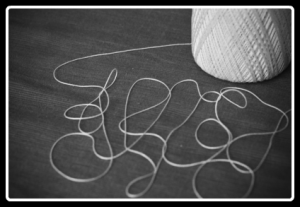
Ariadne's Thread: It was a small gift to offer him a way out, but we remember.

Ariadne's Thread: It was a small gift to offer him a way out, but we remember.

Writing this blog, I’ve said more than a few words about my childhood. One bit that stands out for me is a phase I went through in Middle School. For a while, I stopped writing. I stopped drawing or playing video games. I gave up most of my hobbies to focus on a new obsession: for six months (maybe a year) my only creative interest was mazemaking. Never got a book, and I certainly didn’t have the amazing wealth of the Internet available to teach me in six easy steps. I just taught myself, start to finish.

I wasn’t willing to let that be an excuse for poor quality, though. I had some 99-cent workbooks packed with hundreds of mazes, but they were all garbage. I wanted mine to be works of art. I wanted every maze to be perfect — with as long a path as reasonably possible, and always exactly one solution.

I also spent a lot of time thinking about the old “start at the end and just work backward” trick, so I’d design the maze in both directions, meeting at the middle. And, in case none of that sounds difficult enough (for a twelve-year-old), I was doing this all by hand, on graph paper. It was a tedious process.

There was one trick I learned, in all of this, that made a world of difference. It was just something I made up, a starting point, but it changed my mazes from boring, huge timesinks into real challenges that I could make from beginning to end during just one Pre-Calculus class. It wasn’t that big a deal, either. I just started with a big empty rectangle, and divided it into sections.

At first I used four sections, with one vertical line and one horizontal line each dividing the maze at the middle. I left exactly one space of opening from one section to the next. That guaranteed my “only one solution,” as long as I made sure the maze passed through each section, because I knew none of the side paths could ever get across that boundary.

It was effective but obvious, so I soon learned to mix it up a little. I’d offset the divider lines, make them jagged (so they wouldn’t stand out as well once the rest of the maze was filled in). I also quickly moved beyond quadrants, until a single maze had six or ten or twelve sections, all of different shapes and sizes. The smaller those boxes got, the faster I could draw a path across one, but the more challenging my solution got.

That technique, all by itself, dramatically improved my mazemaking. I learned how to draw the solution on a mostly blank page, with a handful of solid lines doing all the heavy lifting for me. Once that foundation was in place, I’d fill in little cross sections and dead ends and misdirections until the solution disappeared, my guidelines blending in perfectly with all the decoration.

What a Maze Can Teach You about Fixing Rough Drafts

Maybe I wasn’t writing a lot at the time, but I still found myself learning writing lessons from this new pastime. One of the things that struck me most — and probably the thing that appealed to me in the first place — was the similarity between mazemaking and storytelling.

I’ll talk more about that tomorrow, and tell you just what a maze can teach you about fixing rough drafts. Then on Saturday I’ll talk about how to help your readers fall in love with your story. That’s what it’s all about, right?

Photo credit Julie V. Photography.

What I Learned about Writing this Week…from Trusting My Brain

Oh, my dearest inklings. This WILAWriTWe invites you to nod sagely and go, “Mmm-hm. Yes, we knew that already. Haven’t you been paying attention to your own blog, Courtney?”

Sadly, the answer to that internal question of yours is, “Apparently not.” But before I continue in this vein too reminiscent of vaguebooking (would that be vagueblogging?), let me enumerate whence originate these unspecific yet somewhat self-deprecatory ruminations.

And yes, I have ingested coffee.

*ahem*

So. A few days ago, I was somewhere. I don’t remember where. But someone said something, and I thought, “Aha! That’s gonna be the basis for my next WILAWriTWe!” Or maybe I saw something that elicited similar mental exclamations. Or perhaps I was watching something or reading something that made an inner moodstring go twang. Whatever it was, it caused me to pen an entire article inside my head in the space of about three seconds. Give or take a couple hundred microseconds.

However, as the preceding paragraph might have already made you realize, I no longer recall what the inspiration was or what the inspiration inspired me to. Because, my darlings, I failed to write it down.

Aaron has talked about it. We’ve all heard it before. I’ve probably even mentioned it myself somewhere here at Unstressed Syllables. The “it” in question is this: Carry around a scribblebook. Keep scratch paper with you at all times. If nothing else, grab a pen and make illegible microdots on the back of a receipt. Or on the front. Whatever implements you choose, take them to hand and write down your idea.

Don’t trust your brain – your brain’s not trustworthy. It’s got too much going on in it already. It’s trying to remember to pick your kids up from school or to balance your checkbook or to call your mother. You can’t expect it to remember brilliant flashes of creativity. Because those are brilliant flashes of creativity. They are, by nature, brief, temporary, fleeting, insert redundant and overemphatic synonym here. They last – whaddaya know – about three seconds. And if you don’t capture them via some sort of writing instrument paired with a receptive writing surface, those glorious flashes are going to go the way of the dodo. (And if you don’t know what happened to the dodos, I recommend a viewing of Ice Age.)

If ya wanna change the world, ya gotta take notes. Such is the nature of the writing life. I know this. I know this very well. I now reap the disappointing fruits of having ignored this knowledge in favor of whatever foolishness caused me to think I would remember the brain-penned article that turned out to be a whole lot more ephemeral than I imagined.

Therefore, in lieu of a magnificent article chock-full (what is chock, anyway? and why is it good for things to be full of it?) of sweet tidbits for your muses to chew on, I offer these coffee-inspired ramblings to encourage you: Be more diligent than I! Record your cramazing flashes in some permanent fashion – or even a semi-permanent one! Make use of that scribblebook or those (shudder) Starbucks receipts you were going to throw away. Please, I implore you: Don’t consign the light of imagination to the outer darkness of forgetfulness!

And that’s WILAWriTWe. 🙂

Photo credit Julie V. Photography.