Skip to content

My First Mob Hit

A couple years ago I finally joined Facebook, hoping to track down some long-lost friends, and with one very sad exception, I’ve managed to do that.

I’ve also — entirely by accident — gotten a lot closer with other distant friends and my extended family in the process. I’ve made a couple business connections, and even learned a thing or two about the friends I hang out with every Friday night.

I quickly learned that Facebook had some real value. Oh, and one more thing: Games.

One of those friends from high school invited me to join his mob in Mob Wars. How could I resist? I started playing, flew through the tutorial, and then discovered the game’s whole gimmick was to make you spam all your friends to join so you could bolster your mob’s size.

I didn’t do that. I invited a select few who I thought would really enjoy it, but that was all, and it left me in a tight spot. I enjoyed the game enough that I didn’t want to quit, but with such a small mob at my disposal I also found myself with few opportunities to progress.

The big exception to that was money. One of the leaderboards for the game is Total Wealth, so I knew if I could accumulate enough money, I could essentially grab a High Score even with a pathetic little mob. I just needed to make smart financial decisions.

See, one of the game elements is the purchase of real estate. You can buy any of a number of properties (from abandoned lots all the way up to glitzy casinos) which generate constant revenue. The thing is, they’re expensive to buy, and the cost increases over time (while the payout remains the same).

I spent a long time thinking about that game dynamic, and I was pretty sure it could generate some powerful wealth for someone with a good head for numbers. That’s not me. So I turned to one of my very best friends for help: Google.

I started a Google Docs Spreadsheet. I entered the starting costs of every piece of property. I figured out the rate at which those costs increased, and the payout per hour for each property, and my total hourly income across all properties, and how long it would take me to save up for each different property, and (ultimately) how much faster that investment would get me up to leaderboard-level wealth.

I spent hours figuring out the math and designing the spreadsheet — way more than I ever spent playing the game. Once I had the spreadsheet perfected, though, I didn’t need to play the game. I’d check the spreadsheet, log in, buy the properties my equations recommended, update my holdings, and I was done. I got rich, quick. It was pretty fun.

Then one day someone told me about Farmville — a humble Facebook game that was, all by itself, more popular than the entire Twitter service. That caught my attention. I just had to find out what was so special about that game.

And it featured some of the same dynamics — investment, hourly yield, wealth collection, the ability to progress through various levels and gain access to new resources. At first, all I had were strawberries. Strawberries. What a step down from running a notorious New York City crime family!

I did what I had to do, though. I planted Strawberries. And soon enough I was level two, and I could plant Eggplant (which was a little more expensive), and Squash, and Wheat, and each one had a slightly different yield or maturation, and soon enough I realized I needed a spreadsheet for this game, too.

So I made one, at level 4, with half a dozen plants available to me now, and I ran the numbers to see what would make the most profitable plant for me to fill my little garden with.

The answer? Strawberries. None of these newer plants offered any advantage at all. They were, without question, worse. So I set those aside, planted more strawberries, and kept leveling up looking for something better. Surely, someday, there would be something better than the first plant I ever put in the ground.

Spoiler alert! There’s not. And if you’re curious, I’ve got the spreadsheet to prove it.

Photo credit me (with considerable help from Adobe Photoshop).

The Week in Words (May 15)

Aaron Pogue with a scribblebook (Courtesy Julie at PhoxiePhoto.com)

Some things I've said, and things I've read.

Here’s what’s been going on!

At the Editor’s Desk

This week has seen the trial of a new blog posting format — a shorter, more coffee-break friendly posting format. Or that’s what I’m hoping, anyway.

I also went out on a limb and called out a dying industry for what it is. I wouldn’t be surprised if that comes back to bite me!

Oh, I posted some new profile pictures too, thanks to the amazing Julie V. Photography (now proudly featured on our About page). If you want to see the full set, look me up on Facebook.

The Girl Who Stayed the Same (Working Title)

Shane over at the Creative Copy Challenge decided to start stitching things together by hand this week, so I’ve now got my very own series page. That will save me some effort digging up links for the Week in Words, and free up a project section so I can keep you posted on other ongoings. Quite cool.

If you want to get caught up, check out The Girl Who Stayed the Same, by Aaron Pogue. Go ahead and bookmark it for future reference. Expect updates every Monday and Thursday.

The Consortium, OKC

I’m going to upset a someone or two, but I’ve gotten good advice from several people who should know, suggesting that I not reveal my ingenious, visionary business plan to the world at large (and, specifically, other participants in the market I wish to dominate), years and years and years before I’m ready to actually execute on that plan.

I suppose I can see the logic in that.

Still, I’m working on it. If you’re close enough to me to ask, I’ll be happy to get you all caught up to speed. In fact, I’ve got a business meeting scheduled with a business-savvy friend for Sunday afternoon, so I might even have something interesting to say if you ask me after then.

In the meantime, I’ll hang onto my domain name, and tease you all with snippets and rumors without ever providing any real context. Sorry, that’s how the game’s played when you’re busy changing the world for future generations.

On Unstressed Syllables

Oh, and then there’s this site. As I said at the top, we changed some things up this week.

Monday’s Technical Writing exercise (old format) asked you to imagine the e-Book you’d like to sell, and prepare the promotional descriptions for it. It’s a clever sort of prewriting, and one that has served me well.

Tuesday’s Technical Writing article (old format) served as an introduction to Google Docs, including a primer on its purpose and fancy step-by-step instructions for setting up your account.

On Wednesday, Courtney talked about Yann Martel and The Life of Pi, and got some pretty impressive Retweet action out of it. But she’ll never know, because she doesn’t have a Twitter account. Shame her for me in the comments, and maybe we’ll get that rectified. (Ooh, or ply her with cookies! That might work just as well.)

Thursday’s Creative Writing introduction (new format) highlighted my confusion as a child, when I thought I’d enjoy living life like an engineer, and I honestly believed it was reasonable to try riding a bike in cowboy boots. I probably even thought it was cool! I also briefly introduced the week’s Creative Writing topic: the career path of the professional storyteller.

Friday’s Creative Writing background and information (new format) delved deeply into the topic, examining the changing face of publishing, the machinery of the new market, and the relevance of traditional publishing houses.

Saturday’s Creative Writing application and assignment (new format) considered whether an aspiring writer should still try to land an agent and traditional publisher. The answer, of course, depends on the aspiring writer in question, but I’m preparing my own venture into self-publishing and I’m doing everything I can to make sure it’s a successful one.

That finishes off our week here, and gives you a good idea of the new model. Instead of a long article and a short exercise, I’d like to do a short introduction/story, a slightly-longer post providing background information on the topic, and then another short post drawing applications and providing a writing exercise where appropriate.

How did that work for you this week? Did it make sense? Did you lose track of the thread of the discussion, or was it easier to stay engaged with the shorter pieces? Let me know, or I’ll just keep messing with things.

Across the Web

I do have a few links I’d like to share with you this week. But first you should leave me a comment. Seriously. Then you can come back and travel away to fairer lands. I promise.

And that’s the Week in Words.

Photo credit Julie V. Photography.

Giving Up on the Gatekeepers (3 of 3)

The lovely Kelley, writing at a coffee shop(Yes, “The Changing Face of Publishing” was technically 2 of 3 in this series. How about I promise to do a better job with the series titles next week, and you promise not to give me a hard time for this week’s? Okay? Awesome.)

Today’s post is supposed to wrap up our discussion of the right path for the aspiring writer. I’ve given you a funny little tale to capture your interest, a heavy load of background information and details, and now I’m supposed to draw conclusions.

What should you do with your finished manuscript, to get all rich and famous?

The official advice is still what I described as “today’s path” in yesterday’s post — get an effective blog going, build a platform, land an agent, and pray for a book deal. That’s what major acquisitions editors and published authors and famous literary agents would all tell you to do.

Disclaimer

I’m none of those things. I’m pretty good at writing stories — and pretty good at writing in general — but I’m not pretending to speak as an authority on the publishing industry. All I’ve ever done is chase after mainstream, traditional publication (and not even chase that hard, really).

In fact, when Courtney and I started our writer’s group just last summer, I remember talking at length about the dangers of self-publishing — the financial and professional pitfalls lurking out there — and I encouraged our two new writers to tread with care if they ever started heading in that direction.

That’s solid advice, just as much today as it was then. There’s a big difference between treading with care and turning a blind eye, though.

Pros and Cons

There’s benefits and drawbacks both ways. Obviously, going either route, you could waste decades of your life chasing after recognition (whether that’s an acceptance letter from an agent or editor, or significant sales numbers for your self-published book at Amazon).

There’s also money to be lost, especially going the self-publishing route. That’s where all the years of bitter negativity toward the self-publishing market have come from. After all, there are plenty of people out there anxious to tell you you’re going to be a star — that your book is perfect and everyone is craving a copy — and if you’ll just fork over a couple hundred bucks for an ISBN number and maybe a cool thou for a top-rate cover design, you can watch it go flying off shelves.

You’ve got to be careful with your money. Take things slow, do your research, and watch out for scams. That’s…technically it’s a drawback of the self-publishing method, but really it’s just wise financial advice.

On the plus side, if you do self-publish, you get to keep all your creative rights, not to mention a much larger portion of your sales. You’ll need a pretty powerful platform (or some stellar writing…or both) to get those sales numbers anywhere significant, but you’re working on that, right?

I Can Answer for Me

I can’t answer for you, and I wouldn’t try to. I’ll share my own thoughts, though, and let you do with them as you will.

Back in January, I set a New Year’s Resolution to finally land an agent this year. To really, seriously, studiously buckle down and try. As of today (or, really, a couple weeks ago), I’ve officially annulled that resolution.

I don’t want an agent. Not right now, anyway. If I get an offer on a book deal, I’ll look up someone with some legal knowledge to make sure I don’t get run over in the paperwork, but until then I’m done with query letters.

Instead, I’m going to take a stab at the new market. I’m writing a serial novel now (you probably know all about it), and I intend to release Part 1 as a free e-Book sometime this summer.

That’s basically the first act of a novel, and I’m hoping it’ll be enough of a hook to entice readers into picking up the rest of the book — in four more novella-sized parts at $1.99 each, or in a single volume for $5.99. Barring unforeseen circumstances, I should be able to have the finished product available about this time next year.

I’m going to spend the intervening time writing (of course), but also researching. I’m going to see what sort of deal I could get for print publication (probably Print-on-Demand), so I can get paper books available through Amazon. I’ll definitely have copies available for Kindles and Nooks and iPads.

And I’ll let you know how all of that goes. If it’s a colossal failure, I’ll be resolving to land an agent in 2011, and I’ll make sure to let you guys know you should do the same. If it’s a huge success, I’ll probably be warning you that my results aren’t necessarily typical…but I’ll be banging that New Market drum, too.

Why? Because it puts the power in the hands of the creators. That’s a valuable thing. Like any valuable thing, it has its costs — its risks — and that’s why I’m treading carefully. Cautious or not, though, the reward is big enough to keep me heading that direction.

Photo credit Julie V. Photography.

The Changing Face of Publishing

In yesterday’s intro I promised some writing advice about the changing face of publishing and the new market.

It’s a tough topic to tackle, but one we’ve got to address. After all, it’s important to know where you’re going — to know why you’re putting in all the effort to do things like starting a blog to build your platform — but the “career path” for a hopeful writer can be a fickle and cruel thing.

I first started trying to understand that path while I was still in high school. Back then (at least as I understood it), the path to publication went through magazines and periodicals. The “plan” was to publish some short pieces in crappy little magazines desperate for content, then get noticed by the editors at bigger, more popular publications, then publish some pieces there where you could get noticed by a book publisher who could turn you into a real writer.

I tried — Heaven knows I tried — but the stuff I was writing then couldn’t even pass muster at the little niche magazines, and by the time I was writing quality material, the literary magazine was dead.

The Writer as Promoter

With its passing came a new path, though — the one I talked about two weeks ago. Today you’re supposed to establish yourself with an online presence (your blog), then build that into a significant platform, then convince an agent your platform makes you worth his time, then wait while the agent petitions the big important publishers on your behalf.

The problem with this model is that it’s way more work — and work that has nothing to do with writing. At least in the olden days you were writing to get noticed (not doing web design and scouring Flickr for Creative Commons background art).

Not only that, but after you put in the extra work, success in today’s path gets you much smaller rewards. Back then you were getting published at every step of the way (and getting paid!), and when you finally did land a book deal you could count on the publisher to get your book sold.

Publishers today are no longer marketing their products (word is they can’t afford to). That’s why it’s so important for you establish your own platform — you’re the only one who’s going to be able to effectively sell your book — but that takes a big chunk out of the incentive to get a book deal in the first place. What’s the point of signing away your rights to a monolithic corporation if that corporation isn’t dumping money into making you a success?

They are, of course, but as the publishing industry has withdrawn from marketing (and, if I understand correctly, from much copyediting as well), they’ve left themselves specializing almost exclusively in warehousing and delivery, services that are increasingly irrelevant.

The Tools of the New Industry

It’s not as though they could do a lot to transition into the new era, though. The tools of the new industry offer no real advantages to monolithic corporations.

What are these new tools?

  • Internet-based advertising, retailing, and distribution
  • Targeted sales
  • Freelance editing and document design
  • Print-on-demand publication

In other words, all the services that sites like Writer Beware and Preditors and Editors have been (rightly) warning against for the last two decades.

The market has moved, though, and services that were little more than fraud tech yesterday are going to become the core machinery that drives tomorrow’s market.

Tomorrow’s Market

Anytime anyone starts talking about “tomorrow’s market” in the publishing industry today, the first thing that comes to mind is “e-Books.” And the e-Book is a formidable thing — it’s virtually free to print, stock, and distribute (all the services exclusive to traditional publishers). They’re also wonderful for consumers, offering enhanced readability, access, and convenience, not to mention fancy digital perks like hyperlinks, animated illustrations, and even embeddable videos.

And all that fancy bookmaking can be done by…well, anybody. You. Me. I put together a PDF e-Book in about two weeks (after the writing). Converting that into the sort of e-Book you’d read on a Kindle or iPad took me all of three or four hours, and it was the first time I’d ever gone through that process.

There’s more to the new market than just e-Books, though. Real books, paper books, still make up the vast majority of sales (for now), but today’s technology is even democratizing the printing process. Print-on-demand is creating books of higher and higher quality (and lower and lower prices).

That means novels of competitive quality can be produced as-needed, liberating writers from the need for extensive warehousing and expensive consignment agreements with retailers. Universities and libraries are also trying out a new(ish) bookmaking machine that can print, cut, and bind a professional-looking paperback while you wait, drawing on a library of millions of digital files like the one I designed last month.

Between technology like that (which you know will only get cheaper and better over time), the rising popularity of e-Readers, and major digital storefronts like Amazon, a novelist could — all on his own — write, print, and distribute a book to many millions of buyers, sharing none of the profit with commercial publishers (and hanging on to all the creative rights, as well).

In fact, the only pieces missing are copyediting and marketing — one a service you can easily acquire from freelancers without ever thinking the words “slush pile” again, and the other a service publishers increasingly refuse to provide anyway.

Giving Up on the Gatekeepers

Now…what should you do about all this? It’s a tricky question, and I can’t answer with perfect certainty (except to say that you should start a blog to build your platform).

I’ve got some ideas, though. Come back tomorrow for the application and assignment.

Giving Up on the Gatekeepers (1 of 3)

I’ve said often (including just a couple weeks ago) that I decided to become a writer at the age of twelve. Before then, I had other plans. I spent six years telling anyone who would listen that I intended to be an electrical engineer when I grew up.

That has often stricken me as a funny contrast, especially now that I work surrounded every day by electrical engineers. The job is pretty much the opposite of the one I want. I didn’t always know that, though.

My confusion all started in the summer of my sixth year, when I went to visit my grandparents for a week.

Granddad noticed that I had a habit of spending whole afternoons drawing. When I wasn’t busy helping with chores or pestering him to tell me a story, I was filling my notebook with page after page of pencil sketches.

One evening, when he came to call me to dinner, he found me working on that and chuckled. “Boy, are you going to be an artist when you grow up?”

I shook my head and showed him what I was working on — a ridiculously complex arrangement of gears and springs and pulleys, filling a page, all meant to drive five wheels attached to the bottom of a deformable steel panel. I said, “I’m not going to be an artist. I’m going to be an inventor.”

He sank down next to me, suddenly very serious, and said, “They don’t have inventors anymore. What you need to be is an electrical engineer.”

I repeated the name once, trying it out, and then asked him, “Electrical engineers build things like this?”

“Oh yes,” he said, in the mock serious way one talks to a six-year-old. “They’re the best at making things like this.”

And that was the end of my first and last career counseling session. I closed my notebook and went to dinner. Then I spent the next six years repeating that line. “I’m going to be an electrical engineer.”

There was no question in my mind, no worry how long I’d have to spend in school or what skills I’d need to make good on it. It was a matter of destiny. I had to be an electrical engineer because, without realizing it, my granddad had assured me that electrical engineers were the best at making an army of killer robot dinosaurs to conquer the world.

Before I was through, I had over a dozen spiral notebooks filled with pages covered, front and back, with nothing but detailed schematics. I had a plan, and I knew the career path that would get me there.

The Changing Face of Publishing

When I changed my ambition to storytelling, my career path got a lot less clear. It’s not easy to know how to get from pen and paper and a love of words to a creative writing  job that really pays the bills. Depending who you ask the path is sometimes vague, often frustrating, and always cruelly unreliable.

Worse yet, it changes. The writing advice that’ll get you published today isn’t the same as it was yesterday, and signs are pretty clear that it’ll be something different altogether tomorrow (metaphorically speaking).  I’ll tell you more about that tomorrow (literally speaking) when we discuss the changing face of publishing, the new market for storytellers, and the direction things are going.

Photo credit Sherry Pogue (Hi, Mom!)

What I Learned about Writing this Week…from Yann Martel

Courtney Cantrell's weekly writing advice

Sometimes, I dearly wish this column were meant for full book reviews.

Well, no, not really. For one thing, I doubt that many of you, my dear readers, would want me to spoil all your potential fun reads by revealing juicy details about various books. Besides, I’m not terribly interested in penning critiques week after week; I’m way too much into Read-It-For-Fun for that.

However, upon occasion I do come across a story I enjoy so much that I want to delve more deeply into it by analyzing, speculating, ruminating, and other gerunds of a thoughtful nature. Not that I don’t gain an equal amount of enjoyment from other stories; it’s just that some stories lend themselves so well to in-depth blogging, I find it difficult to resist taking out my shovels and pickaxes of literary criticism and hacking away with abandon until I’ve thoroughly deconstructed the whole kit and caboodle.

Deconstruction…Not

Well, no, not really. I don’t know about you, but I’m not much into deconstruction myself (see Jacques Derrida if you want to know more), so I’m not ever likely to pick any text apart until there’s nothing left of it. That said, Yann Martel‘s Life of Pi is one of those stories that makes me want to write about it and write about it, and then write about it some more, it touches me so deeply and so completely.

But, dear inklings, I shall restrain myself. If you have an uncontrollable urge to deconstruct or even deeply analyze Life of Pi, I invite you to do so within the comfortable coziness of your own blog — and use the comments section below to share the link to your ruminations with the rest of us!

In the meantime, I’ll keep plugging away here, telling you WILAWriTWe-style of what Life of Pi has taught me about writing, a what which pertains to structure (note the lack of any de– prefix) and variety.

Structure and Variety

Here are three specifics that stand out to me:

1. Martel tells his story (Martells his story? hee hee) in exactly 100 chapters, mostly from the perspective of main character Pi Patel. In a few of them, the point-of-view (POV) switches to an unnamed first-person narrator, whom the reader assumes to be Mr. Martel himself. In the last six chapters, POV is ostensibly the I-narrator’s, but with Pi’s POV frequently nested within the narrator’s. Yes, strangely enough, that falls under my definition of “simple.” Trust me, when you’re reading, it makes perfect sense. And it’s brilliant, besides.

2. The variety within the novel is simple, too, if variety can be called simple. Some of the chapters are “long”; some of them are “short.” Flipping through the book, I find a chapter that goes on for seven pages; this seems to be one of the longer ones. Chapter 97 consists of two words. The final chapters consist of a transcript.

3. Pi’s narrative is printed in a standard font. The I-narrator’s is italicized. Within the final chapters, the words of two Japanese investigators use a different font entirely.

Mix It Up

For once, I can sum up WILAWriTWe in a single header: the one you just read (unless you’re one of those people who just skims everything and skips headers WHICH ARE IMPORTANT!!! *ahem*). When you’re writing, mix it up! Be bold! If you’re a new writer, be cautious about multiple POVs (PsOV? [I seem to have a thing for parentheses today.])–and no matter how many novels you have under your writing belt, beware editorial wrath resulting from the use of too many fonts (unless you’re going the e-Novel route). But be bold! Vary chapter length! Let your characters express themselves in as long or in as brief a time as they see fit. It’s fun for your readers…

…and I can tell you from personal experience, it’ll be fun for you as a writer, too. In “Shadows After Midnight,” my current work-in-progress, several of my characters engage in dialogues in-between chapters. Not all of the characters are privy to these conversations, which makes it a special challenge to remember who knows what and who doesn’t. But those sections of the novel are great fun to write, mostly because it gives my mind a chance to play with a different sort of toy for a while. When I go back to chapter-writing, the chronological scenes sparkle fresh and new — and because I’ve given my characters a few moments to speak uninterrupted between the chapters, I suddenly know those characters better. I swear, it’s like magic.

So mix it up. Don’t be afraid to play. For heaven’s sake, don’t start worrying about what other people are gonna think about you going beyond standard precepts! Be creative. After all, that’s what this whole root-tootin’ writin’ hoopla is about, ain’t it?

And that’s WILAWriTWe!

(Click some of those Amazon links up yonder. If you buy something off’n them, I gits a few coins to rub together at the next county fair! [And where the country bumpkin came from, I promise you, I do not know.])

Photo credit Julie V. Photography.

How to Write, Share, and Review with Google Docs (Part 1)

I’ve introduced Courtney Cantrell to you as an amazing writer, and my good friend. She’s been “my good friend” for less than a year, though. We went to the same university, pursued the same degree, even attended some of the same classes together — and all of that nearly a decade ago. We’ve also attended church together for years, and we have mutual friends all around the globe. For all that time I’ve known of her, but none of those things we had in common was enough to really get us talking.

What finally did the job, appropriately enough, was a blog.

I don’t make a lot of new friends — my roster’s already full with the best of them — but when I heard rumors that I was destined to end up in a writing group with this girl, I realized (again in spite of all those things I listed above) that I didn’t really know anything about her. So I determined to find out what I could. I use research as a self-defense mechanism.

What I found was a writer — a full-time novelist with a remarkable insight and an addictive voice. I found out she was a painter, too. And a missionary. I dug through all her archives, crawling years and years back into her life, and found myself cheering her victories and grieving her tragedies. In fact, entirely unexpectedly, I found myself friends with her — and she still knew little more of me than my name.

That’s some of the special magic of blogging. It was enough to overcome my own hesitation and make me my first new friend in seven years. And then I got to know her.

She shared her paintings with me, and I realized she was good. She shared her masterpiece novel with me, and I discovered she was remarkable. Fun as they are, her blog posts don’t do her justice. Her novels absolutely shine.

She’s going to blush to hear me say all this, but the fact is without that, I probably never would have joined her writing group (and, by reasonable extrapolation, probably never would have started this blog). It was the glimpse of her true craft that convinced me she was worth the effort…that, and the discussion we shared about her work.

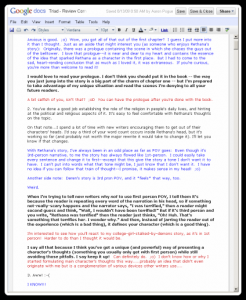
That conversation happened partly in GMail, but primarily in a Google Doc that I started and shared with her, “Triad – Review Comments.” As I read through her novel, I recorded my questions, comments, and emotional responses in plain text. She replied in red, often agonizingly answering, “Read and find out,” or just, “I know.”

Other comments she answered with questions, though, seeking clarification, or with explanation and insight into her writing process. I replied to those in bold and she responded in blue, back and forth, until my technicolor notes on her novel stretched to over 60,000 words.

I’ve used that image as an illustration before, and again here, because that boring little notepad in the cloud became the foundation on which amazing things have been built.

Share

As a writer, we all depend on our ability to share what we write. That’s why we must know how to build a platform, it’s why we must know how to get feedback and how to use feedback. It’s why we spend so much time, in so many ways, trying to improve our fundamentals — so that when a document finally reaches a reader, it works.

Making all that happen, though, is a tricky process. There are tools available — some new and some ancient — but my favorite tool (short of publication at Random House, anyway) is Google Docs.

I’ve talked before about the benefits Google Docs offers in the writing process, but the most significant by far is the ability to share — whether it’s with readers as a read-only manuscript or as a review copy for easy commenting, or with collaborators as a living, changing document supported by robust tools to manage multiple authors.

Sound like something you could use? It’s simple to get started, and completely free. All you’ve got to do is sign up.

Create new

First things first, you need to create a Google account.

Getting Started

If you already have a Gmail address, you’ve already got an account. If you’re interested in a free and reliable email service, you can sign up for a Gmail account at http://mail.google.com/ and use that username and password to access Google Docs.

If you’d prefer to set up an account with your existing email address, though, start out by going to http://docs.google.com/

The Google Docs login page

If I haven’t sold you on the value of the service (or adequately explained its offerings) you can find plenty of additional material on this page, including a video sales pitch. When you’re ready to set up your account, click the big blue Get Started button on the right side of the page.

Note: If you’ve already got a Gmail account, you can simply enter your Gmail address and password in the login form, and hit Sign In.

Creating Your Account

Google Docs is designed to work with an email address. Much of the power of Google Docs is its support for collaboration – allowing a document to be shared for viewing and editing among many Google Docs users. Collaboration requires communication, so Google requires every account be associated with an email address, rather than just a unique username.

In a way, that simplifies your account creation process. Just choose the email address you want to use as your point of contact for this account, and then provide a password.

Provide an email address and password to create your Google Docs account

After those two fields you’ll see a couple checkboxes. “Stay signed in” enables a pretty standard web cookie, but Enable Web History activates a custom tracking cookie that might be of more concern to you. If you’re concerned about that cookie (or just want to be on the safe side), you can easily uncheck that option without it having any negative consequences for your Google Docs account.

Before you can proceed, you’ll need to assert that you’re not a robot by entering the CAPTCHA text, and approve the End-User License Agreement.

Account creation requires you to enter a CAPTCHA and approve an EULA

Note that this license agreement gives Google permission to copy and retransmit any original works you create through Google Docs – a legal right they need in order to do the very things I’ve mentioned every time I’ve discussed the service (namely, let you create a document at work and then view it at home).

I don’t have any reason to suspect Google will abuse this right (and, as an author, I am comfortable authoring nearly all my creative work within Google Docs), but if you feel uncomfortable with the EULA you can walk away from Google Docs right here.

Either way, I encourage you to read through the (admittedly lengthy) EULA and decide for yourself what you’re willing to store on Google’s servers.

Verifying Your Account

If you’ve ever signed up for any internet service, ever, you already know what to do next. Google will send a verification email to the email address you provided.

Before you can begin, you have to verify that you are who you claim to be

Check your email, find the message from Google, and click the link provided. This verifies to them that you really are who you say you are, and allows you to access your Google Docs folder.

Your new Google Documents folder is ready to be filled up

Google Docs allows you to create folders to organize your documents, and it even uses some default folders to help you switch quickly among a list of documents that you created, a list of documents that other people shared with you, and a list of all your items. Initially, though, your folder is going to be completely empty.

Save and Close

Still, once you’ve got an account, you’re ready to go. You can make text documents, spreadsheets, presentations, and much more (just wait until you get into the custom templates). Next week I’ll take some time to tell you how to use Google Docs to improve your writing, but in the meantime poke around a little and see what you can do on your own.

It’s a remarkable tool, simple and powerful, and even if you don’t give up Word altogether, I suspect you’ll find places in your workflow for a Google Doc or two. If nothing else, it’s terribly handy for giving feedback — and making friends, if you use it right.

Pitch and Tagline (Technical Writing Exercise)

Business Writing Exercise

Does that title look familiar? I’ve used it before, but last time it was for a Creative Writing Exercise.

That exercise was follow-up to an article on Plot Synopses — different types of detailed descriptions of a novel. As a handful of you already know, that article was actually adapted from a chapter I wrote for the e-Book I launched last week.

And that chapter was all about how to get started writing your e-Book. I’ve long held that one of the most effective methods of prewriting is description.

That was the principle behind having you write an About page last week to help you plan what would be on your blog, that was the principle behind this assignment when it was aimed at my creative writers, and that’s the principle behind it now.

If you’re going to have a professional blog (and you are), you’re eventually going to need to write an e-Book. Why not get started now, and save yourself some effort? Describe what your e-Book is all about (as though it’s already written), and put your ambition into a more permanent form. Give yourself a clear objective to shoot for, and it’s much more likely you’ll actually get there someday.

So make a pitch — two to four paragraphs describing what your book is about, and what makes it special. Then prepare a tagline, too — a one-sentence summary of everything you’ve got to say. Make it pop, because it’s a sales pitch.

If you do it right, you’ll sell yourself on putting in the effort to get it done. It’s no small undertaking, but trust me — you’ll be glad you did it.

If you do it right, you’ll sell yourself on putting in the effort to get it done. It’s no small undertaking, but trust me — you’ll be glad you did it.

The Week in Words (May 8)

Aaron Pogue with a scribblebook (Courtesy Julie at PhoxiePhoto.com)

Some things I've said, and things I've read.

Here’s what’s been going on!

At the Editor’s Desk

Obviously I’ve spent this week chasing the launch of my e-Book, but that actually hasn’t kept me as busy as you might expect. I got most of the moving parts in place last week, so the launch as pretty much been rolling right along on its own.

I do want to remind you, in case you’ve been considering buying, that the coupon code SYLLABLES will get you 25% off the cost of the book as long as you buy it before the end of the day tomorrow. After that, it’ll go to full price and stay there.

The Girl Who Stayed the Same (Working Title)

We had some excellent challenge words this week, and both of my posts flourished under them. I’ve pressed most of the way through chapter two this week, so even if I don’t quite start chapter three next week, I’ll definitely finish up two.

Here are my new scenes:

  • Chapter 2: Chasing the Light — Part 3, 4

New Websites

I did mention on Monday that I’d registered some new domains. I spent some significant time this week passing Courtney some pointers on setting up her own blog (and you can count on me to make absolutely sure you know about it once she goes live).

I also, as I mentioned, took the first steps toward setting up some new sites of my own. I registered ConsortiumOKC.com and TheConsortiumOKC.com as a place to start collecting my ideas and formatting them in something resembling a comprehensible Plan. (To that end, I’ve scheduled a business meeting with a friend next week to try to figure out the Business side of this whole thing.)

I picked up WhatIsHathor.com, too, for a project I’ve been toying with for months. The plan is to discuss the “sci-fi” technology in Gods Tomorrow and the rest of the Ghost Targets series.

I’d enjoy the opportunity to get into more detail with the tech (because my protagonist just refuses to be gadget geek), and it would also give me a chance to build a little hype for the books. It should be a lot of fun, but I have no idea where I’m going to find the time.

Oh, and on that note, none of those URLs actually go anywhere yet. I’ve purchased them, but I haven’t even had time to put up a “Coming Soon” page. That’s why I didn’t bother linking them up. I’ll let you know when they go live, too.

On Unstressed Syllables

Here at Unstressed Syllables, we had some pretty lively discussion this week — all of it following some really long blog posts. (I’ve generally kept my average word count between 1200 and 1500, but for the last couple weeks it’s been bouncing up around 2,000).

I’ve heard from a couple of you that you really like the stuff I have to say, but you just don’t have time to make it all the way through my long posts. I thought about that a lot this week, and I’m going to try to address it.

Starting next Thursday, I’m going to change my blog post schedule a bit. I’ll take the Thur/Fri creative writing stuff and spread it over Thur/Fri/Sat. Mon/Tue will stay the same next week, for a direct comparison (and because I’ve already got those written).

And, of course, I really need your feedback. Let me know (today, right now) how you feel about the way I’ve been doing things. Let me know next week what you think of the new order.

I’ll probably roll with it for at least a week or two of trial, but if it doesn’t work out I can easily transition back.

Anyway, this week I stuck to the old schedule.

Monday’s Technical Writing exercise prompted you to get started on your new blog by writing an About page.

In Tuesday’s Technical Writing article, I finally got around to explaining what’s inside How to Build an e-Book. That also resulted in a truly astonishing number of those 3D virtual book photos cluttering up my front page. That’s probably over now.

On Wednesday, Courtney talked about talking, and she did it with style. WILAWriTWe was all about how to proofread your writing, and the answer was the spoken word (phlegmy or not).

Thursday’s Creative Writing article opened with some high school hijinks, and transitioned into a consideration of all the different (and sometimes quite complicated) processes in the simple act of writing.

Friday’s Creative Writing exercise invited you to share some hijinks of your own. One of our first real writing prompts in a while, I asked you to write a page or two about some trouble you’d been in. There’s always some good drama there.

Across the Web

I ran into several things of interest this week, and I still owe you for last week, so here you go.

And that’s the Week in Words.

Photo credit Julie V. Photography.

My Felony (Creative Writing Exercise)

The lovely Kelley, writing at a coffee shop

Creative Writing Exercise

We’ve done a lot of work with our Friday exercises lately, and that’s probably something I should save for my business writers, huh?

Fine. Let’s tell a story this week. (Or tell another one, if you’ve already told two over at the Creative Copy Challenge.) Make it 250-750 words. Make it a blog post or a CCC, but make it an excellent tale. Big event, complications, and a protagonist we can root for.

Oh, and don’t forget conflict. In keeping with this week’s theme, make it trouble with the law (or, if your life hasn’t been that exciting, trouble with the folks). I shared my felony yesterday, now it’s your turn to share yours.

Tell us a true story of the most interesting thing you’ve done wrong — or the most interesting one you can share with the public, anyway.  Always bear in mind that your future boss could end up reading anything you ever post to a blog. My felony just shows off my self-starter attitude and top-notch problem-solving skills. I’m comfortable with that.

If you’re not…maybe make up fake names. Change some of the details around. Whatever you’ve got to do, just tell a good tale. We all look forward to hearing it.

Photo credit Julie V. Photography.